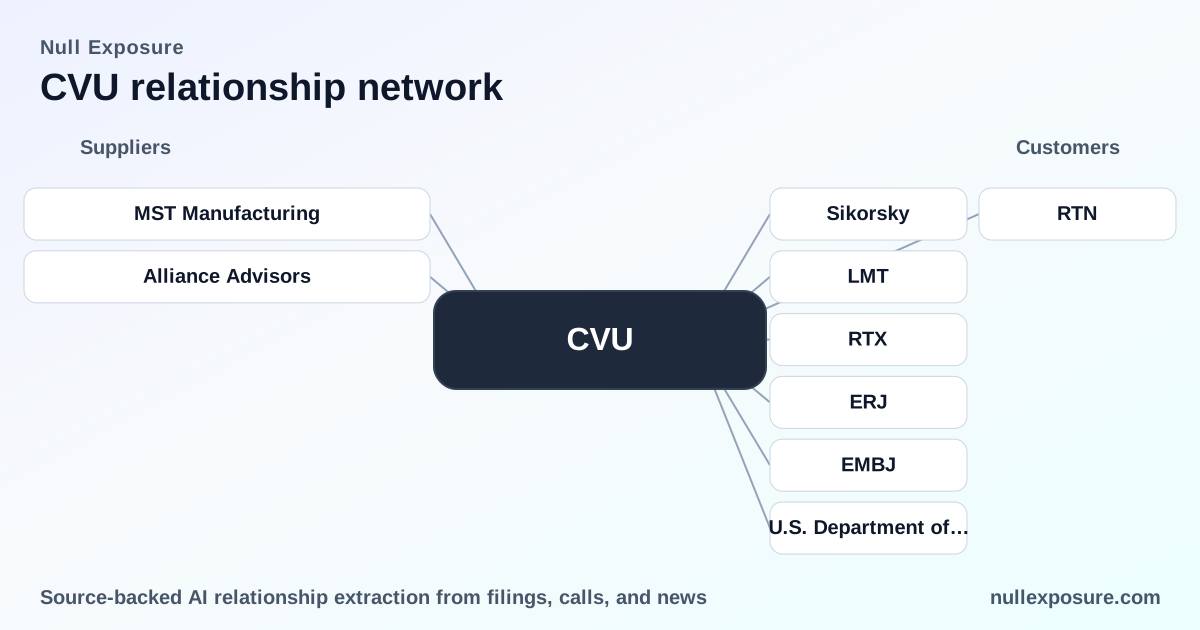
CPI Aerostructures (CVU): Supplier relationships and operational constraints — what investors should price in
CPI Aerostructures (NYSE: CVU) manufactures structural aircraft components and monetizes through contract production and long-term supply agreements with OEMs and integrators, while outsourcing a large share of component fabrication to third-party manufacturers under firm fixed-price orders. The company’s revenue base (~$71.8M TTM) is small relative to fixed-cost exposures, margins are negative, and disclosed supplier concentration and subcontracting posture create discrete counterparty and cost risks that investors must incorporate into valuation and operational diligence. For a focused supplier-risk view, see more at https://nullexposure.com/.
Quick snapshot: how the business model maps to supplier risk
CPI Aerostructures is an upstream component producer for both commercial and defense platforms, but its operating model is characterized by two decisive structural features:
- Subcontracting posture: CPI subcontract production of substantially all parts incorporated into its products under firm fixed-price orders, which makes the company a buyer of manufacturing services rather than a vertically integrated fabricator. That contracting stance concentrates execution risk with a handful of suppliers.
- Notable supplier concentration: As of December 31, 2024, the company disclosed that 13%, 12%, 11% and 11% of accounts payable came from its top four vendors, a level that signals meaningful dependency on a small supplier set. (Company disclosure, 12/31/2024.)
- Small-cap financials magnify supplier risk: With market capitalization of about $26.7M, revenue of $71.8M, EBITDA roughly $0.79M and a slightly negative profit margin (-1.29% TTM), CPI operates with thin profitability and limited balance-sheet cushion versus supply-chain shock.
These features make supplier counterparty performance, fixed-price contract terms, and continuity of subcontractors critical inputs to near-term cash flow and margin recovery.
Who CPI Aero is working with (straightforward summaries)
MST Manufacturing — a long-term production supplier
CPI announced that it signed another Long-Term Agreement (LTA) with MST Manufacturing for the supply of components to support its aerostructures production, announced during the Paris air show. This LTA signals a multi-year sourcing commitment that supports production planning and throughput for CPI’s aerostructures lines. (GlobeNewswire release, June 17, 2025: https://www.globenewswire.com/news-release/2025/06/17/3100570/0/en/CPI-Aerostructures-Inc-and-MST-Manufacturing-Sign-Long-Term-Agreement.html)
Alliance Advisors — investor relations/contact counsel
A media release routing investor contacts lists Alliance Advisors as the investor relations counsel for CPI Aerostructures, indicating an advisory relationship for capital markets communications rather than a manufacturing vendor. This is a disclosure and communications relationship rather than an operational supply link. (Yahoo Finance posting, March 9, 2026: https://finance.yahoo.com/news/cpi-aerostructures-receives-additional-orders-130000097.html)
What these relationships imply for operational continuity and valuation
The LTA with MST is an operational positive: multi-year supplier agreements stabilize production inputs and can reduce short-term sourcing volatility. However, the broader company-level signals require caution:
- Concentration amplifies counterparty exposure. The top-four vendor percentages cited in the company’s disclosure indicate that any single supplier disruption could disproportionately harm production and working capital.
- Fixed-price subcontracting transfers cost inflation risk to CPI. Under firm fixed-price orders, CPI as the buyer commits to pay for contracted outputs while absorbing raw-material and labor cost swings at its subcontractors’ level, which compresses margins when input costs rise.
- Communications and disclosure posture matter. Use of retained IR counsel like Alliance Advisors and public LTAs show proactive investor and market engagement, which improves transparency but does not reduce operational supplier concentration.
For a practical next step, investors should review LTA scope, termination and pricing escalators, and supplier performance KPIs before assuming revenue stability; for further analysis and supplier-risk scoring, visit https://nullexposure.com/.
Operational constraints that shape upside and downside
Two company-level constraints from CPI’s disclosures are central to supplier-risk assessment:
- Materiality of supplier concentration — the company’s top vendors represent a material share of payables, a signal that supplier concentration is a persistent, company-level vulnerability rather than an anecdotal exposure.
- Buyer/subcontracting role — CPI’s model of subcontracting production under firm fixed-price orders defines its contracting posture: the company is dependent on third-party manufacturers for execution and bears the margin consequences of cost variation.
These constraints together create a profile where: (a) negotiating leverage sits partially with suppliers that control capacity; (b) production continuity is critical and not fully internalized; and (c) margin recovery depends on either moving to more favorable contract terms, scaling revenue faster than cost, or shifting product mix to higher-margin programs. On top of operational constraints, ownership is relatively concentrated (insiders ~24%, institutions ~20%), which can affect strategic options and liquidity.
Sentiment, disclosure signals, and what to watch next
CPI’s public communications—announcing LTAs at industry events and listing investor-relations contacts—indicate a proactive disclosure stance that helps the market monitor supply-side developments. Key near-term watch items for investors:
- LTA performance metrics and delivery cadence from MST.
- Any changes in AP concentration or the addition/loss of large subcontractors.
- Margin trajectory and whether fixed-price contracts are re-priced or hedged.
- Investor flow and insider activity given the concentrated ownership base.
If you need a structured supplier-impact briefing or an investor-facing risk memo, find actionable resources at https://nullexposure.com/.
Investment takeaway
CPI Aerostructures runs a capital- and contract-sensitive business where supplier relationships and contract design materially determine profitability. The MST LTA is constructive for production stability, but top-vendor concentration and a subcontracting buyer posture are structural constraints that limit upside until margins normalize and AP concentration declines. Investors should prioritize diligence on LTA terms, supplier performance, and the company’s ability to pass through or absorb cost changes before assigning significant upside.
For tailored supplier-risk assessments and ongoing monitoring, start here: https://nullexposure.com/.