Community West Bancshares (CWBC): How advisory relationships shape a regional-bank consolidation strategy
Community West Bancshares is a Goleta-headquartered regional bank holding company that generates revenue through traditional banking channels—net interest margin on loans and investments, plus fee income—and supplements organic growth with targeted acquisitions. With roughly $142.7 million in trailing revenue and a market capitalization near $435 million, the company is executing deal-driven expansion in California; that strategy depends on a small set of external advisers for M&A execution and board-level comfort. For investors evaluating supplier relationships, the recent United Security Bancshares transaction crystallizes how Community West contracts and who it leans on for legal and financial assurance.
Explore supplier signals and transaction context on Null Exposure
The event that put CWBC's advisors in the spotlight
Community West signed a definitive merger agreement to acquire United Security Bancshares in FY2025, and the filing and press coverage name the advisers who executed core roles. CWBC engaged a financial advisor that delivered a board fairness opinion and retained outside counsel to handle transaction documentation and regulatory navigation. Those two categories—financial advisory and legal counsel—are the critical external supplier relationships visible from public reporting.
The relationships you must know about (straightforward, one-by-one)
-
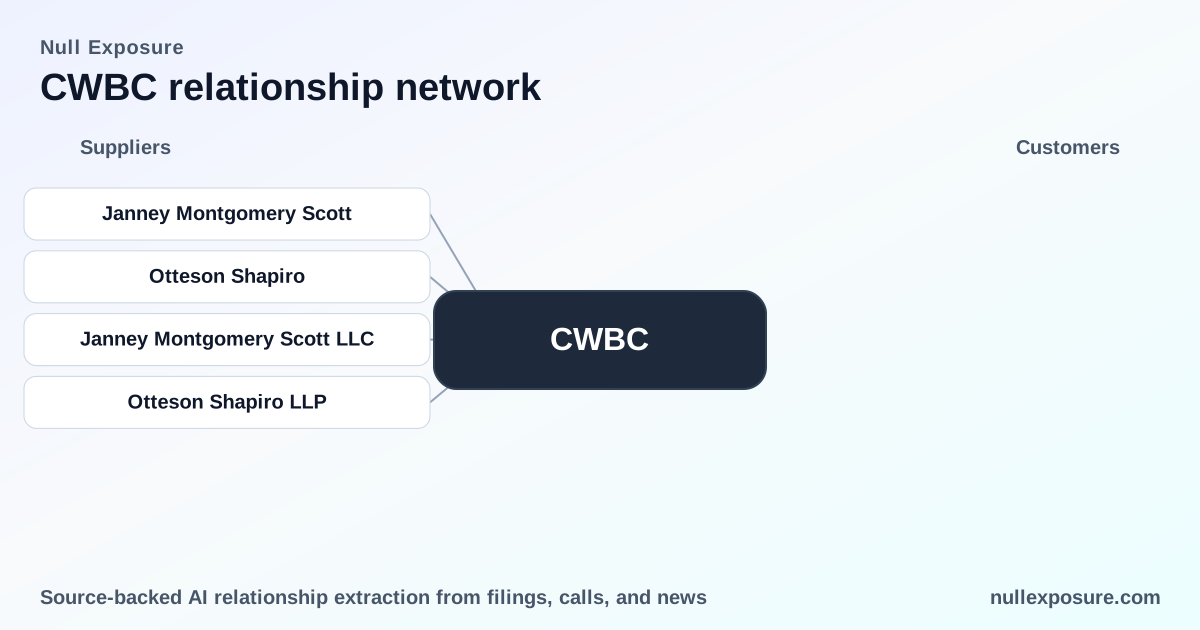
Janney Montgomery Scott — Janney served as financial advisor to Community West Bancshares and delivered a fairness opinion to its board, supporting the board’s valuation and recommendation on the United Security transaction. Source: Yahoo Finance coverage of the deal (March 9, 2026), https://finance.yahoo.com/news/community-west-bancshares-united-security-112355105.html.
-
Otteson Shapiro — Christian Otteson and the Otteson Shapiro firm acted as legal counsel to Community West Bancshares, handling legal work tied to the merger agreement with United Security. Source: Yahoo Finance coverage of the deal (March 9, 2026), https://finance.yahoo.com/news/community-west-bancshares-united-security-112355105.html.
-
Janney Montgomery Scott LLC — MarketScreener’s report corroborates Janney’s engagement, noting Janney Montgomery Scott LLC acted as financial advisor and delivered a fairness opinion to CWBC’s board of directors in FY2025. Source: MarketScreener (March 9, 2026), https://www.marketscreener.com/news/community-west-bancshares-signed-a-definitive-merger-agreement-to-acquire-united-security-bancshares-ce7d50dfde8af227.
-
Otteson Shapiro LLP — MarketScreener separately identifies Christian Otteson of Otteson Shapiro LLP as legal counsel to Community West Bancshares for the transaction. Source: MarketScreener (March 9, 2026), https://www.marketscreener.com/news/community-west-bancshares-signed-a-definitive-merger-agreement-to-acquire-united-security-bancshares-ce7d50dfde8af227.
What these adviser choices signal about CWBC’s operating model
The vendor set tied to the United Security acquisition yields clear, actionable signals about Community West’s supplier posture:
-
Contracting posture: transactional and targeted. Community West engages specialist advisers for discrete, high-stakes events (M&A) rather than maintaining a broad roster of continual strategic consultancies. That posture keeps fixed vendor costs low and concentrates expertise where the bank has the greatest need.
-
Concentration: high for key functions. The company relied on a single financial advisor and a single legal firm for a material transaction, which improves coordination but increases supplier concentration risk for critical deal execution functions.
-
Criticality: advisory relationships are mission-critical for deal outcomes. The fairness opinion and legal counsel directly influence board decisions, regulatory filings, and closing certainty—functions that materially affect shareholder value in an acquisition.
-
Maturity: institutional and conventional. Using a nationally recognized advisory firm and an established regional law firm reflects a conventional and mature approach to regional-bank M&A: recognized brands for valuation robustness and targeted legal expertise for banking regulation.
No supplier-level constraints were disclosed in the available reporting; on a company level, there are no recorded contractual constraints that change this interpretation.
Risk and upside implications for investors
Community West’s adviser choices and the structure of the deal create a compact set of investment implications:
-
Upside through disciplined deal-making. Using an external fairness opinion reduces execution risk and helps boards deploy capital for accretive growth; that supports CWBC’s revenue-per-share and return-on-equity profile (ROE ~9.9% TTM).
-
Concentration risk around advisory continuity. Relying on a single adviser for fairness assessment concentrates execution risk in the event of adviser conflict or disagreement. For a small regional bank, that single point of failure carries outsized influence during a transaction.
-
Regulatory and legal execution is central to value realization. Timely regulatory approvals and clean legal documentation determine whether projected synergies and capital impacts materialize; the selection of Otteson Shapiro underlines that CWBC prioritized experienced regional banking counsel.
-
Financial profile supports disciplined M&A. Valuation multiples (trailing P/E ~11.35, price-to-book ~1.05) and moderate dividend yield (~2.1%) give the board flexibility to fund consolidation without overleveraging core lending operations.
If you are vetting CWBC as a partner or counterparty, these dynamics—targeted external advisors, high criticality of advisory services, and limited supplier diversity—should shape contract negotiations and post-close monitoring.
Check supplier relationships and deal signals at Null Exposure
Practical steps for investors and counterparties
-
Demand transparency on fee arrangements and potential conflicts for any engaged financial advisor and legal counsel ahead of future transactions. A delivered fairness opinion is valuable only if the advisor’s engagement economics and independence are clear.
-
Monitor whether CWBC diversifies its advisory panel over multiple transactions; repeated use of the same small group concentrates execution risk, which should be quantified in scenario analysis.
-
For counterparties or acquirers, confirm that regulatory and legal milestones are captured as explicit contingencies in transaction agreements; that preserves value if approvals are delayed or conditions change.
Final read: how supplier signals translate into investment action
Community West Bancshares is executing a conventional, advisor-driven consolidation play in the California regional-banking market. The company monetizes through core banking economics and augments growth via M&A, relying on established financial and legal advisers to underwrite transaction legitimacy. For investors, the most important takeaways are the benefits of advisory rigor (fairness opinions and experienced counsel) balanced against concentrated supplier exposure for mission-critical execution. Monitor follow-on filings and adviser disclosures to detect changes in contracting posture or concentration risk.
For a focused view of CWBC’s supplier relationships and other transaction signals, visit Null Exposure and review the public reporting that underpins these conclusions.