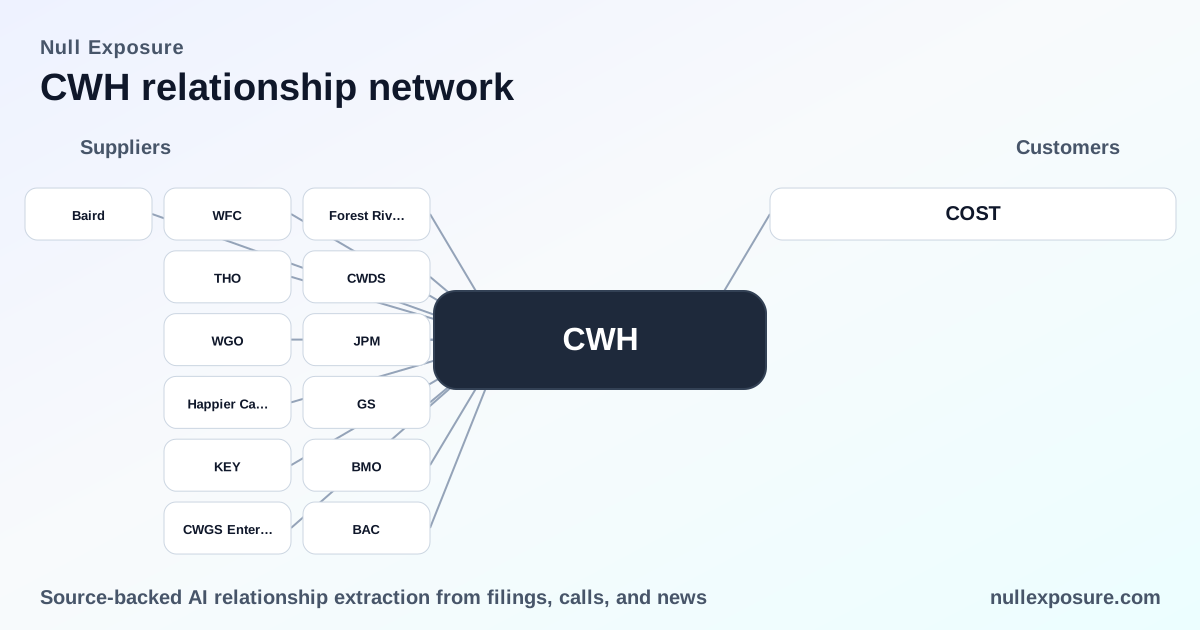
Camping World Holdings (CWH) — supplier relationships and what they mean for investors
Camping World is a national RV retailer and aftermarket distributor that monetizes through vehicle and accessory sales, financing and insurance services, and Parts & Service revenue at its SuperCenters; it sources new RVs directly from OEMs, runs long-term supply commitments for certain categories, and leverages capital markets activity for balance sheet flexibility. Investors should view Camping World as a retail-distribution operator with concentrated supplier exposures in RV OEMs and structured long-term procurement commitments for divested product lines, and evaluate counterparties on commercial terms, criticality to inventory flow, and potential balance-sheet or operational interdependence. For a quick overview of third‑party relationship intelligence and supplier risk, see https://nullexposure.com/.
High-level takeaways for capital allocators and operators
Camping World’s supplier footprint is a mix of OEM manufacturing partners, underwriting and capital markets counterparties, and targeted strategic investments. The company operates with a deliberate contracting posture: it has executed multi-year supply commitments that lock in purchase obligations and reduce manufacturing complexity, while relying on syndicated financing and underwriters for liquidity and growth capital. That combination creates operational predictability in inventory sourcing but also concentrates counterparty and financing risk in North American markets where the company operates 206 stores across 43 states (FY2024 disclosure). If you manage supplier risk or evaluate underwriting exposure, prioritize continuity provisions with OEMs and scrutiny of the company’s long-term supplier obligations. Learn more at https://nullexposure.com/.
The supplier roster, one line at a time
Below I list every relationship surfaced in the record and summarize the commercial role and why it matters.
Forest River
Camping World works closely with Forest River to give manufacturing partners visibility into real‑time demand so those partners can adjust parts and material ordering. Source: Camping World Q4 2025 earnings call commentary.
Thor
Camping World is collaborating with Thor to streamline parts reordering and reduce repair cycle time for customers, indicating operational integration on aftermarket service logistics. Source: Camping World Q4 2025 earnings call.
Winnebago
Management reported extensive work with Winnebago to provide real‑time demand signals and coordinate parts procurement across service channels. Source: Camping World Q4 2025 earnings call.
CWDS (former RV furniture business / buyer under a Supplier Agreement)
Following the May 2024 divestiture of the RV furniture business, Camping World entered an approximately ten‑year Supplier Agreement that requires the company to purchase an aggregate $250 million of product from the buyer over the contract term, plus a sublease of certain properties and equipment. This is a material, long‑term purchase commitment and is disclosed in the FY2024 Form 10‑K. Source: Camping World FY2024 10‑K (divestiture notes).
J.P. Morgan
J.P. Morgan served as a joint lead book‑running manager and representative of the underwriters on a March 2026 stock offering that provided proceeds to Camping World. This places J.P. Morgan in a capital‑markets relationship role rather than as an operational supplier. Source: RVBusiness report on the company’s stock offering (March 2026).
Goldman Sachs & Co. LLC
Goldman Sachs served as joint lead book‑running manager and underwriter representative on the offering, positioning it as a primary capital markets counterparty for equity issuance. Source: RVBusiness report on the company’s stock offering (March 2026).
BMO Capital Markets
BMO acted as a joint book‑running manager on the offering alongside other banks, supporting Camping World’s access to equity capital. Source: RVBusiness report on the company’s stock offering (March 2026).
BofA Securities
BofA Securities was named among joint book‑running managers for the offering, contributing to the syndicate that distributed the equity issuance. Source: RVBusiness report on the company’s stock offering (March 2026).
Wells Fargo Securities
Wells Fargo Securities participated as a joint book‑running manager in the underwriting syndicate for the equity offering. Source: RVBusiness report on the company’s stock offering (March 2026).
KeyBanc Capital Markets
KeyBanc Capital Markets is listed as one of the joint book‑running managers on the offering, supporting distribution and pricing. Source: RVBusiness report on the company’s stock offering (March 2026).
Baird
Baird participated as a joint book‑running manager for the offering, forming part of the underwriting group. Source: RVBusiness report on the company’s stock offering (March 2026).
CWGS Enterprises LLC
Proceeds of the offering were used in part to purchase common units directly from CWGS Enterprises LLC at a price equal to the public offering price less underwriting discounts and commissions, indicating a related‑party capital flow in the financing event. Source: RVBusiness report on the company’s stock offering (March 2026).
Happier Camper Inc.
Camping World made a strategic partnership investment with Happier Camper to deliver Adaptiv systems and technology products for van and camper conversions into Camping World SuperCenters, signaling selective product innovation and channel exclusivity for small‑format conversion platforms. Source: RVBusiness report on Camping World’s investment in Happier Camper (FY2021 coverage).
How the constraints shape the commercial picture
The extracted constraints provide insight into Camping World’s operating model and supplier economics:
- Long‑term contracting posture is established at the company level and explicit for CWDS. The FY2024 10‑K discloses an approximately ten‑year Supplier Agreement requiring $250 million in purchases, which converts a manufacturing exit into a predictable multi‑year procurement commitment. That contract materially alters working capital planning and supplier negotiation leverage for that product category.
- Spend concentration is material. The $250 million commitment over ~10 years places CWDS in the >$100M spend band for that category, making continuity and price escalation clauses commercially important.
- Manufacturer relationships are critical to inventory availability. Camping World sources new RVs directly from OEMs and works tightly with Thor, Forest River, and Winnebago to synchronize parts and reduce repair cycle time—this is a strategic dependency on a small set of OEM partners located within North America.
- Geographic footprint is North America‑centric. With 206 stores in 43 states (FY2024), supplier logistics and distribution scale are U.S.‑focused, which concentrates operational risk by region.
- Third‑party service provider risk is material. The company explicitly flags reliance on external service providers and cloud services as capable of materially impacting operations if disrupted, which elevates vendor due diligence and cyber resilience requirements.
Operational implications and investor risks
- Liquidity and capital markets relationships matter. The syndicate of underwriters led by Goldman Sachs and J.P. Morgan demonstrates continued access to equity markets, but also creates obligations around use of proceeds and related‑party transfers (CWGS Enterprises LLC).
- Supply certainty vs. purchase obligation trade‑off. Long‑term supplier commitments create inventory predictability but lock in procurement spend and reduce flexibility if product economics change.
- Concentration risk in OEMs and regional operations. Heavy reliance on a handful of OEM manufacturers and a U.S. store base amplifies supplier and logistics shocks.
- Cyber and service‑provider dependency is a real operational lever. Third‑party IT and cloud providers are called out as material; prioritize audits and continuity clauses in those engagements.
For a practical next step: if you are evaluating counterparty credit or operational risk, request the full contract schedules for the CWDS Supplier Agreement and OEM floorplan terms, and cross‑check underwriting engagement letters tied to recent capital raises. If you want deeper supplier intelligence and contract‑level analysis, visit https://nullexposure.com/.
Final thought: Camping World is not a lightweight retail buyer — it runs deliberate, long‑dated supply arrangements and relies on concentrated OEM and financing relationships. That structure delivers operational predictability but concentrates counterparty and financing risk that active investors and operators must quantify and monitor. For expanded supplier maps and contract‑level signals, go to https://nullexposure.com/.