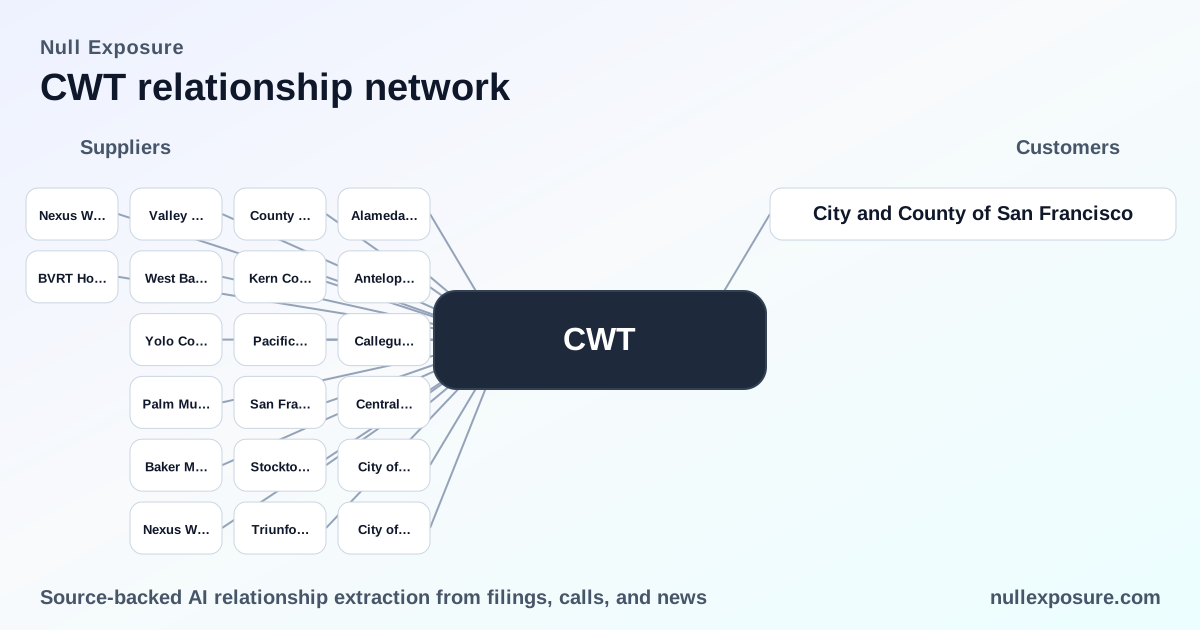
California Water Service Group (CWT): Supplier Map and Strategic Implications for Investors
California Water Service Group is a regulated water utility that monetizes through a rate‑regulated retail model: it purchases wholesale water from government and municipal suppliers, invests in capital to expand and maintain infrastructure, and recovers costs plus an allowed return through regulated rates. The company’s commercial runway combines predictable retail cash flows with ongoing capital commitments and inorganic growth via targeted acquisitions. For a concise supplier intelligence briefing and related disclosures, see https://nullexposure.com/.
How Cal Water sources and pays for the water that powers its economics
Cal Water operates as both a buyer of wholesale water and a regulated retailer/seller of treated water to end customers. The company's supplier posture has four defining characteristics drawn from its public disclosures:
- Long‑term contracting is the baseline. The 2024 10‑K explicitly notes long‑term commitments to purchase water from wholesalers and a named long‑term supply contract with the San Francisco Public Utilities Commission through June 30, 2034.
- Most contracts are usage‑based. Cal Water reports that most wholesale agreements do not require minimum annual payments and vary with volume purchased, aligning supplier payments to consumption cycles.
- Counterparties are often government entities or municipal districts, reducing counterparty credit risk but increasing regulatory and political exposure.
- Annual supplier spend is material. Company disclosures signal recurring wholesale and related charges in the $10m–$100m band (e.g., well pump taxes and capital facilities charges are reported at multi‑million dollar annual levels), which drives both operating expense volatility and regulatory rate filings.
Those features create a supplier profile that is contractually mature, operationally critical, and financially significant—a dynamic investors should weigh against Cal Water’s growth-through-acquisition strategy. Explore the full supplier coverage at https://nullexposure.com/ for sourcing and verification.
The complete list of counterparties and what each relationship means
Below are every counterparty mentioned in the supplied results, with concise takeaways and source references.
-
Alameda County Flood Control and Water Conservation District, Zone 7 — Zone 7 furnished a large portion of purchased water for Cal Water’s Livermore district (1,896 MG, ~68.7% of purchased water). Source: Cal Water 2024 10‑K (FY2024).
-
Antelope Valley‑East Kern Water Agency — Identified as a wholesale supplier for the Los Angeles area footprint where purchased supply was concentrated (reported in the FY2024 10‑K). Source: Cal Water 2024 10‑K (FY2024).
-
Calleguas Municipal Water District — Listed as the wholesale source for the Westlake system, providing the full purchased supply (1,941 MG, 100%); noted in the FY2024 10‑K. Source: Cal Water 2024 10‑K (FY2024).
-
Central Basin Municipal Water District — Cited as the wholesale supplier for certain Los Angeles sub‑markets, including deliveries tied to City of Commerce operations; disclosed in the FY2024 10‑K. Source: Cal Water 2024 10‑K (FY2024).
-
City of Bakersfield — The City of Bakersfield is a named source for the Bakersfield system, sharing supply obligations with Kern County Water Agency (10,047 MG, ~53.3% combined); reported in FY2024 10‑K. Source: Cal Water 2024 10‑K (FY2024).
-
City of Torrance — The City of Torrance is identified alongside West Basin as the supplier for Cal Water’s South Bay region (10,192 MG, 78.3%); included in the FY2024 10‑K. Source: Cal Water 2024 10‑K (FY2024).
-
County of Butte — Named as a participant in the North Valley region supply mix alongside Pacific Gas & Electric for modest purchased volumes (669 MG, 8.4%); shown in the FY2024 10‑K. Source: Cal Water 2024 10‑K (FY2024).
-
Kern County Water Agency — A primary wholesale partner for Bakersfield, jointly supplying that system as disclosed in the FY2024 10‑K. Source: Cal Water 2024 10‑K (FY2024).
-
Pacific Gas and Electric Co. (PG&E) — Listed as a source of purchased water for part of the North Valley region (disclosed in the FY2024 10‑K); PG&E appears in the vendor/supplier mapping for that operating area. Source: Cal Water 2024 10‑K (FY2024).
-
San Francisco Public Utilities Commission (SFPUC) — Cal Water purchases supply for the Bayshore and Bear Gulch districts under long‑term contracts that run through June 30, 2034, making SFPUC a strategically important wholesale partner. Source: Cal Water 2024 10‑K (FY2024).
-
Stockton East Water District — The Stockton system’s purchased supply is primarily sourced from Stockton East (5,938 MG, ~79.2% of purchased supply) per FY2024 disclosures. Source: Cal Water 2024 10‑K (FY2024).
-
Triunfo Water and Sanitation District — Identified as jointly supplying the Westlake system alongside Calleguas (100% of purchased supply for that system), per FY2024 10‑K. Source: Cal Water 2024 10‑K (FY2024).
-
Valley Water — The Los Altos district sourced the majority of its purchased water from Valley Water (2,188 MG, ~62.0%), according to the FY2024 10‑K. Source: Cal Water 2024 10‑K (FY2024).
-
West Basin Municipal Water District — A dominant wholesale supplier for the South Bay region; supply and cost dynamics tied to West Basin materially affect rates for that operating area, per FY2024 10‑K. Source: Cal Water 2024 10‑K (FY2024).
-
Yolo County Flood Control & Water Conservation District — Identified as a major supplier in the Bay Area region alongside SFPUC (6,361 MG, ~98.5% combined), noted in FY2024 filings. Source: Cal Water 2024 10‑K (FY2024).
-
Palm Mutual Water Company — On December 11, 2025 the California Public Utilities Commission approved Cal Water’s acquisition of Palm Mutual Water Company, a regulatory milestone for the transaction announced in late 2025. Source: TradingView/Zacks and supporting news (Dec 2025–Jan 2026 reporting).
-
Baker McKenzie — Served as external legal counsel to Cal Water on recent transactions, confirming use of large external law firms for M&A and regulatory work. Source: Smart Water Magazine and QuiverQuant reporting (2026 coverage).
-
Nexus Water Group — Cal Water executed an agreement to acquire Nexus Water Group’s Nevada and Oregon water and wastewater systems, adding approximately 36,000 connections and a combined rate base of about $109 million (deal announced and covered in multiple 2026 press reports). Source: Company releases and industry reporting (GlobeNewswire, SmartWaterMagazine, QuiverQuant, TradingView, Jan–Mar 2026).
-
Nexus Water — Management confirmed in the Q4 2025 earnings call that Cal Water executed the purchase agreement to acquire Nexus Water’s operations in Nevada and Oregon; this was reiterated on the Q4 2025 call transcript. Source: Q4 2025 earnings call transcript and related coverage (InsiderMonkey, early 2026).
-
BVRT Holdings — Cal Water announced in December (reported on the Q4 2025 call) that it will buy the outstanding minority interest in BVRT Holdings to become sole owner of seven Texas water and wastewater utilities, consolidating its JV exposure. Source: Q4 2025 earnings call reporting (InsiderMonkey, 2026).
Mid‑article note for analysts
If you want a structured supplier intelligence package and the underlying filing excerpts, visit https://nullexposure.com/ to access curated supplier profiles and contract signals.
Strategic and risk implications for investors and operators
- Concentration and counterparty mix. Cal Water’s wholesale supply network is concentrated in regional municipal districts and counties; this reduces commercial credit risk but increases exposure to regional water policy, drought response, and wholesale rate moves.
- Contract characteristics limit margin control. Long‑term and usage‑based contracts pass a large component of wholesale cost through to the company’s operating profile; this shifts the battleground to regulatory proceedings where cost recovery is established.
- Capital intensity and M&A change the supplier picture. The company’s recent acquisitions (Nexus systems; Palm Mutual regulatory approval; BVRT consolidation) expand its footprint and create new supplier relationships and regulatory jurisdictions, increasing integration complexity and near‑term capex requirements.
- Spend scale. Multi‑million recurring supplier charges (well pump taxes, capital facilities charges) mean supplier negotiations and regulatory outcomes have measurable EBITDA and cash‑flow consequences.
Investor takeaways and next steps
- Cal Water’s supplier model is structurally defensive but regulated risk remains the key driver of returns. Long‑term supply contracts, government counterparties, and usage‑based payments create predictability, but wholesale cost pass‑through depends on successful regulatory rate cases.
- M&A expands the counterparty surface area. The Nexus and Palm Mutual transactions materially alter rate base and require attention to integration costs and new regulator relationships.
- For diligence and ongoing monitoring, prioritize long‑term contract expirations, wholesale rate proceedings, and announced capex commitments.
For ongoing coverage and supplier‑level disclosures, visit https://nullexposure.com/ and subscribe to updates. For tailored research packages that map supplier concentration and contractual maturities, start at https://nullexposure.com/.