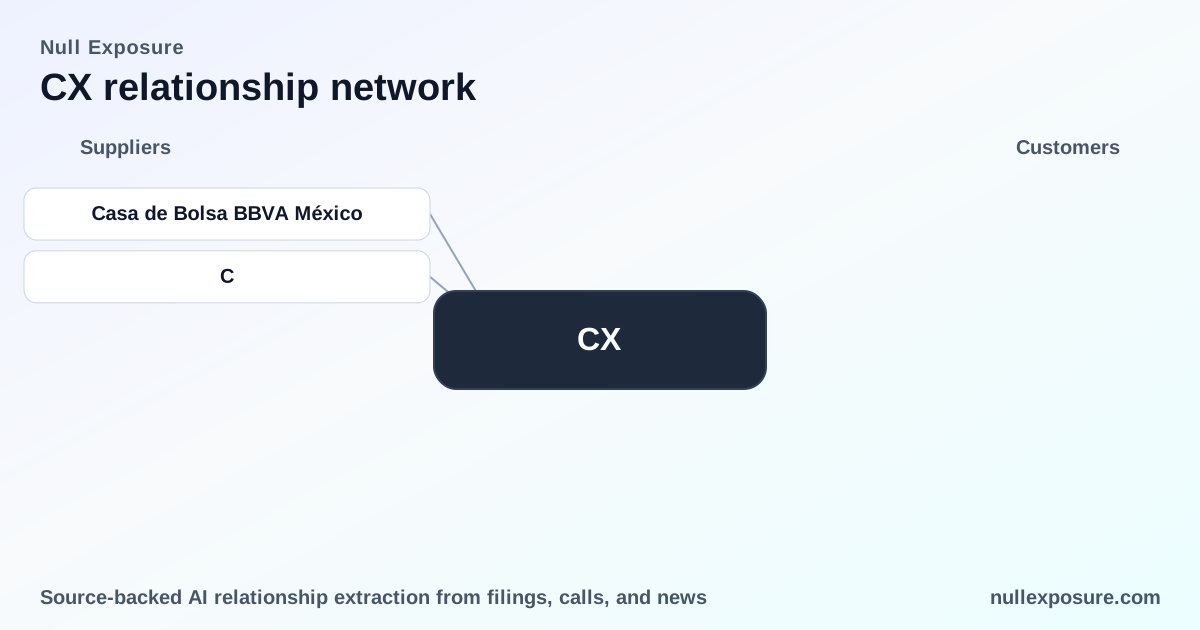
CEMEX (CX): Supplier relationships and capital-allocation counterparties — investor briefing
CEMEX SAB de CV (ADR ticker: CX) operates as a global cement and construction-materials manufacturer, monetizing through sales of cement, ready-mix concrete, aggregates and related products across integrated regional networks. The firm’s balance-sheet and shareholder returns are being managed actively: recent disclosures show a programmatic share-repurchase cadence executed through Mexican broker-dealers, signaling direct capital-allocation focus rather than dividend distribution. For investors tracking supplier and counterparty risk, these relationship signals illuminate how CEMEX executes market operations and which financial intermediaries it uses for liquidity management.
Explore a consolidated feed of supplier and counterparty exposures at https://nullexposure.com/.
Brokered buybacks are the dominant visible supplier interaction
The visible supplier relationships in the record are not raw-material vendors but financial counterparties used to execute share repurchases. In FY2026 CEMEX routed multiple buyback tranches through Casa de Bolsa BBVA México and Citi México Casa de Bolsa under a shareholder-approved repurchase program started March 25, 2025. These transactions reflect operationalized capital returns and a preference for domestic Mexican brokers for execution. A middle-market investor should treat these broker relationships as execution-concentration indicators rather than supply-chain dependencies. For a broader view of such counterparties and how they affect supplier risk, visit https://nullexposure.com/.
Casa de Bolsa BBVA México — MXN 69.1 million tranche (FY2026)
CEMEX executed a repurchase totaling MXN 69.1 million (≈USD 4.0 million) through Casa de Bolsa BBVA México, demonstrating the firm’s use of domestic brokerage services to carry out buybacks in early 2026. The trade was reported in a Globe and Mail press release covering FY2026 buyback activity.
Casa de Bolsa BBVA México — MXN 174 million tranche (FY2026)
Under the shareholder-approved program initiated on March 25, 2025, CEMEX executed another tranche of MXN 174 million through Casa de Bolsa BBVA México; the company committed to disclosing future repurchases per Mexican securities rules. This was noted in a Globe and Mail press release dated in FY2026.
Citi México Casa de Bolsa — MXN 217 million tranche (FY2026)
Citi México Casa de Bolsa executed a MXN 217 million repurchase for CEMEX under the same March 25, 2025 program, reinforcing that the company uses multiple domestic broker-dealers to spread execution. The transaction was summarized in a Globe and Mail FY2026 press release.
Citi México Casa de Bolsa — MXN 68 million tranche (FY2026)
A further MXN 68 million buyback was executed through Citi México Casa de Bolsa and reported alongside the firm’s disclosure obligations under Mexican law; this reinforces a pattern of segmented repurchase tranches across counterparties. The item was documented in a Globe and Mail FY2026 press release.
Company-level operational constraints and what they signal
No explicit supplier constraints were recorded in the relationship feed provided. As a company-level signal, CEMEX’s operating model shows these characteristics:
- Contracting posture: Capital-intensive and centralized on long-term, regionally contracted supply and distribution channels for raw materials and logistics, while financial-market operations use short-term brokerage contracts for buybacks.
- Concentration: Execution of repurchases through at least two domestic brokers indicates moderate dispersion of execution counterparties for market operations; concentration risk is lower for brokerage execution but remains meaningful for physical-material suppliers given industry dynamics.
- Criticality: Supplier relationships for cement feedstock, aggregates and logistics are mission-critical to revenue generation; by contrast, these broker relationships are critical to capital allocation execution but not to product delivery.
- Maturity: The visible counterparties are incumbent financial institutions operating within Mexican securities infrastructure, signifying mature, regulated execution channels rather than ad hoc counterparties.
These company-level constraints should be read as operational signals about how capital is moved and how execution risk is managed, separate from raw-material supply-chain risks.
Investment implications: risk versus signal
- Capital returns over dividends. CEMEX’s zero dividend per share and active buyback program indicate management prefers share repurchases as the primary shareholder-return mechanism; that supports EPS growth when buybacks are accretive.
- Execution strategy reduces single-counterparty exposure. Using both BBVA and Citi for buybacks signals deliberate counterparty diversification for market operations; traders and risk teams should monitor whether this practice extends to other financial services.
- Operational criticality remains in physical supply chains. While the disclosed relationships are financial counterparties, core revenue depends on upstream materials and distribution networks that are not visible in these items; underperforming suppliers in the physical chain would have far larger top-line impact than execution counterparties.
- Governance and disclosure discipline. The program’s shareholder approval and the firm’s stated disclosure commitments under Mexican regulation reflect robust compliance posture for capital allocation events.
Key financial context: CEMEX reported TTM revenue of about $16.1 billion and EBITDA roughly $2.79 billion, with institutional ownership near 36%, indicating sizeable market participation and liquidity that underpins buyback strategies.
What investors and operators should monitor next
- Monitor incremental repurchase announcements and which broker-dealers execute them to detect changes in execution concentration.
- Watch regulatory filings for updates to the shareholder-approved program that could increase aggregate buyback capacity or change timing.
- Track supplier disclosures outside of market operations to assess raw-material concentration and logistics vulnerabilities that will affect margins more than brokerage relationships.
Practical next step: review consolidated counterparty exposure and supplier relationships on the platform at https://nullexposure.com/ to compare CEMEX’s broker usage with peers.
Bottom line
CEMEX’s visible supplier relationships in the record are execution counterparties used for a structured buyback program, not operational-material vendors. The firm demonstrates a disciplined capital-allocation posture, using regulated Mexican broker-dealers to execute repurchases while maintaining disclosure commitments. For investors focused on counterparty and supplier risk, the immediate takeaway is that brokerage execution risk is distributed and low relative to the much higher strategic importance of physical supply chains. For a wider assessment of both financial and operational counterparties, visit https://nullexposure.com/.