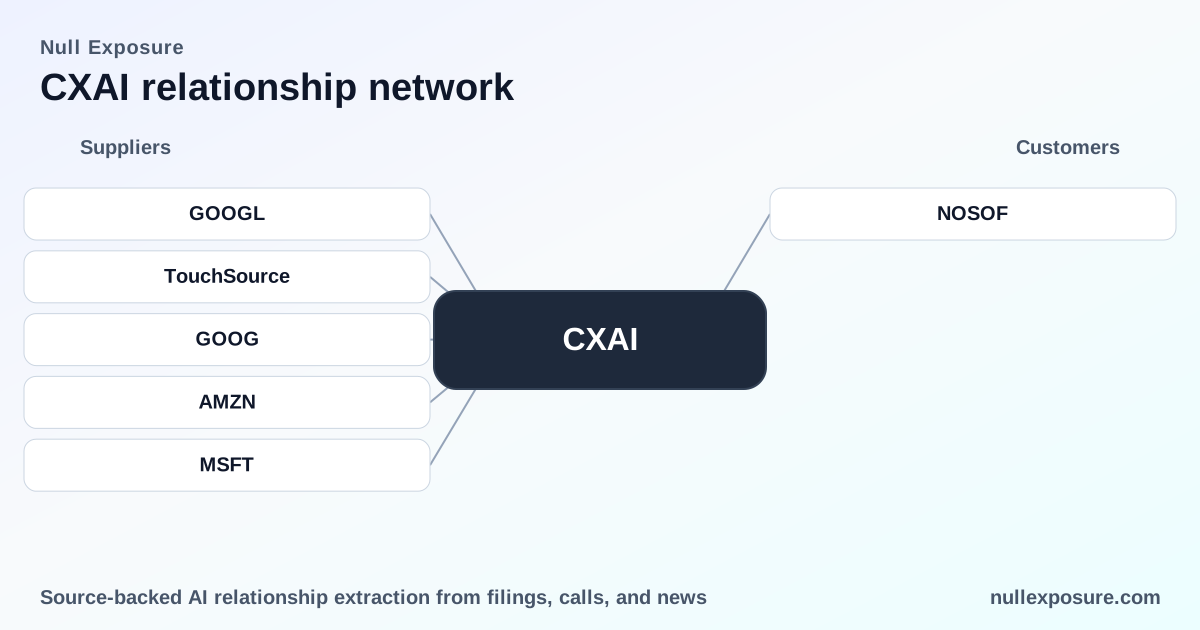
CXAI: How partnerships and cloud strategy sell an early-stage agentic AI platform
CXApp Inc. (CXAI) operates an agentic AI platform for workplace and venue experiences, delivered through integrations with major cloud providers and channel partners. The company monetizes by selling enterprise software and integration services that sit on top of cloud infrastructure, while leveraging strategic partnerships to accelerate product development and customer adoption. For investors, the core commercial lever is partner-driven distribution and platform adoption rather than scale from direct sales alone.
For a quick vendor-risk scan and partner scorecard, visit https://nullexposure.com/.
Partners are the product roadmap: what CXAI’s partner map reveals
CXAI’s public disclosures and press coverage make clear that cloud partnerships are central to both product capability and go-to-market. Management repeatedly describes Google Cloud as its largest strategic cloud partner while also operating on AWS and Azure to deliver end-to-end solutions. That posture gives CXAI technical breadth and channel reach, but creates dependency dynamics that investors and operators must monitor closely.
At the company level there is also a signal about how CXAI transacts: a constraint labelled “distributor” documents drop-ship and third-party delivery arrangements where CXAI negotiates sale prices, pays suppliers directly, manages credit risk, and acts as the principal in transactions. This is a company-level operating signal about contracting posture, not a statement about any single partner.
- Contracting posture: CXAI acts as a principal in commercial relationships and leverages third-party supply/delivery, implying it retains revenue recognition control and credit exposure.
- Concentration: Management cites Google Cloud as the biggest strategic partner, creating a concentration vector even though Azure and AWS are also in scope.
- Criticality: Partnerships are not peripheral — the platform’s AI capabilities are developed and marketed through these alliances, so partner health directly affects CXAI’s product roadmap and sales momentum.
- Maturity: Financials show a very early commercial profile — Revenue TTM is $5.22M with negative EBITDA and slowing quarterly revenue — which amplifies partner-related operational risk while offering asymmetric upside if channel adoption accelerates.
If you need a structured supplier risk assessment, start here: https://nullexposure.com/.
Supplier relationship breakdown (each public mention covered)
Google (earnings call, 2025Q3)
Management confirmed during the 2025Q3 earnings call that CXAI is partnered with Google while also enabling deployments on AWS and Azure, framing Google as a strategic partner in the company’s multi-cloud strategy. Source: CXApp 2025Q3 earnings call (first seen 2026-03-07).
Google Cloud (news coverage and press releases, FY2024–FY2025)
Multiple press releases and news reports across FY2024–FY2025 attribute CXAI’s agentic AI product progress to a partnership with Google Cloud, crediting that relationship with accelerating AI infrastructure and new product capabilities. Sources: Yahoo Finance report (FY2024) and FY2025 press releases reported via Futunn, FinancialContent, and AccessNewswire (FY2025).
Google Cloud (earnings call, 2025Q2)
In the 2025Q2 earnings call management reiterated that Google Cloud is the company’s biggest strategic partner, while also confirming active relationships with Azure and AWS to deliver end-to-end solutions. Source: CXApp 2025Q2 earnings call (2025Q2).
AWS (earnings call, 2025Q2)
CXAI stated in its 2025Q2 earnings call that it has relationships with AWS as part of its strategy to support customers across major cloud providers. This positions AWS as a deployment option within CXAI’s multi-cloud delivery model. Source: CXApp 2025Q2 earnings call.
Azure (earnings call, 2025Q2)
The same 2025Q2 call names Azure alongside Google Cloud and AWS as a supported cloud partner, indicating CXAI’s technical and commercial intent to maintain multi-cloud compatibility for enterprise customers. Source: CXApp 2025Q2 earnings call.
TouchSource (press release, FY2026)
A FY2026 press release announced a strategic partnership with TouchSource, where CXAI’s agentic AI becomes the intelligence layer orchestrating experiences across TouchSource’s in-venue infrastructure — an example of CXAI embedding into vertical channel partners. Source: Markets ChronicleJournal / PR release (2026-02-05).
What this partner map means for investors and operators
- Revenue leverage through partners is a double-edged sword. Strategic cloud partners like Google Cloud accelerate product capability and sales motion, but the company’s own disclosures identify Google Cloud as the largest strategic partner, creating concentration risk even as AWS and Azure provide diversification.
- CXAI controls commercial terms but assumes credit and delivery risk. The distributor-style constraint indicates CXAI often acts as the principal: it negotiates price, pays suppliers, and manages credit — that increases operational exposure but also preserves margin capture and customer relationships.
- Platform criticality increases stickiness but raises execution stakes. Embedding the agentic AI layer into venue and workplace infrastructure (for example with TouchSource) creates recurring value if integrations stick, yet that outcome requires sustained technical investment and partner alignment.
- Balance sheet and scale amplify partner dependency. Public financials show Revenue TTM $5.22M, EBITDA -$11.72M, Market Cap roughly $11.0M, and quarterly revenue growth that declined year-over-year; these facts make partnerships essential to scaling but also make the company sensitive to partner negotiation power and contract terms.
Operational and commercial checklist for due diligence
- Validate the terms and duration of the Google Cloud relationship and whether any revenue or joint go-to-market commitments are exclusive or prioritized. If possible, obtain language on revenue sharing and joint-solution commitments.
- Confirm multi-cloud parity: ensure AWS and Azure integrations are production-ready and not merely proof-of-concept, because multi-cloud delivery materially changes customer procurement decisions.
- Scrutinize the drop-ship / principal contracting model: understand CXAI’s credit exposure, supplier payment terms, and indemnities that could create contingent liabilities.
- Assess customer stickiness in partner-driven deployments like TouchSource integrations — look for multi-year contracts, SLA commitments, and renewal rates before assuming recurring revenue.
Bottom line and next steps
CXAI is a partner-centric, early-stage platform company with meaningful upside if cloud partnerships convert to scale, but the combination of small scale, negative EBITDA, and partner concentration creates material execution risk. Investors and procurement teams should prioritize contractual clarity with Google Cloud and verify production readiness on AWS/Azure, while operators should validate how distributor-style commercial arrangements affect cash flow and liability.
For a deeper supplier risk profile and actionable intelligence on partner exposure, visit https://nullexposure.com/.
If you want an investor-grade supplier risk pack and partner scorecard delivered fast, start here: https://nullexposure.com/.