CXApp Inc. (CXAIW) — Cloud partnerships and supplier exposure investors need to price in
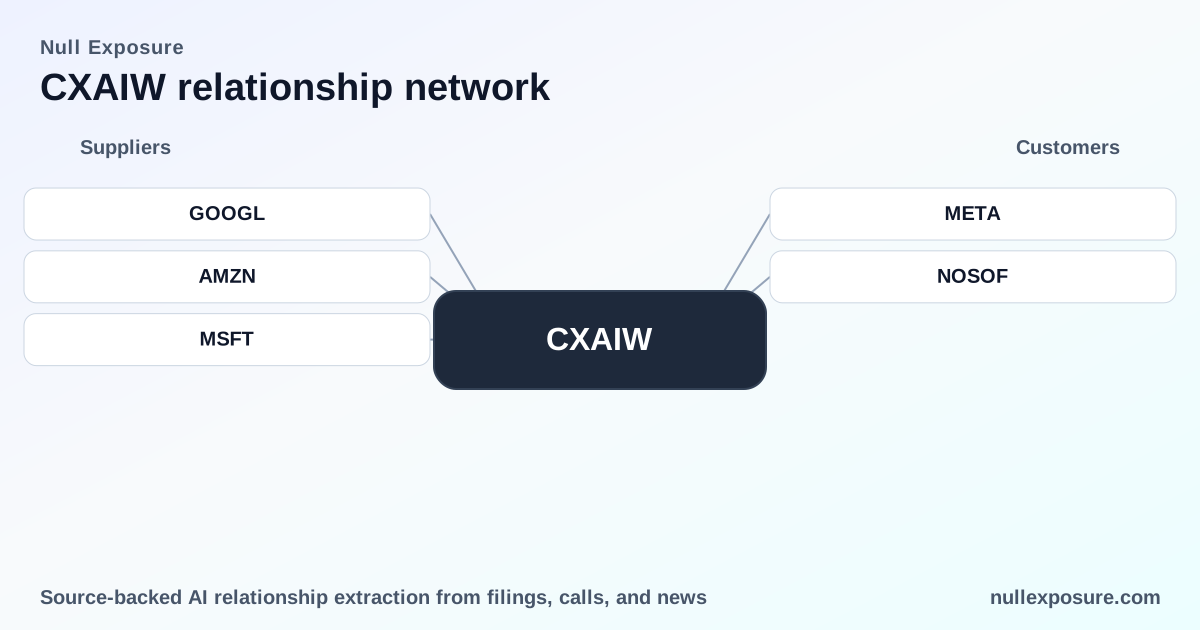
CXApp Inc. operates as a software provider that delivers customer-experience and workplace-technology solutions through integrations with major cloud platforms; the company monetizes through platform-enabled software licensing and partner enablement agreements with hyperscalers and enterprise customers. CXApp’s commercial footprint is built on integrations with Google Cloud, AWS and Microsoft Azure — the primary channels through which its product is delivered and scaled. For further supplier intelligence on CXAIW, see https://nullexposure.com/.
The claim above is drawn from the company’s most recent public commentary: management stated its partner posture explicitly on the 2025 Q3 earnings call, and that remark defines both how CXApp distributes its product and where its operational leverage lives. Investors evaluating CXAIW should treat cloud partnerships as both revenue conduits and concentration points for operational and contract risk.
Why the cloud partners matter for revenue and risk
The practical consequence of partnering with the three hyperscalers is straightforward: delivery, scalability and go-to-market are outsourced to platform integrators rather than being vertically owned. That lowers capital intensity for CXApp but increases dependency on partner terms, platform pricing and technical compatibility. At the same time, the disclosure that the company “enables things on AWS and Azure” alongside Google indicates a multi-hyperscaler strategy that reduces single-provider lock-in while concentrating critical operations within a small set of very large vendors.
There is an important company-level manufacturing disclosure in CXApp’s filings that introduces a distinct supply-side vulnerability unrelated to cloud hosting: the company warns that “Any production interruptions for any reason, such as a natural disaster, epidemic, capacity shortages, or quality problems, at one of our manufacturing partners would negatively affect sales of product lines manufactured by that manufacturing partner.” This manufacturing dependency is a material operational signal for investors: even if CXApp’s core product is software, the firm maintains hardware or manufactured components in its supply chain that are exposed to production interruptions.
Supplier relationships disclosed on the most recent call
Google (GOOGL)
Management stated a formal partnership with Google during the 2025 Q3 earnings call; the remark frames Google as a primary channel partner for CXApp’s solutions and implies product availability or certification on Google Cloud. According to the 2025 Q3 earnings call (quoted March 8, 2026), “We’re partnered with Google…,” establishing Google as a named partner in the company’s go-to-market strategy.
AWS (AMZN)
CXApp confirmed it “enables things on AWS” on the same 2025 Q3 earnings call, which positions Amazon Web Services as an active hosting and integration environment for the company’s products. The single-sentence disclosure on the 2025 Q3 earnings call (first reported March 8, 2026) indicates AWS is a supported delivery platform for CXApp’s offerings.
Azure (MSFT)
Management also reported enablement on Microsoft Azure during the 2025 Q3 earnings call; Azure is therefore part of the tri-hyperscaler distribution plan and likely a target for enterprise engagements requiring Microsoft stack compatibility. The 2025 Q3 earnings call (quoted March 8, 2026) explicitly lists Azure alongside Google and AWS.
These three citations come from the same earnings-call transcript (2025 Q3), publicly disclosed March 8, 2026, and together they map CXApp’s cloud partner topology.
Contracting posture, concentration and maturity — what investors should infer
- Contracting posture: CXApp operates as a partner/vendor to hyperscalers, not as a vertically integrated provider. That implies commercial terms tied to partner resale, marketplace placements, and host-provider service agreements rather than solely standalone enterprise licenses.
- Concentration: Concentration risk is concentrated conceptually, not necessarily with a single vendor. Using three hyperscalers dilutes dependence on any single cloud provider, but it concentrates critical services into the hyperscaler layer overall — an industry concentration risk rather than a single-counterparty risk.
- Criticality: Cloud partners are mission-critical to delivery. Any change in platform support, pricing, or technical integrations at the hyperscaler level will have direct operational and economic effects.
- Maturity: Given public comment but limited publicly reported revenue and balance-sheet detail, commercial maturity is early-stage; partnerships are in place, but CXApp’s financial statements do not show mature, recurring revenue metrics in the disclosed TTM fields.
The firm-level manufacturing disclosure should be read as a parallel risk vector: even with cloud delivery, manufacturing and physical production channels exist and are material enough to warrant a direct risk disclosure, increasing overall supply-chain complexity.
Valuation implications and risk management for investors
From an investor perspective, the combination of hyperscaler partnerships and a disclosed manufacturing dependency creates a dual-path risk profile:
- Upside drivers: Hyperscaler partnerships enable fast scaling and lower marginal costs, improving gross economics if enterprise adoption follows. Partnership placement in cloud marketplaces can create high-leverage distribution without commensurate capex.
- Downside risks: Platform concentration, partner contract terms, and manufacturing interruptions create asymmetric operational downside that can compress expected cash flows. The company’s public financial metrics (reported zeros across revenue and margin fields in the latest available snapshot) require investors to build conservative adoption and revenue ramp assumptions.
Recommended next steps for due diligence:
- Review the detailed partnership agreements, marketplace listings and any revenue-share or price-protection clauses with Google, AWS and Azure.
- Audit the manufacturing relationships and supplier contingency plans referenced in the company’s disclosure about production interruptions.
- Stress-test valuation models for scenarios where hyperscaler pricing or certification friction increases.
For a tailored supplier-risk dossier and to compare these signals against peer supplier maps, visit https://nullexposure.com/ for the full supplier intelligence toolkit.
Tactical takeaways for operators and procurement teams
Operators negotiating with CXApp should extract specific contractual protections:
- Service-level commitments and marketplace placement guarantees with each hyperscaler.
- Transition and portability clauses to mitigate the risk of partner-induced lock-in.
- Manufacturing contingency and replacement supplier commitments to reduce revenue exposure to production interruptions.
These are not theoretical concerns: the company’s own disclosure about manufacturing interruptions is explicit and should be contractually addressed in procurement terms.
Bottom line and recommended investor action
CXApp’s business model is partner-centric: it leverages Google, AWS, and Azure for delivery while retaining product control and monetization through software licensing and integrations. That structure enables scalable distribution but concentrates operational risk at the platform and manufacturing layers. Investors should prioritize contractual transparency around hyperscaler terms and the company’s manufacturing contingency plans before placing material weight on upside scenarios.
For deeper supplier relationship intelligence and comparative supplier-risk benchmarking, visit https://nullexposure.com/.