Sprinklr (CXM): Supplier Relationships, Contract Signals, and What Investors Should Price In
Sprinklr operates a unified, cloud-native customer experience management (CXM) platform and monetizes primarily through enterprise SaaS subscriptions, professional services, and third‑party hosting and data contracts that support its global footprint. The business combines recurring software revenue with service-led delivery and long-term hosting commitments, creating a revenue base that is sensitive to both platform adoption and supplier continuity. For investors evaluating Sprinklr as a supplier-dependent technology vendor, the crucial questions are: how entrenched are the hosting/data relationships, how global and durable is the contract posture, and how do those dependencies map to valuation and operational risk?
Learn more about supplier signal analysis at NullExposure.
Why supplier relationships drive Sprinklr’s economics
Sprinklr is a software company whose product delivery depends on third‑party cloud infrastructure and data integrations. Customers buy access to the platform and expect global availability, data locality, and compliance controls; Sprinklr satisfies these requirements by contracting for hosting, data, and integration services with external providers. That operating model converts supplier continuity directly into revenue certainty and customer retention: when hosting or data contracts are long‑dated and global, the company can present a more durable service promise to large enterprise clients.
From a valuation lens, this matters because Sprinklr trades as an enterprise software vendor (Market Cap ~ $1.42B; Revenue TTM $857.2M) but carries additional vendor‑risk compared with vertically integrated cloud players. Investors should therefore treat supplier relationships as operational leverage: they amplify upside if stable and create asymmetric downside if concentrated or unstable.
What Sprinklr’s contracts and disclosures reveal about its posture
The company’s public filings and disclosures provide explicit, company‑level signals about contracting, geography, role and segment:
-
Long‑term contracting posture. The company reports non‑cancelable minimum guaranteed purchase commitments for data, hosting and software services extending through 2030, aggregating to $324,822 as reported in the filing covering commitments through January 31, 2025 and later fiscal years. These commitments demonstrate a multiyear procurement profile that underpins operational continuity.
According to the company filing covering commitments as of January 31, 2025, the reported schedule includes $107,070 for FY2026, $120,970 for FY2027, and a total of $324,822. -
Global delivery footprint. Sprinklr explicitly serves customers from third‑party data centers and cloud providers “located around the world,” indicating a distributed hosting model built for multinational clients rather than single‑region deployments.
-
Role as a service integrator and buyer of hosting/data services. The company describes its relationships with third‑party providers in the context of leases and third‑party hosting, positioning Sprinklr as an integrator that purchases hosting and data services to deliver its platform.
-
Service segment focus. The commitments and excerpts center on purchases for data, hosting and software services, signaling that a meaningful portion of supplier spend is operational (run‑time hosting and data) rather than one‑time capital purchases.
These signals are company‑level—useful for judging Sprinklr’s operating model, concentration and criticality of supplier relationships—without attributing the constraint language to any single vendor unless the disclosure names them.
Visit NullExposure for more supplier intelligence and supplier risk dashboards.
Who the company is partnering with now — two relationships investors should note
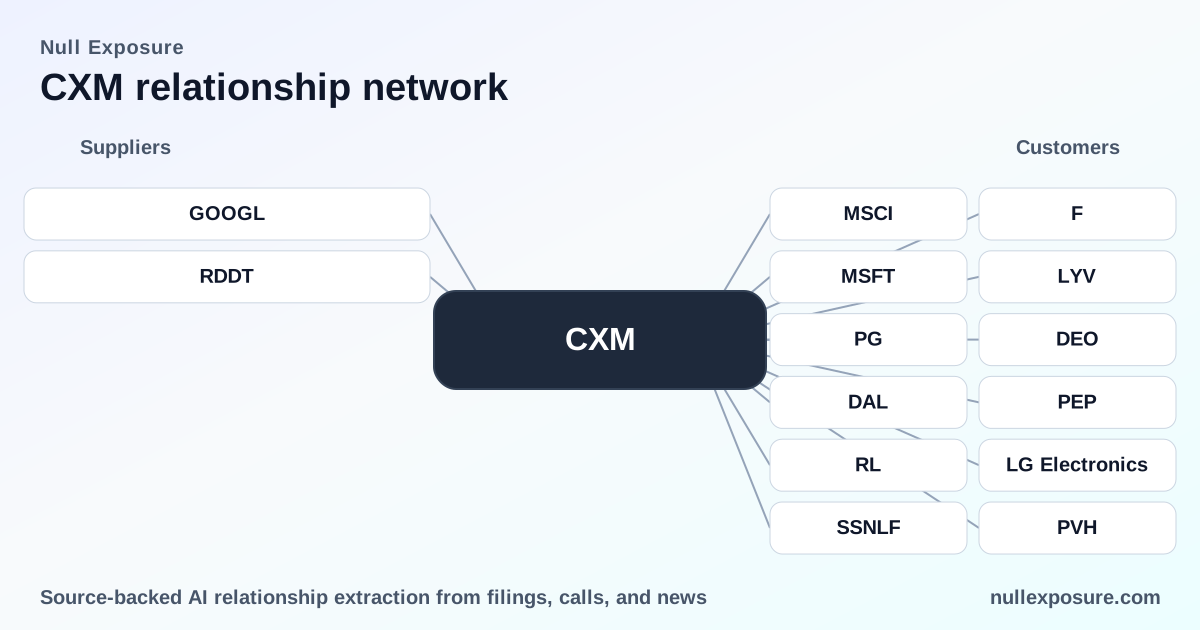
Google Cloud — Sprinklr announced a local data hosting solution in Germany implemented via Google Cloud, a move that addresses data‑locality and European compliance requirements and broadens Sprinklr’s European infrastructure options. According to reporting on the announcement, the deployment was publicized in March 2026 and frames Google Cloud as a channel for local hosting capacity. (Source: simplywall.st coverage of the March 18, 2026 announcement.)
Reddit — Sprinklr is the first official partner to use Reddit’s Advertising API, integrating Reddit’s Data API and Ads API to give enterprise advertisers access to Reddit inventory and insights through Sprinklr’s platform. This partnership extends Sprinklr’s advertising and social listening capabilities by adding Reddit as a measured and transactable channel. (Source: Reddit blog post describing the partnership; referenced to Sprinklr’s role as of FY2024.)
What these relationships imply for revenue, risk and strategic optionality
-
Strategic optionality through multi‑cloud and channel partnerships. The Google Cloud Germany hosting arrangement signals that Sprinklr is executing a multi‑cloud, regionally conscious infrastructure strategy that supports enterprise procurement requirements and can reduce customer churn risk tied to data residency demands.
-
Product extension and monetization via platform integrations. The Reddit Ads/API partnership is a product‑level expansion that feeds two revenue levers: improved platform utility for advertisers (supporting higher subscription tiers and ad‑management fees) and incremental services revenue as clients adopt new channels.
-
Concentration and criticality remain watchpoints. While the company reports long‑term supplier commitments and global hosting, investors should still quantify exposure to any single cloud provider and assess contractual terms (service credits, exit costs, minimum purchase guarantees) inside the long‑term commitments. The disclosed commitment schedule demonstrates maturity in contracting but also shows multi‑year fixed obligations that can become a fixed cost burden if utilization lags.
Investment implications — valuation and operational monitoring
Sprinklr’s financial profile (Revenue TTM $857.2M; Market Cap ~$1.42B; EV/Revenue ~1.12; Operating Margin TTM ~6.84%) positions it as a growth software company with modest current operating profitability and substantial institutional ownership. Key investor actions:
- Monitor renewal and customer retention metrics alongside disclosed supplier commitments—long‑dated hosting obligations support retention but amplify cost if customer growth slows.
- Track supplier concentration disclosures and incremental announcements that shift hosting geography or major cloud commitments; region‑specific hosting (e.g., Germany via Google Cloud) is a positive for European sales and compliance.
- Evaluate how partnerships that expand advertising and data sources (like Reddit) affect ARPU and professional services demand.
Bottom line and next steps
- Sprinklr’s platform is structurally dependent on third‑party hosting and data suppliers, but the company has formalized that dependency with multiyear commitments and global delivery arrangements.
- Partnerships with Google Cloud (regional hosting) and Reddit (ads and data integration) are tangible evidence of strategic diversification across infrastructure and channel partners.
- Investors should weigh the benefit of demand elasticity from richer channel integrations against the fixed‑cost reality of the company’s long‑term hosting and data commitments.
If you evaluate supplier risk as part of investment due diligence, view Sprinklr’s supplier posture through both the contractual commitments and the strategic partner map. For deeper supplier risk scoring and to see how these relationships interact across a wider procurement base, visit NullExposure.
For a hands‑on review of supplier dependencies and contract maturity tailored to portfolio risk models, explore more at NullExposure.