Crane NXT (CXT): Supplier relationships and what they mean for investors and operators
Crane NXT operates and monetizes through a combination of hardware sales, consumables, and increasingly higher-margin authentication and software-enabled solutions for payments, vending and security-sensitive markets. The company pursues growth by acquiring adjacent technology businesses, migrating legacy customers to proprietary micro-optic technology, and leveraging recurring revenue from supplies and services to stabilize cyclicality in industrial machinery. For investors, the revenue mix and integration track record of recent acquisitions are the primary levers for near-term margin expansion and valuation multiple compression. Learn more at https://nullexposure.com/.
Why recent deal activity changes the supplier picture
Crane NXT is executing a deliberate strategy of inorganic expansion into authentication and traceability, which directly alters supplier dynamics — procurement, outsourcing and production staffing become active levers rather than passive cost centers. The company funded and integrated acquisitions in 2025 that raise both revenue and complexity: acquisitions delivered a material sales contribution to FY2026 Q4 and management is actively upgrading customers to higher-margin technologies.
- A March 2026 earnings call for Q4 2025 noted that the De La Rue acquisition contributed to Crane Authentication results but that margins were affected by unfavorable international mix, higher freight and procurement costs, and investments to support future growth and next‑generation micro‑optics (CXT 2025 Q4 earnings call, March 2026).
- A GGRAsia news report covering FY2026 said the May 2025 acquisition of De La Rue Authentication Solutions contributed approximately US$43.6 million to fourth-quarter net sales (GGRAsia, March 2026).
- In the Q3 2025 earnings call management explicitly said they are upgrading legacy De La Rue customers to Crane’s micro‑optics, improving margins and customer stickiness over time (CXT 2025 Q3 earnings call, November 2025).
Each of these developments shifts the supplier posture from simple buy-and-produce toward integrated product-service relationships where Crane NXT controls more of the technology stack and recurring revenue streams.
Relationship-level facts you should file away
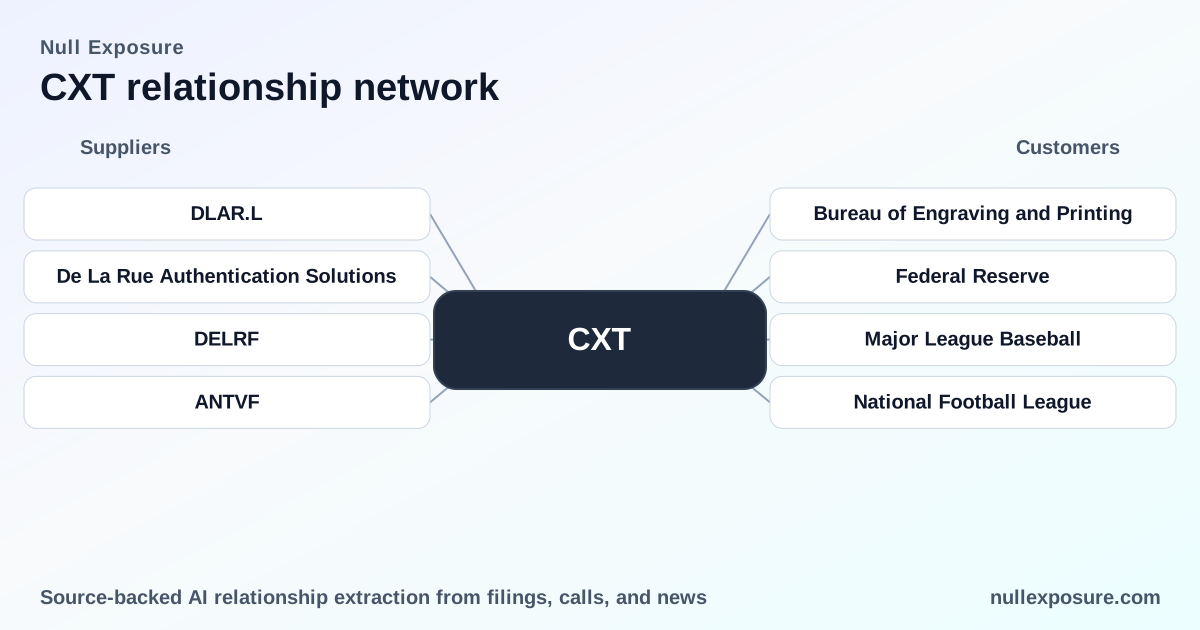
Below are concise, source-linked summaries for every relationship captured in the company’s supplier scope.
- De La Rue — Q4 2025 earnings call: Management reported strong volume growth but offset margin benefits with unfavorable international mix, higher freight and procurement costs, and targeted investments to support next-generation micro‑optics; the De La Rue acquisition contributed positively to Crane Authentication results (CXT 2025 Q4 earnings call, March 2026).
- De La Rue Authentication Solutions — FY2026 news report: The May 2025 acquisition of De La Rue Authentication Solutions was estimated to add US$43.6 million to fourth-quarter net sales (GGRAsia, March 2026).
- De La Rue — Q3 2025 earnings call: Management confirmed a program to upgrade legacy De La Rue customers to micro‑optics technology, a structural move to improve margins and customer retention (CXT 2025 Q3 earnings call, November 2025).
- Antares Vision — Q3 2025 earnings call: In September 2025 Crane NXT signed an agreement to acquire Antares Vision, which extends the company into detection, inspection and track-and-trace markets in life sciences and food & beverage (CXT 2025 Q3 earnings call, November 2025).
- Antares Vision — Q4 2025 earnings call: By Q4 2025 Crane NXT had closed an initial equity investment in Antares Vision to expand presence in higher-growth end markets, signaling a staged approach to full ownership and integration (CXT 2025 Q4 earnings call, March 2026).
These snippets illustrate a two-track approach: immediate revenue accretion from acquisitions and a parallel program to convert acquired customers to Crane NXT’s higher-margin technologies.
Supplier constraints and what they reveal about Crane NXT’s operating model
Crane NXT’s public disclosures and management commentary generate clear company-level signals about procurement and vendor relationships:
- Global sourcing posture: Management states that the company “purchases raw materials from many independent sources around the world,” which signals a geographically dispersed supplier base and exposure to multi-currency procurement dynamics. This is a company-level constraint that increases operational complexity and FX sensitivity.
- Buyer contracting stance: The same statement implies Crane NXT functions primarily as a buyer in its supplier ecosystem, negotiating across many independent suppliers rather than relying on single-source captive vendors.
From these signals derive practical operating-model characteristics investors and operators must weight:
- Contracting posture: Crane NXT is a buyer with dispersed suppliers; procurement strategy will drive margin resilience. Expect active vendor management, selective outsourcing, and periodic spot buys that influence near-term margin volatility.
- Concentration risk: Low single-supplier concentration reduces catastrophic supplier risk but increases execution overhead and logistics cost; management already highlighted higher freight and sourcing costs during integration.
- Criticality and maturity: Raw materials and substrates are critical to manufacturing and margin delivery; the company’s investments in production staff training and selective outsourcing indicate an operationally mature but actively scaling manufacturing footprint.
- Integration intensity: Acquisition-led growth increases complexity across supply, fulfillment and customer migration programs. The migration of legacy customers to micro-optics converts installed base into a more sticky, higher-margin revenue stream but requires coordinated supplier and production execution.
If you are evaluating counterparty risk or operational diligence, treat these constraints as primary drivers for supplier scorecards rather than secondary metrics.
Learn more about supplier exposure and integration risk at https://nullexposure.com/.
What investors and procurement teams should watch next
- Monitor integration milestones: revenue contribution vs. expected synergies and timing for margin recovery following the De La Rue and Antares transactions. Management’s commentary shows near-term margin drag tied to mix, freight and raw-material procurement.
- Track customer upgrade cadence: conversion rates of legacy De La Rue customers to micro‑optics will determine long-term margin profile and recurring revenue stickiness.
- Watch supply chain metrics: procurement lead times, freight costs, FX impacts and any move toward supplier consolidation or verticalization. These inputs will drive gross margin volatility during 2026.
- Verify deal structure execution for Antares Vision: Crane’s staged equity investment suggests a phased integration that reduces near-term cash outlay but requires clarity on governance and roadmap for scale.
Key takeaway: Crane NXT’s acquisitive strategy accelerates revenue growth and provides a clear path to higher margins, but it introduces short-term supply-chain and integration risks that are already evident in management’s earnings commentary.
For a deeper read on supplier relationships and integration impacts, visit https://nullexposure.com/.
Bottom line
Crane NXT has converted M&A into immediate revenue, and management is executing a deliberate upgrade strategy to lock in higher-margin, technology-driven revenue streams. Investors should underwrite integration and supply-chain execution risk while rewarding the structural margin opportunity from micro‑optics and traceability businesses. Procurement and operations leaders must prioritize supplier consolidation, FX management, and conversion metrics to realize the expected margin gains.
Explore more supplier intelligence and deal analysis at https://nullexposure.com/.