Community Health Systems (CYH): Transactional advisor, ERP partner, and procurement posture — what investors need to know
Community Health Systems (CYH) owns, leases and operates general acute care hospitals across the U.S., and it monetizes through patient services and facility-level operations while extracting scale benefits from centralized purchasing and administrative platforms. Revenue is driven by hospital operations; cash flow and margin improvement depend on asset sales, procurement discipline, and back-office efficiency programs such as the company-wide ERP. For investors and operators evaluating supplier and advisory relationships, the recent mentions clarify where CYH directs capital, whom it relies on for strategic transactions and technology modernization, and where material procurement commitments sit. Learn more at the Null Exposure homepage: https://nullexposure.com/
Quick take: what these relationships tell you about CYH’s strategy today
CYH is actively reshaping its asset base while modernizing administrative technology and relying on centralized procurement. The company is engaged with investment bankers for hospital dispositions, deploying Oracle ERP tools to compress administrative costs and introduce AI-enabled workflows, and operating with large, short-term purchase commitments. These dynamics create both immediate liquidity flexibility and execution risk tied to third-party providers and market appetite for hospital transactions.
Where each named counterparty fits — plain English relationship summaries
-
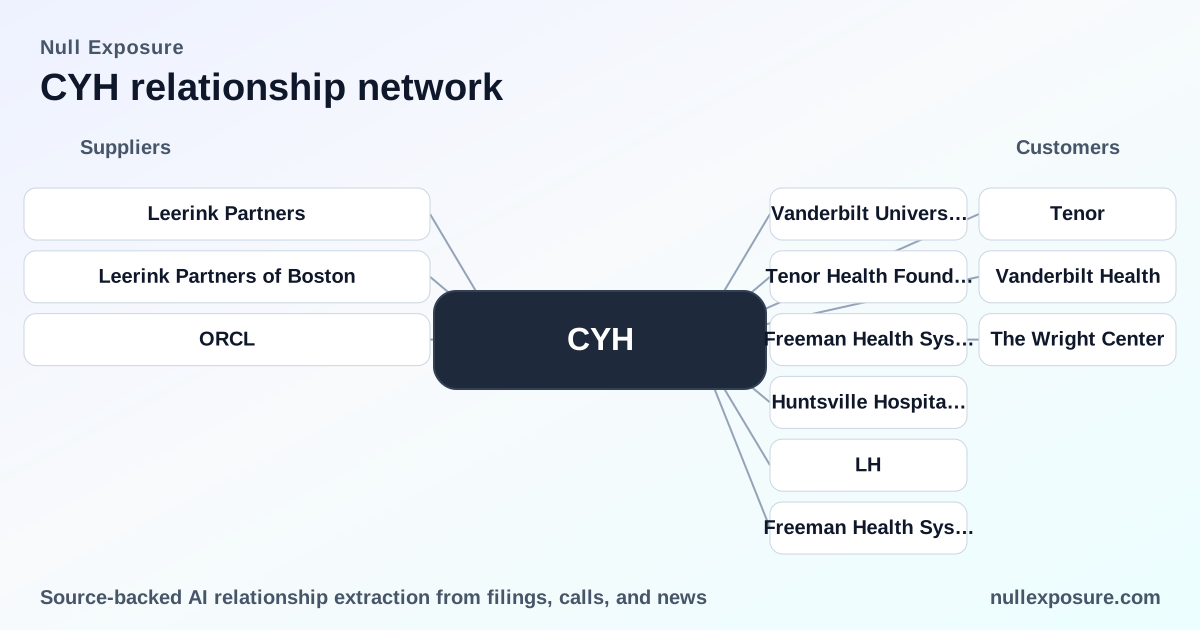
Leerink Partners — Community Health Systems has engaged Leerink Partners as its exclusive financial adviser in a March 2026 transaction to sell four hospitals in northwest Arkansas, indicating a formal sell-side advisory relationship for asset dispositions; the role was reported across regional and healthcare trade outlets in March 2026. A local news report covering the $112 million transaction and subsequent coverage by Digital Health News and Arkansas Business note Leerink’s exclusive advisory role in FY2026.
Sources: 5News (March 2026), Digital Health News (March 2026), Arkansas Business (March 2026). -
Oracle — CYH is running Oracle as its enterprise resource planning (ERP) backbone and is leveraging Oracle’s increasingly AI-capable administrative tools to mature processes and process transactions; management discussed these Oracle-enabled capabilities on the Q4 2025 / FY2026 earnings call and in subsequent press/earnings transcripts. InsiderMonkey and coverage in The Globe and Mail transcribed management commentary referencing Oracle ERP enhancements and their contribution to administrative efficiency in FY2026.
Sources: InsiderMonkey earnings transcript (FY2026), The Globe and Mail / Motley Fool coverage (FY2026).
Why these relationships matter for investors and operators
-
Transaction execution and capital allocation: Engaging a sell-side advisor like Leerink for the Arkansas hospital sales signals a focus on portfolio optimization and liquidity generation. The announced $112 million divestiture is a meaningful near-term liquidity event relative to market capitalization of roughly $428 million and provides a direct line into free cash flow improvement if closed as announced. Reports in March 2026 confirm the advisor appointment and the asset sale timeline.
-
Operational modernization through ERP: The Oracle relationship is core to CYH’s cost-transformation agenda. Management commentary in FY2026 explicitly ties Oracle’s ERP tools — and the AI features embedded in those tools — to scalable administrative process improvements, which can lower operating expenses and improve margin profile if successfully rolled out across the hospital footprint.
-
Procurement and working capital posture: Company disclosures show open purchase orders totaling $146 million as of December 31, 2024, which places a material short-term cash and supplier exposure on the balance sheet. This level of committed spend drives both vendor negotiation leverage and counterparty concentration risk during periods of stress.
Operating constraints and what they signal about vendor posture
The publicly available constraint excerpts present clear, company-level signals about how CYH engages suppliers and service providers:
-
Contracting posture — centralized, GPO participation: CYH participates in a Group Purchasing Organization (HealthTrust) under a participation agreement that extends through December 2025 with automatic one-year renewals unless terminated. This indicates a centralized procurement strategy that seeks volume pricing and occasional exclusivity in supplier arrangements, which reduces unit cost but can increase dependency on specific contract terms.
-
Service relationships — outsourced clinical staffing: The company contracts third parties to provide hospital-based physician services across emergency, anesthesiology, hospitalist, radiology and surgical specialties. This structure reduces headcount leverage but increases operational criticality for those vendors because clinical coverage is essential to revenue generation.
-
Spend concentration and near-term commitments: Open purchase orders of approximately $146 million at year-end 2024 signal large, near-term vendor obligations and illustrate a spend-band consistent with high single-digit to low double-digit percent of annual revenue committed to suppliers over short horizons.
Together, these constraints portray a mature, centralized procurement model with meaningful short-term spend, mixed insourcing/outsourcing of clinical services, and reliance on strategic advisors for monetization.
Risk and opportunity checklist for investors
- Asset-sale execution risk: The Leerink-advised sale reduces asset exposure but introduces timing and valuation execution risk; deal outcomes will directly affect liquidity and leverage metrics.
- Implementation risk for Oracle ERP: ERP rollouts historically carry integration and workforce-transition risks; success will determine the extent of administrative cost savings and AI-enabled productivity gains.
- Supplier dependency and working capital pressure: The $146 million in open POs and GPO participation create counterparty and concentration risk; vendors with critical clinical supplies or physician staffing leverage can influence operational continuity under stress.
What to watch next
- Transaction close and proceeds recognition for the Arkansas hospital sale, and any related adjustments to leverage or capital allocation plans reported in CYH filings or press releases.
- ERP implementation milestones and measurable administrative cost reductions reported in quarterly results or investor presentations.
- Any changes to the HealthTrust participation agreement or disclosure of supplier concentration that would alter counterparty risk.
Explore deeper supplier and relationship intelligence at the Null Exposure homepage: https://nullexposure.com/
Bottom line for decision-makers
Community Health Systems is executing a two-track strategy: monetize non-core assets to shore up liquidity while pushing administrative modernization through an Oracle ERP program. Both moves are financially meaningful for an operator with over $12.4 billion in trailing revenue and material short-term purchase commitments. For investors and operators, the combination of sell-side advisory activity, ERP modernization, and centralized procurement implies potential upside to margins if execution is clean — and measurable downside if transaction timelines slip or implementation falters.
For continued coverage and to monitor evolving supplier relationships and contractual exposures, visit the Null Exposure homepage: https://nullexposure.com/