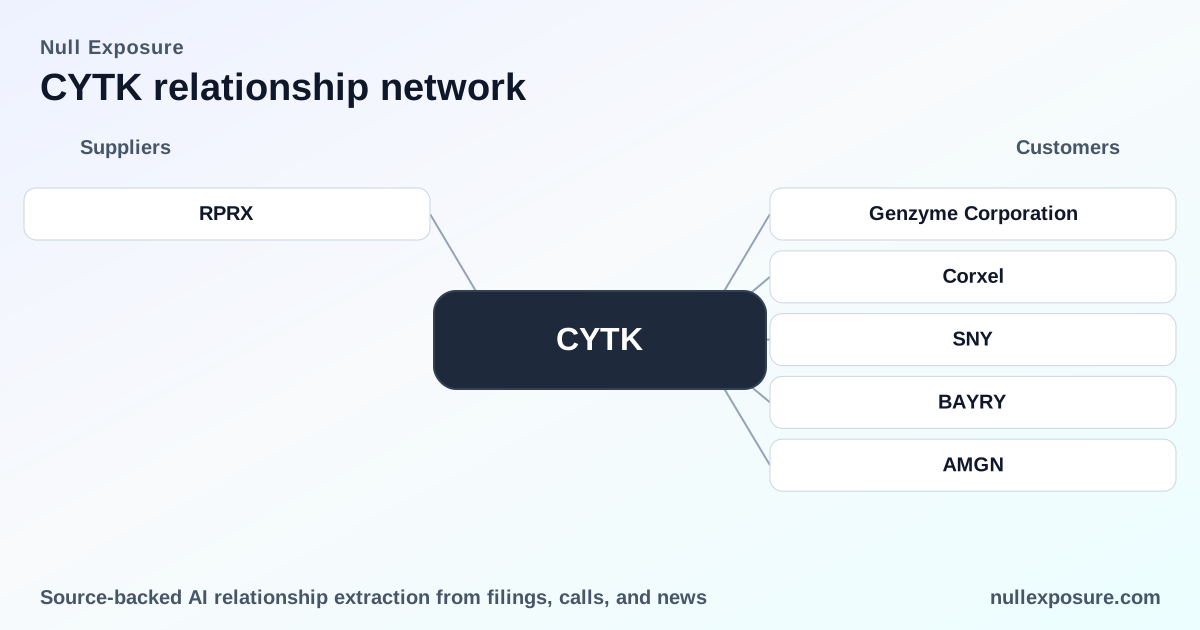
Cytokinetics (CYTK): supplier posture, financing partner implications, and what procurement- and investor-facing teams should know
Cytokinetics is an advanced-stage biopharmaceutical company that develops muscle activators and inhibitors and plans to monetize through commercial launches (notably aficamten), partnered funding arrangements, and product sales once commercialization begins. The company performs drug discovery and development in-house but outsources manufacturing and many clinical services, while selectively using external capital structures—including royalty financing—to de-risk the balance sheet ahead of launch. For investors and operator teams evaluating supplier relationships, the central dynamic is clear: commercial readiness is financed externally while operational execution is outsourced to contract manufacturers and CROs. Learn more at https://nullexposure.com/.
The short signal: a funding partner changes the narrative, not the supply model
A recent industry write-up flagged a funding deal with Royalty Pharma and referenced broader industry M&A activity, concluding that Cytokinetics is well-capitalized to pursue an independent commercial launch of aficamten and target profitability by 2026. That financing dynamic reduces immediate liquidity pressure but does not change the company’s outsourcing posture for manufacturing and clinical operations. A Finviz news article dated March 9, 2026, summarized the funding context and its market implications.
What Cytokinetics’ supplier relationships actually look like
Regulatory disclosures and corporate statements make two operational realities explicit:
- Manufacturing is outsourced. Cytokinetics has no internal manufacturing capacity and relies on third-party contract development and manufacturing organizations (CDMOs) for active pharmaceutical ingredients, finished drug product manufacture, and packaging. Company disclosures state that multiple third-party CDMOs have entered into scopes of work with respect to manufacturing aficamten.
- Clinical execution uses CROs. The company has used, and intends to continue to use, a limited number of contract research organizations (CROs) both inside and outside the United States to conduct clinical trials and related activities.
- Long-term commercial supply agreements are in place. In preparation for commercialization, Cytokinetics reports securing long-term commercial supply agreements with reputable contract manufacturers for finished drug product and API supply.
These points are drawn from the company’s public disclosures and filings describing supply arrangements and development outsourcing. The excerpts used in those filings explicitly note long-term supply agreements and the absence of internal manufacturing capacity.
Relationship coverage: Royalty Pharma
Royalty Pharma (RPRX) provided a funding arrangement with Cytokinetics that influenced market commentary about the company’s capitalization and strategic options. A Finviz news article (March 9, 2026) reported that the funding deal with Royalty Pharma, alongside sector M&A activity, cooled acquisition speculation and left Cytokinetics well-capitalized to independently launch aficamten, with profitability potentially reachable by 2026.
How these supplier signals translate to practical constraints
The company-level signals in Cytokinetics’ disclosures imply distinct procurement and operational characteristics:
- Contracting posture — long-term and committed. The existence of long-term supply agreements signals a procurement posture focused on securing continuity ahead of launch rather than spot sourcing. That reduces short-term supply volatility but creates contractual lock-in that procurement teams must manage during ramp-up and renegotiation windows.
- Concentration and criticality — single-source risks exist. Outsourcing all manufacturing and packaging to a limited set of third parties raises concentration risk: disruption at a key CDMO would directly affect product availability. This is a company-level signal across filings rather than a relationship-specific disclosure.
- Operational maturity — experienced external partners but internal dependency. Using reputable contract manufacturers suggests mature manufacturing partners, but the company’s lack of in-house capacity creates operational dependency—the firm’s commercial success hinges on third-party performance, quality, regulatory compliance, and capacity.
- Service-provider dynamics — clinical trial continuity depends on CRO relationships. The stated use of a limited number of CROs implies a focused network for clinical operations; that structure improves coordination but concentrates operational risk in a few providers.
These constraint signals come from Cytokinetics’ regulatory statements about supply and service relationships and are company-level characteristics unless the disclosure names a specific counterparty.
Operational and investment risks to monitor
For investors, procurement leads, and sourcing teams, the following are the most consequential items to track:
- CDMO capacity and quality performance. Track lot release timelines, regulatory inspection outcomes, and capacity commitments from named manufacturers in filings.
- Contract duration and termination clauses. Long-term agreements reduce rollover risk but can carry price and flexibility constraints; examine termination rights and supply continuity provisions.
- API sourcing complexity. If APIs are single-sourced or come from concentrated vendors, raw-material shortages or regulatory holds increase supply risk.
- CRO trial continuity and geographic footprint. Clinical timelines are sensitive to CRO throughput; any consolidation or capacity stress in CRO partners can delay regulatory milestones.
- Capital structure shifts from royalty financing. Funding from Royalty Pharma improves near-term liquidity but introduces future royalty obligations that affect cash flow once commercialization begins.
Use these focal points to pressure-test due diligence and scenario analyses ahead of commercial launch.
Learn how supplier intelligence fits into broader investment due diligence at https://nullexposure.com/.
Final takeaways for investors and operators
- Cytokinetics is capitalized to pursue commercial launch but remains operationally dependent on external manufacturers and CROs. Financing from Royalty Pharma strengthens balance-sheet flexibility without changing the outsourced operating model.
- Long-term supply agreements reduce immediate supply volatility while introducing contractual lock-in and concentration risks. Procurement teams should prioritize mapping counterparty capacity, quality history, and contractual termination provisions.
- Monitoring priorities are tactical and measurable: CDMO performance metrics, CRO continuity, API sourcing, and the financial terms attached to royalty financing.
For a structured supplier-risk briefing tailored to capital markets and procurement teams, visit https://nullexposure.com/ and request the Cytokinetics supplier dossier.