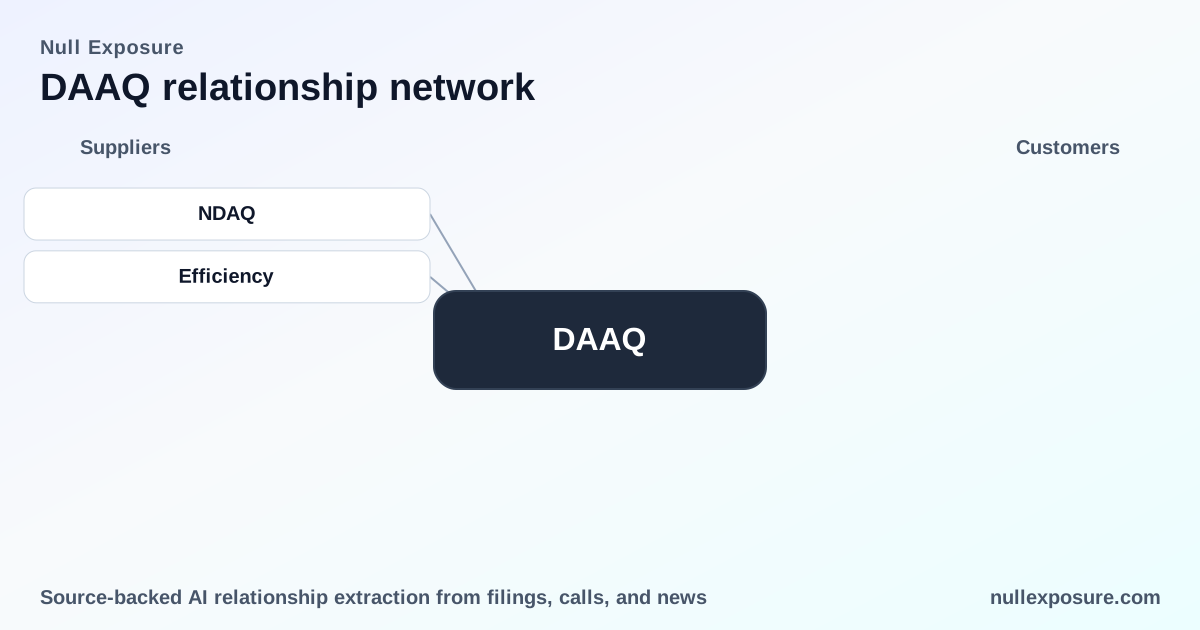
Digital Asset Acquisition Corp. (DAAQ): Supplier relationships that matter to investors
Digital Asset Acquisition Corp. is a Nasdaq-listed shell vehicle whose value proposition is simple: it holds public-market cash and equity units while seeking a business combination, with monetization occurring through a successful merger, unit conversion events, or liquidation of trust assets. DAAQ carries the typical SPAC profile: zero operating revenue, a market-capitalized vehicle managed to create optionality for a transaction, and dependence on public-market infrastructure and transfer-agent services to deliver liquidity and corporate actions to holders. For a concise supplier-risk read on this issuer, review the operational partners and what they imply for execution and investor access. Visit https://nullexposure.com/ for more supplier-risk intelligence.
Company snapshot
- Ticker: DAAQ (NASDAQ). Sector: Financial Services; Industry classified as Shell Companies.
- Market capitalization: $235.2 million; latest reported quarter: 2025-12-31.
- No operating revenue reported (Revenue TTM = $0); EPS reported as 0.25; book value negative at -0.254 per share. Institutional ownership is high at 95.75%, indicating concentrated professional investor participation.
Why supplier relationships matter for a shell issuer DAAQ’s operational success is not driven by product or sales but by the integrity of market infrastructure — the exchange that lists its securities and the transfer agent that executes unit separations and shareholder recordkeeping. For investors and counterparties, the quality and stability of those suppliers are the closest proxy for execution risk, liquidity, and the speed with which corporate actions are processed.
Primary supplier relationships (what the record shows) Below I cover every supplier relationship returned in the record, with plain-English summaries and source references.
The Nasdaq Global Market — listing and ticker structure
DAAQ’s Class A ordinary shares and warrants will trade separately on The Nasdaq Global Market under the symbols DAAQ and DAAQW, while any unseparated units will continue trading as DAAQU. This change formalizes unit separation and the market ticker architecture that investors use to access the underlying securities. The arrangement was announced in a market notice published in March 2026. Source: Futunn news post, 9 March 2026 (announcement on separate trading of units).
Efficiency — the company’s transfer agent responsible for unit separations
Holders who need to separate units into Class A shares and warrants are instructed to have their brokers contact Efficiency, the transfer agent, via the DWAC request email (dwacrequests@useefficiency.com) to effect the separation. This indicates Efficiency is the operational counterparty for shareholder record changes and DWAC transfers tied to liquidity events. Source: Futunn news post, 9 March 2026 (transfer-agent instructions).
What these relationships imply for DAAQ’s operating model
- Critical reliance on exchange mechanics. The Nasdaq relationship is not a discretionary vendor choice; it is the fundamental market plumbing that gives investors tradable instruments and pricing transparency. Any disruption to that listing or symbol structure would immediately affect liquidity for holders.
- Operational criticality of the transfer agent. Efficiency’s role in unit separation and DWAC processing is operationally critical: delays or errors in transfer-agent processing can hold up conversion of units to shares/warrants, affect voting rights, and impede secondary-market flows.
- Contracting posture is standard public-market practice. The vendor interactions implied here follow typical exchange and transfer-agent contracts — standardized, highly regulated, and executed at scale — which reduces custom-contract risk but concentrates dependency on a small number of infrastructure providers.
- Concentration and maturity signals. The supplier list is short and composed of mature market institutions rather than boutique vendors; this suggests low vendor diversification but high systemic redundancy, since Nasdaq and established transfer agents are entrenched market utilities.
Constraints and company-level signals (what the record does not restrict but reveals) There were no explicit constraint excerpts in the supplier record. Company-level signals worth noting for supplier-risk posture:
- High institutional ownership (95.75%) signals professional investor exposure and potentially rapid liquidity shifts around corporate actions.
- Zero reported operating revenue and classification as a shell company confirm that DAAQ’s operational relevance is primarily about trust assets, legal structuring, and the ability to complete a merger; supplier relationships therefore govern execution rather than product delivery.
- Negative book value and limited public float dynamics create sensitivity to transaction outcomes and to how smoothly constituents (exchange, transfer agent, brokers) execute separations and post-deal recordkeeping.
Risk implications for investors and operators
- Execution risk is concentrated, not diversified. Because DAAQ depends on a small set of market infrastructure suppliers, the primary operational risk is the failure, delay, or regulatory friction at the exchange or transfer-agent level, not vendor solvency in the product sense.
- Regulatory and process compliance are central. Transfer-agent procedures (DWAC transfers, unit separations) and exchange listing rules are the gating items for investor liquidity; operational missteps have immediate market consequences.
- Investor composition amplifies technical events. With a large institutional holder base, any corporate-action communication problems can translate into concentrated trading flows and amplified price moves.
What investors should watch next
- Confirm that Nasdaq continues to list DAAQ, DAAQW, and DAAQU under the announced structure and note any regulatory filings that further detail unit separation logistics.
- Monitor transfer-agent confirmations and broker communications for the DWAC process turnaround times; Efficiency’s role is the single most actionable supplier detail investors can validate on short notice.
- Track institutional trades and filing activity given the concentrated ownership profile — changes here will be the proximate drivers of market moves in the absence of operating revenues.
If you want deeper supplier-risk mapping and monitoring for DAAQ and similar vehicles, explore tailored intelligence and ongoing relationship tracking at https://nullexposure.com/. For portfolio teams evaluating counterparties across public-market SPAC mechanics, our site offers structured supplier profiles and signals you can act on: https://nullexposure.com/.
Final take DAAQ is a classic SPAC construct: its value is execution-dependent rather than revenue-dependent, and its two recorded supplier relationships — Nasdaq (market structure) and Efficiency (transfer agent) — together determine liquidity and the mechanics of investor entitlements. For investors and operators, the critical questions are procedural: is the exchange ticker architecture intact, and is the transfer agent executing DWAC and separation requests efficiently? If the answers are yes, the market mechanics that enable monetization are in place; if not, liquidity and optionality evaporate quickly. For ongoing supplier-risk coverage and alerts, visit https://nullexposure.com/.