DAIC (CID HoldCo): Supplier footprint and what it means for investors
CID HoldCo, Inc. (ticker DAIC) operates as an investment management and operating-holdco platform that monetizes through strategic equity and debt positions in operating subsidiaries, combined with direct operating revenue from its owned businesses. The firm’s financials show small-cap scale with operating losses and concentrated insider ownership, while corporate disclosures and market coverage highlight a handful of supplier and manufacturing relationships that underpin its operating subsidiaries’ product and supply-chain capabilities. For investors evaluating supplier risk and operational leverage, the key question is how these supplier ties translate into commercial scale and execution risk across CID HoldCo’s assets.
Explore supplier exposure and competitive signals at https://nullexposure.com/.
Business model and operating posture — what the supplier links reveal CID HoldCo presents as a micro-cap, asset-backed manager with active operating subsidiaries. Financials (Revenue TTM $5.8M; negative EBITDA and EPS of -1.78; Market Cap ≈ $6.7M) indicate an organization still in scaling mode, relying on a limited revenue base and heavy insider control (insiders ~44% ownership). That profile produces several company-level operating signals:
- Contracting posture: The company manufactures hardware through a wholly owned unit (Dot Works), indicating a preference for internalized production rather than outsourcing all manufacturing — this is a posture that reduces external supplier dependency for core hardware but raises capital intensity and execution risk at small scale.
- Concentration and criticality: Given modest revenues and the existence of a few named supplier/partner relationships in public coverage, supplier relationships are likely concentrated and operationally critical to the revenue profile of specific subsidiaries.
- Maturity and leverage: The balance of negative operating margins and concentrated insider ownership signals an immature commercial stage where supplier relationships can materially influence short-term delivery and product-roadmap execution.
No supplier constraints were recorded in the data feed used for this review; that absence is a company-level signal that no flagged procurement restrictions or pre-existing contractual encumbrances were reported in the available sources, rather than proof of unconstrained supplier access.
If you’re modeling downside scenarios or supplier-concentration risk into valuation, CID HoldCo’s supplier footprint is a critical input — review supplier links and filings at https://nullexposure.com/.
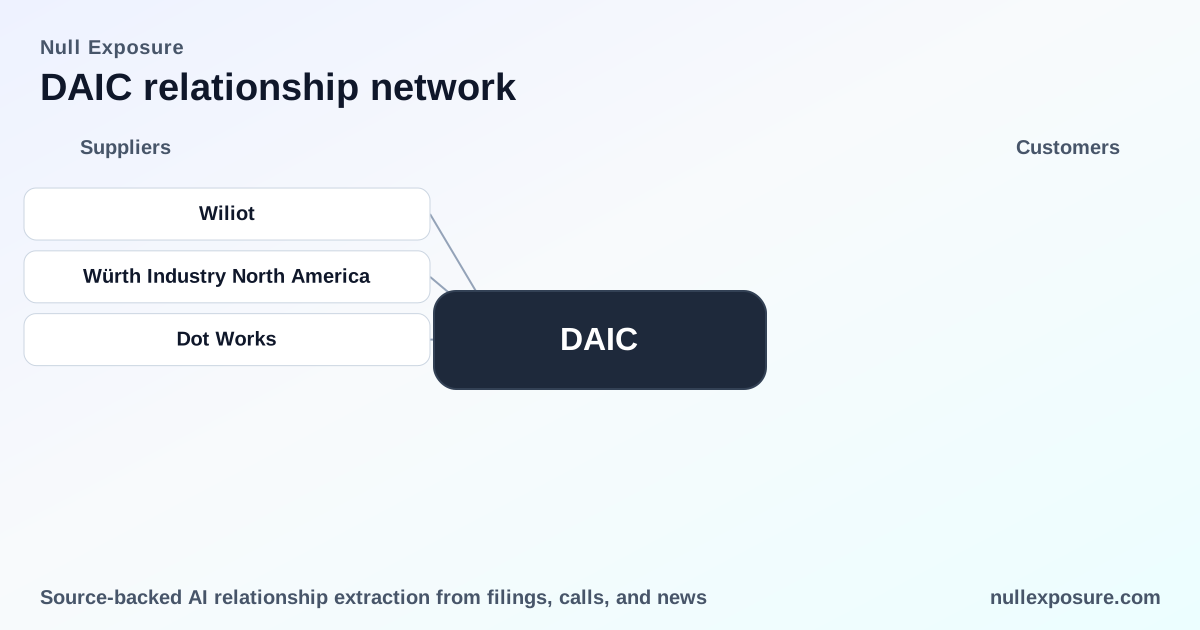
What the public records list as supplier/partner ties The dataset returns three named relationship references: Wiliot, Würth Industry North America, and Dot Works. Each is summarized below with a direct-source reference.
Wiliot — an industrial ambient-IoT partner
CID HoldCo’s public coverage references a collaboration that validated an industrial implementation of Wiliot’s tag technology, emphasizing improved readability and range in metal or wet environments through a patent-pending plasmonic folded ground plane structure. According to an Intellectia news item tied to CID HoldCo coverage (March 9, 2026), this collaboration extends industrial use cases for Wiliot’s ambient-IoT tags. This relationship signals technology integration and product-level dependency for subsidiaries focused on IoT-enabled supply-chain solutions. (Source: Intellectia news, March 9, 2026 — https://intellectia.ai/news/stock/cid-holdco-appoints-new-cro-shares-surge-238-after-hours)
Würth Industry North America — industrial infrastructure partner
Public commentary places Würth Industry North America in a partnership network that integrates industrial-grade infrastructure with ambient IoT capabilities, a combination framed as enhancing intelligence across complex supply chains. An Intellectia report from March 9, 2026 highlights the synergy between Dot Ai (a CID HoldCo operating brand), Wiliot, and Würth Industry North America, underscoring a stack of hardware and infrastructure suppliers supporting the operating subsidiary’s solutions. This tie indicates access to industrial distribution and installation expertise, important for scaling deployments in manufacturing and logistics environments. (Source: Intellectia news, March 9, 2026 — https://intellectia.ai/news/stock/cid-holdco-appoints-new-cro-shares-surge-238-after-hours)
Dot Works — in-house manufacturing capability
CID HoldCo discloses that it manufactures hardware in Puerto Rico through its wholly owned subsidiary Dot Works, signifying direct control over at least part of its hardware supply chain. This is documented in a filing summary surfaced on TradingView referencing CID HoldCo’s SEC 10‑Q disclosures (reported March 2026), and it confirms that CID HoldCo runs on a hybrid operating model combining investment holdings with captive manufacturing operations. The Dot Works presence is a core operational lever: it reduces reliance on third-party contract manufacturers but concentrates production risk within the corporate family. (Source: TradingView summary of CID HoldCo SEC 10‑Q, March 2026 — https://www.tradingview.com/news/tradingview:ec0788b644fc4:0-cid-holdco-inc-sec-10-q-report/)
Mid‑report investor action: auditors and supply‑chain diligence matter Given the small revenue base and material operating losses, investors should prioritize supplier due diligence and operational audits to validate manufacturing capacity and partner contracts. For a concise vendor map and updated supplier signals, reference https://nullexposure.com/ — it’s an efficient way to start stress-testing counterparty and concentration risk.
Risk implications and what to watch next
- Execution risk is elevated. At current scale, any disruption at Dot Works or the industrial partners that enable deployments (Wiliot/Würth) would materially affect near-term revenue and growth trajectories.
- Concentration amplifies supplier power. A small number of relationships supplying differentiated hardware or integration services creates negotiating leverage for suppliers and increases single-point-of-failure risk.
- Integration is a value lever. Captive manufacturing plus embedded IoT partnerships give CID HoldCo a path to product differentiation if the company executes on rollout and can contain costs.
Investor checklist (practical items)
- Confirm the scope and term length of any supplier contracts with Würth or Wiliot in subsidiary filings and any related-party disclosure.
- Verify Dot Works’ production capacity, quality controls, and order backlog relative to revenue run-rate.
- Monitor insider and institutional ownership trends — high insider concentration increases strategic control but reduces market liquidity.
Conclusion and next steps CID HoldCo’s supplier footprint combines in-house manufacturing (Dot Works) with strategic technology and infrastructure partners (Wiliot and Würth Industry NA). For investors, the combination is a double-edged sword: it offers product control and differentiated capabilities but also concentrates execution risk into a small set of moving parts. To convert these supplier relationships into an investment thesis, validate contract terms, production economics, and deployment pipelines in subsidiary disclosures.
For ongoing supplier intelligence and to integrate these signals into valuation and risk models, visit https://nullexposure.com/. If you want a focused vendor-mapping briefing for DAIC, request an analyst summary at https://nullexposure.com/ — supply-chain exposure is the next frontier for micro-cap operational due diligence.