Daktronics (DAKT): MicroLED acquisition tightens supply control and reframes supplier risk
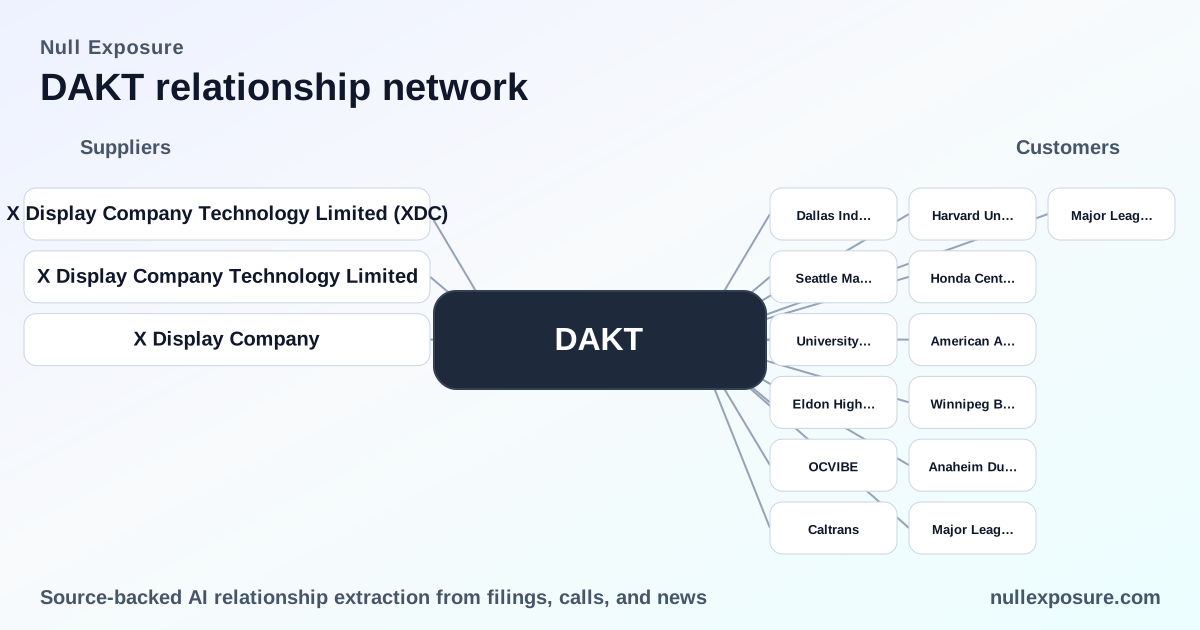
Daktronics designs, manufactures and sells electronic display systems and control products and monetizes through hardware sales, long-cycle installation projects and recurring control/software services. The company is funding a strategic shift into MicroLED and mass-transfer capability by acquiring IP, equipment and technical talent from X Display Company, converting a supplier relationship into owned capability and changing the supplier risk profile for display-critical components. For investors evaluating supplier exposure and operational leverage, that conversion is the single most material supplier development in FY2025–FY2026.
Explore deeper supplier intelligence at https://nullexposure.com/.
Business model in plain English: where the dollars come from
Daktronics is a vertically-oriented display manufacturer: product sales and project deliveries drive most revenue, while software and control systems add recurring value and serviceable revenue. Financial scale is meaningful for a specialized manufacturer — TTM revenue of $802.6M and a market capitalization near $996M — but margins are thin by tech standards: profit margin ~3.4% and operating margin ~1.06%, reflecting project mix and supply costs. Valuation multiples show investors pricing growth: EV/Revenue ~1.05, EV/EBITDA ~29.4, forward P/E ~16.1. Quarterly revenue growth of ~21.6% YoY supports a constructive growth narrative into MicroLED-enabled product upgrades.
Why the X Display Company deal changes the supplier map
In late December 2025 Daktronics announced it acquired intellectual property, equipment assets and technical expertise from X Display Company (XDC), a specialist in mass-transfer and MicroLED technologies. That transaction converts an element of the upstream supply chain — specialized MicroLED mass-transfer — into an internal capability. The deal delivers three immediate effects: short-term capex and integration burden, medium-term potential margin improvement through verticalization, and reduced dependency on outsourced MicroLED processes that were concentrated in Asia. The move is strategic: it directly targets the manufacturing bottleneck for next-generation displays and creates differentiation around higher-performance, higher-margin product variants.
According to the company press release and subsequent news coverage, the assets include IP and equipment as well as technical talent transferred to Daktronics, accelerating in-house MicroLED and microIC development (GlobeNewswire, Dec 23, 2025; SahmCapital coverage, Dec 24, 2025).
Every relationship record in the public results
-
Daktronics announced the acquisition of IP, equipment and technical expertise from X Display Company Technology Limited (XDC) in a SahmCapital news item describing the December 2025 transaction; the article frames the move as a bold MicroLED bet to secure mass-transfer capability. Source: SahmCapital coverage dated Dec 24, 2025 — https://www.sahmcapital.com/news/content/daktronics-makes-bold-microled-bet-with-ip-and-talent-grab-2025-12-24
-
A GlobeNewswire press release (Dec 23, 2025) states Daktronics acquired intellectual property and equipment assets from X Display Company Technology Limited to expand MicroLED and MicroIC capabilities, positioning Daktronics as a technology owner rather than a pure OEM buyer for mass-transfer processes. Source: GlobeNewswire press release (Dec 23, 2025) — https://www.globenewswire.com/news-release/2025/12/23/3210169/0/en/Daktronics-Acquires-Intellectual-Property-and-Equipment-Assets-from-X-Display-Company-to-Expand-MicroLED-and-MicroIC-Capabilities.html
-
SahmCapital published a follow-up or duplicate-style article (Dec 24, 2025) reiterating that Daktronics acquired IP, equipment and technical expertise from X Display Company Technology Limited to expand MicroLED and microIC capabilities, emphasizing the strategic rationale for in-house mass-transfer. Source: SahmCapital article dated Dec 24, 2025 — https://www.sahmcapital.com/news/content/daktronics-acquires-intellectual-property-and-equipment-assets-from-x-display-company-to-expand-microled-and-microic-capabilities-2025-12-24
-
TradingView reported on Dec 23, 2025 that Daktronics announced acquisition of X Display Company’s display business, summarizing the transaction as the company taking ownership of display-related assets and operations. Source: TradingView news post (Dec 23, 2025) — https://www.tradingview.com/news/tradingview:8b3556fb86285:0-daktronics-inc-acquires-display-business-from-x-display-company/
-
GlobeNewswire published an additional syndicated release (Dec 23, 2025) repeating that Daktronics purchased IP and equipment assets from X Display Company Technology Limited to accelerate MicroLED and MicroIC capabilities; the repetition in press channels confirms company-led disclosure. Source: GlobeNewswire syndicated release (Dec 23, 2025) — https://www.globenewswire.com/news-release/2025/12/23/3210169/10684/en/Daktronics-Acquires-Intellectual-Property-and-Equipment-Assets-from-X-Display-Company-to-Expand-MicroLED-and-MicroIC-Capabilities.html
Supply-chain and contracting constraints that matter to investors
The public disclosures and company risk statements collectively imply a few consistent operational characteristics:
-
Short-term contracting posture: Daktronics executes purchasing agreements and pricing contracts that generally run under one year, which creates higher exposure to input-price volatility and forces active procurement management rather than long-term fixed-cost sourcing. This is a company-level signal supported by the firm’s procurement language.
-
Global sourcing with APAC concentration for semiconductors: Materials are sourced worldwide, and China is explicitly the greatest source for semiconductor-type components (LEDs, PCBs, ICs). That geography profile establishes supply-chain exposure to APAC manufacturing, logistics and geopolitical disruptions.
-
Overall supplier immateriality with pockets of single-source risk: No single supplier accounts for 10% or more of cost of sales, but Daktronics operates with a complex global supply chain and a number of single-source suppliers for specific parts — a structure that is immaterial in dollar concentration but critical in delivery risk when single-source components are required for project deadlines.
These constraints collectively create a profile of operational sensitivity to component pricing and lead-time volatility, even though supplier concentration at the cost-of-sales level is not dominant.
Explore supplier scoring and scenario analysis at https://nullexposure.com/.
Investment implications — upside, dilution of risk, and watch points
The XDC acquisition is a clear strategic leaver: owning mass-transfer IP and equipment reduces an important operational choke point for MicroLED products and supports future margin expansion if Daktronics executes commercialization. That upside is offset by integration risk and near-term cash/working-capital demands; current operating margin and EBITDA reflect project complexity and legacy sourcing economics. Key investor takeaways:
-
Upside: Verticalization into MicroLED mass-transfer can create differentiated products and higher gross margins over time, supporting the forward P/E of ~16.1 if growth materializes.
-
Risk: Short-term supplier contracts and APAC dependence for base semiconductor inputs mean Daktronics still faces cost and lead-time exposure outside the XDC scope.
-
Valuation context: Market capitalization (~$996M) and EV/Revenue (~1.05) indicate the market has priced modest growth with execution risk; EV/EBITDA (~29.4) signals premium for earnings expansion potential.
Bottom line and recommended next steps
Daktronics has converted a supplier relationship into owned capability, materially changing supply dynamics for next-generation displays. This is a supply-chain to product-strategy shift — not just a vendor swap — and it warrants attention from investors focused on industrial differentiation and margin recovery.
- For deeper supplier risk profiles and to monitor integration metrics, visit https://nullexposure.com/.
- To track contract exposure and regional sourcing stress tests, see our supplier dashboards at https://nullexposure.com/.
Actionable focus for investors: monitor FY2027 product margin trajectory, stated integration milestones for XDC assets, and any changes in procurement tenor for semiconductor inputs; these will determine whether the acquisition lifts structural profitability or simply reallocates supplier risk internally.