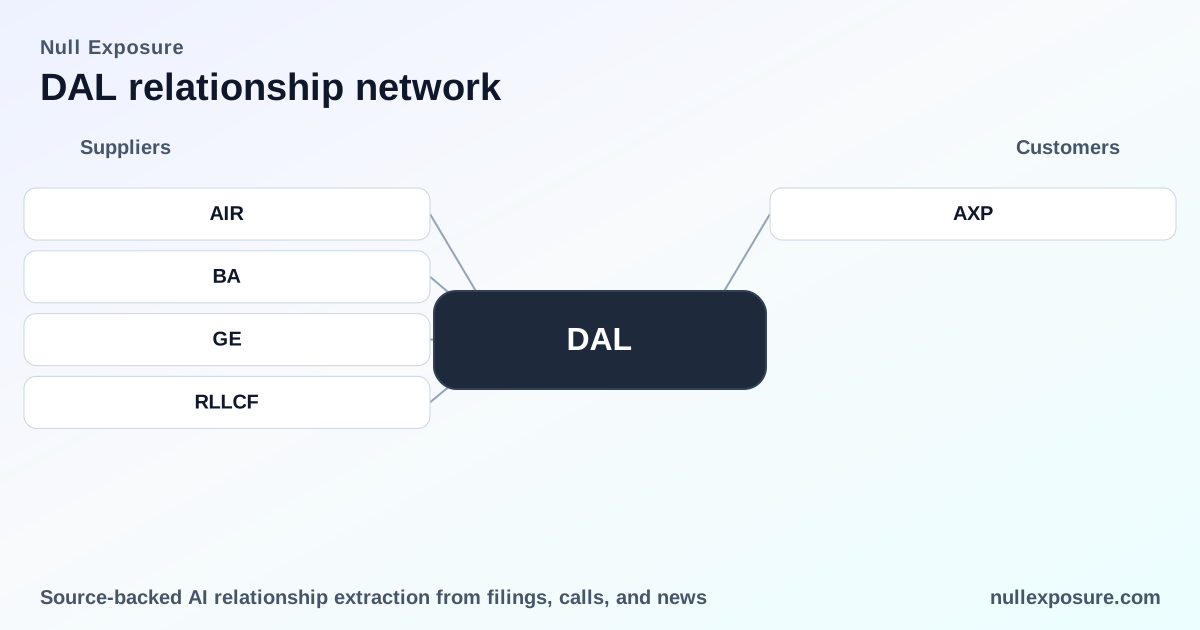
Delta Air Lines (DAL): supplier relationships shaped by a multi-year fleet program and large-ticket engine and fuel exposure
Delta is a network carrier that monetizes a global route system through ticket sales (premium and basic economy), ancillary products, cargo, and a high-margin loyalty ecosystem; the company funds growth and unit-cost improvement primarily through fleet modernization and long-duration purchase obligations with aircraft and engine manufacturers. Delta’s supplier profile is defined by a mix of long-term, high-dollar aircraft purchases and routine spot purchases (notably fuel), creating both concentrated counterparty exposure and predictable capital commitments. For a concise view of supplier relationships and the implications for portfolio managers, visit nullexposure.com.
Why the recent aircraft orders matter for investors
Delta’s recent public commentary and filings document a material multi-vendor fleet refresh: new widebody and narrowbody orders tie the airline to two global OEMs and their engine suppliers for the next decade. These are not transactional purchases but strategic, long-term capital commitments that alter the company’s cash flow profile, vendor concentration and operational flexibility. The orders support international capacity growth and premium seating expansion, while simultaneously locking Delta into multi-year delivery schedules and engine support ecosystems.
Key operational constraint: Delta combines long-term aircraft purchase agreements with spot exposure in commodity inputs like jet fuel, creating a dual contracting posture that increases strategic leverage with OEMs while keeping near-term margin volatility from fuel. The company reported approximately $11.2 billion of purchase obligations as of December 31, 2025, indicating high committed spend over the coming years (with a scheduled decline from about $1.4 billion in 2026 to $800 million in 2030). This is a company-level signal of large-ticket, multi-year capital commitments.
The supplier roll call (what every relationship does and why it matters)
Airbus
Delta announced orders for Airbus aircraft across narrowbody and widebody families to refresh both its A320-series and long-haul fleet, including 31 next-generation widebodies and 34 A321neo narrowbodies to improve unit costs and premium capacity. According to a MarketBeat alert summarizing Delta comments on the refresh (Mar 1, 2026), Airbus deliveries are targeted at improving fuel efficiency and premium-revenue opportunities.
Boeing
Delta placed a large order for Boeing 787-10 Dreamliners (reported as 30 jets) and maintains formal purchase agreements with Boeing for other types (including a filed Purchase Agreement PA-04696 for 737-10 aircraft). Delta’s purchase agreement with Boeing is a formal, long-term contractual relationship that anchors a meaningful portion of its future capacity and capital spend; the 787-10 order was reported in recent market commentary (Sahm Capital, Mar 1, 2026) and the Boeing purchase agreement is documented in Delta’s public filings (Exhibit PA-04696, filed with SEC disclosures).
General Electric
Delta’s announced Boeing 787-10 fleet will include GEnx engines built by General Electric, assigning GE to a critical role in propulsion, spare parts and engine support economics for that subset of the fleet. This linkage is documented in Delta’s 2025 Form 10‑K which specifies the B-787-10 will include GEnx engines manufactured by General Electric (Delta 2025 10‑K).
Rolls‑Royce
For selected Airbus widebodies in Delta’s program, Rolls‑Royce supplies core propulsion: the A330-900 will run Trent 7000 engines and the A350-900 will use the Trent XWB family. Delta’s 2025 Form 10‑K lists these engine assignments, tying Rolls‑Royce to long-term maintenance and parts commitments on Delta’s Airbus widebody fleet (Delta 2025 10‑K).
(Every relationship above reflects the set of sources available in Delta’s filings and the recent market commentary; see earlier links for the primary reporting.)
Visit nullexposure.com for an indexed view of these relationships and their contractual footprints.
Contracting posture, concentration and maturity — what the constraints tell investors
- Contracting posture: Delta mixes long-term OEM purchase agreements (documented Boeing PA-04696 and other capacity purchase language) with spot purchases for commodities such as jet fuel, which leaves the company operationally hedged on equipment but exposed to fuel-price volatility. The fuel spot exposure is explicitly mentioned in MD&A language describing purchases on the spot market from refiners.
- Concentration and counterparty type: The manufacturer relationships are concentrated among a small set of very large enterprises (Boeing, Airbus) and tier-one engine suppliers (GE, Rolls‑Royce). The Boeing purchase agreement cited in filings identifies Boeing as a named counterparty to a large, long-term contract.
- Criticality: Aircraft and engine suppliers are mission-critical; delivery timing, engine support and spare-part availability directly affect route capacity and revenue-generating capability.
- Maturity and spend profile: The company reported roughly $11.2 billion of purchase obligations as of December 31, 2025, with the near-term annual committed payments concentrated in the next several years — a structural, high-dollar liability that declines over the 2026–2030 window. This indicates high immediate capital commitments followed by a tapering obligation schedule.
Portfolio implications and risk vectors
- Earnings sensitivity: Fleet modernization improves unit costs and premium revenue potential, but heavy upfront capital commitments compress near-term free cash flow and increase leverage risk if demand softens.
- Supply-chain concentration: Long-term tie-ins to Boeing and Airbus reduce Delta’s vendor flexibility and create single points of negotiation for delivery timing; engine supplier relationships (GE, Rolls‑Royce) create additional dependencies for maintenance and reserve spares.
- Commodity exposure: Fuel purchased largely on the spot market generates short-term margin volatility even as aircraft efficiency reduces structural unit costs.
- Counterparty negotiation power: As a large, repeat buyer Delta has negotiating leverage on pricing and delivery options, but the sheer scale of orders increases the impact of OEM production constraints or engine reliability episodes.
Investors should treat Delta’s OEM and engine contracts as strategic, high-dollar supplier exposures that materially affect capital allocation, margin trajectory and operational flexibility.
For an organized supplier exposure snapshot with delivery schedules and obligation timelines, consult nullexposure.com for the complete index and linked filings.
Bottom line and recommended next steps
Delta’s supplier relationships are a defining feature of its capital profile: long-term aircraft contracts with Boeing and Airbus, engine dependencies on GE and Rolls‑Royce, and substantial committed spend create both growth optionality and concentrated vendor risk. Active obligations of roughly $11.2 billion as of year-end 2025 are non-trivial for cash-flow modeling and credit assessment.
Actionable next steps for investors and operators:
- Reconcile Delta’s delivery schedule against route expansion plans and unit-revenue forecasts.
- Stress-test margins under higher fuel-cost scenarios given the company’s spot fuel posture.
- Monitor OEM production cadence and engine reliability bulletins that can affect capacity timing.
For a quick reference of these contractual exposures and how they map to Delta’s balance sheet and cash-flow forecasts, visit nullexposure.com to access the supplier relationship dossier and primary filing links.