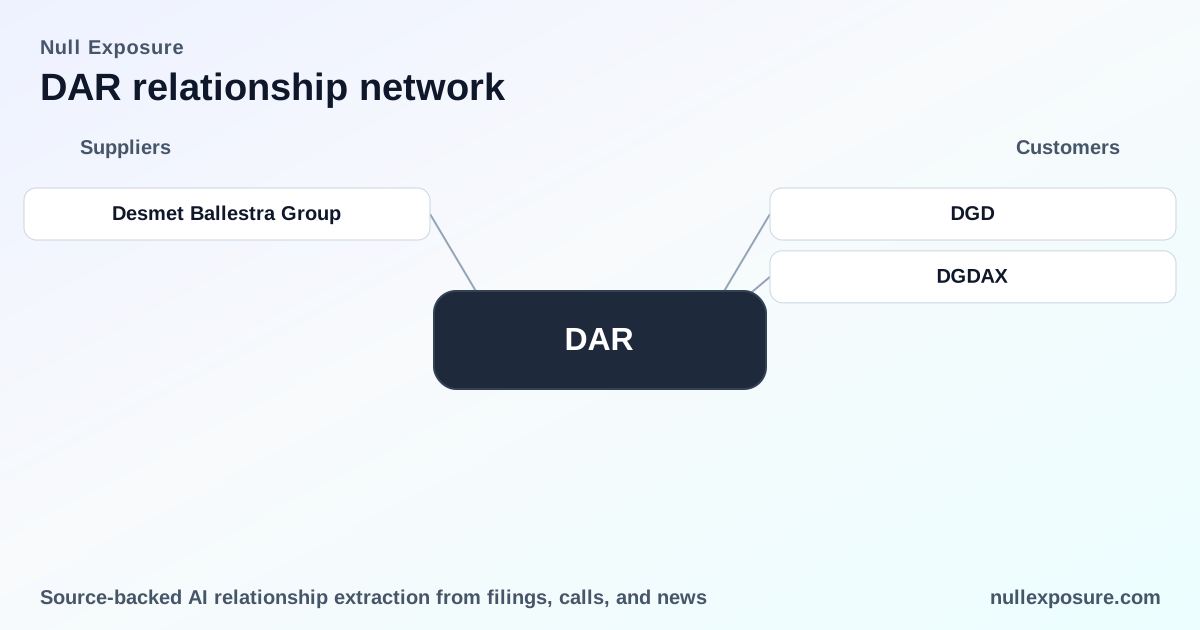
Darling Ingredients (DAR): supplier relationships, operational constraints, and what investors should watch
Darling Ingredients converts animal- and food-processing byproducts into commoditized and higher-value natural ingredients and renewable fuels, monetizing through product sales across specialty proteins, feed ingredients, and renewable diesel produced at its DGD facilities. The company’s operating model is integration-heavy: it collects raw bio-nutrients, processes them at owned facilities, and sells finished ingredients and fuels to industrial and agricultural customers. Investors should evaluate supplier and technology dependencies because Darling’s manufacturing footprint scales revenue but concentrates operational risk.
For immediate access to organized supplier intelligence on Darling, visit https://nullexposure.com/.
Why supplier relationships are a central investment variable for DAR
Darling’s value chain is built on capture and conversion: securing feedstock, maintaining processing capacity, and licensing or deploying refining processes for higher-margin products like renewable diesel. This creates a mixed contracting posture: the company signs long-term supply and technology arrangements for critical processes while retaining spot collection and commodity sales exposure for lower-margin outputs.
- Scale and economics: Darling reports roughly $6.14 billion in trailing revenue and $915 million of EBITDA (TTM), so a single major plant outage or supply interruption can have outsized P&L implications.
- Concentration risk: The company’s public disclosures explicitly flag that several facilities are highly dependent on one or a few suppliers, making supplier continuity a company-level risk rather than a peripheral operational detail.
- Technology dependencies: Renewable diesel production uses licensed hydroprocessing and specialized pretreatment — these are not fungible pieces of equipment and require engineering partners and licensors to deploy and maintain at scale.
These characteristics make supplier diligence a primary input to any valuation or operating-case forecast for DAR: the upside from renewable diesel and specialty ingredients is meaningful, but so is the downside from supplier or technology failure.
Supplier relationships disclosed in the filings
The filing-level data set for DAR includes a qualifying engineering and pretreatment relationship disclosed in the FY2024 filing. Each relationship below is described in plain English with a source reference.
Desmet Ballestra Group
Desmet Ballestra developed the pretreatment process used at Darling’s DGD renewable diesel facilities; Darling’s 10‑K states that renewable diesel is produced using the Ecofining Process license from UOP LLC combined with a pretreatment step developed by Desmet Ballestra. This signals a technology and engineering partnership that underpins the DGD production chain. Source: Darling Ingredients FY2024 Form 10‑K (filed Dec 28, 2024).
(That is the complete list of supplier relationships disclosed in the provided results.)
Operational constraints drawn from company disclosures — what they mean
Darling’s FY2024 disclosures include a materiality constraint about supplier concentration: certain operating facilities are highly dependent on one or a few suppliers, and interruptions could materially impair operations and financial condition. This is a company-level signal and should be read as a governance and operational red flag for investors.
Interpreting that constraint in investor terms:
- Contracting posture: Darling operates with a mix of licensed process technology (licensor relationships like UOP) and outsourced engineering/pre-treatment partners, indicating strategic dependence on third-party know-how and feedstock channels rather than purely captive technology.
- Concentration: When a facility depends on “one or a few” suppliers, the replacement cost of supply or technology can be high and lead times extended, increasing business continuity risk.
- Criticality: Renewable diesel is a higher-margin product and relies on both licensed hydroprocessing and pretreatment; any supplier disruption in these inputs or engineering services directly threatens margin-bearing production.
- Maturity: The Ecofining Process is an established licensed technology, but the combination of license plus bespoke pretreatment suggests an operational maturity that is stable yet brittle—stable because processes are proven, brittle because they are not easily substituted in a short interval.
Key takeaway: Darling’s supplier and technology relationships are structurally important to output and margins; they are a first-order investment risk rather than a secondary operational nuance. The company’s own filing frames this as potentially material to results.
For deeper supplier mapping and risk scoring on Darling, see https://nullexposure.com/.
How these supplier dynamics translate into investment risk and opportunity
- Upside: Darling’s integration into renewable diesel via licensed processes and specialized pretreatment supports durable margin expansion when feedstock access and plant utilization are maintained; this underlies analyst confidence (consensus target price near $62).
- Downside: Supplier concentration and single-point dependencies create scenario risk—extended outages or supplier exits would depress utilization and cash generation rapidly because feedstock collection and process continuity are not fully fungible.
- Execution focus: Investors should prioritize metrics that capture supply continuity (feedstock contracts, collection volumes), plant uptime, and the existence of fallback engineering or in-house replacement options.
A practical checklist for research and operations teams
- Verify the contractual tenor and termination terms of technology licenses and engineering agreements supporting DGD plants.
- Monitor feedstock origination channels and counterparty concentration by plant; quantify what percentage of throughput is tied to top suppliers.
- Track plant utilization and scheduled maintenance disclosures versus historical outages. Public filings already state the concentration risk; your job is to quantify exposure.
- Ask management about contingency plans and in‑house capabilities to replicate pretreatment steps if a partner relationship fails.
Mid-analysis resource: for an aggregated supplier profile and to benchmark DAR against peers, go to https://nullexposure.com/.
Bottom line and investor actions
Darling Ingredients is a sizable, integrated processor with meaningful exposure to higher-margin renewable diesel production. Supplier and technology relationships — especially those that are concentrated and license-dependent — are decisive for both valuation and downside protection. Investors should treat supplier diligence as core to any DAR investment, not an ancillary check.
Two immediate actions for investors and operators:
- Conduct targeted due diligence on the contractual structures and contingencies for the DGD facilities’ pretreatment and licensing arrangements.
- Stress-test valuation models for realistic outage scenarios tied to supplier interruption.
For organized supply-risk intelligence and continuous monitoring on Darling, visit https://nullexposure.com/.