DARE: supplier footprint and commercial levers investors should price in
Daré Bioscience operates as a clinical-stage women’s health company that turns early-stage assets into commercial products and licensing income. The company monetizes through exclusive licensing deals, third-party manufacturing and pharmacy partnerships that enable product rollout (notably DARE to PLAY™ topical sildenafil cream), and periodic capital raises executed via placement agents. Investors should value DARE as a small-cap biotech with limited internal manufacturing and a commercialization model that leans on specialized suppliers and partners to convert clinical assets into revenue.
If you want a consolidated view of supplier relationships and their investor implications, review our platform for structured supplier intelligence: https://nullexposure.com/.
How DARE’s supplier posture drives value — a concise investor thesis
Daré outsources the critical steps between an R&D stage asset and the patient: formulation/manufacturing, pharmacy distribution and telehealth-enabled prescribing, and licensing for platform technologies. That structure keeps fixed overhead low and accelerates market entry, but it creates concentration and operational dependency that directly influence time-to-market and margins. Investors should price a higher execution premium for successful launches, and a higher discount for supplier risk given the company’s historical reliance on short-term, project-based manufacturing contracts.
What the relationships look like in plain English
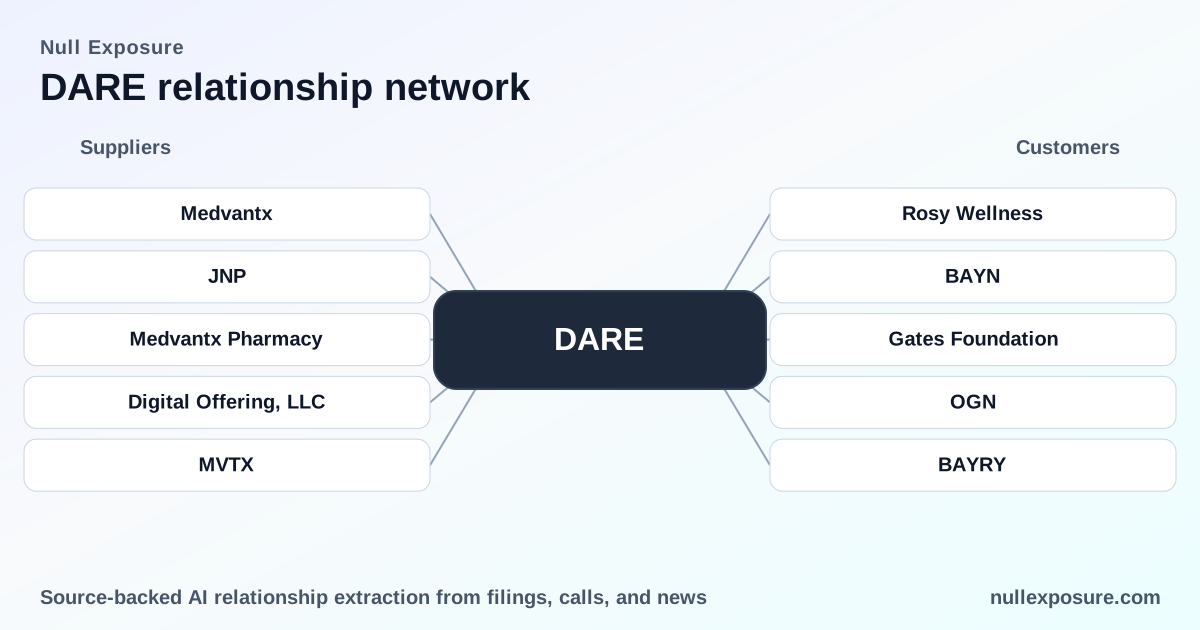
Below I cover every supplier relationship flagged in the public record and summarize what each partner does for DARE.
Medvantx — pharmacy services and logistics partner
Medvantx operates the DARE Health Hub that accepts prescriptions for DARE to PLAY™ and provides pharmacy services and logistics supporting the product’s commercial rollout, including telehealth-enabled prescribing. This operational role is documented in multiple press releases and the company’s Q3 2025 earnings call where management described Medvantx as the pharmacy services and logistics partner. (See GlobeNewswire, December 10, 2025; GlobeNewswire, February 11, 2026; and Daré 2025 Q3 earnings call.)
Medvantx Pharmacy — telehealth and 503B dispensing channel
Daré uses Medvantx Pharmacy to power telehealth services and 503B dispensing for initial state-limited commercialization of topical sildenafil cream, enabling prescriptions through the DARE Health Hub. Public announcements and trade reporting in early 2026 state that telehealth and pharmacy dispensing are powered by Medvantx Pharmacy as part of the DARE to PLAY™ rollout. (See GlobeNewswire, February 11, 2026; SAHM Capital report, February 11, 2026.)
Juniper Pharmaceuticals (JNP) — licensing of intravaginal ring technology
Daré secured an exclusive worldwide license to Juniper Pharmaceuticals’ intravaginal ring technology, including preclinical candidates, under a licensing agreement intended to expand Daré’s platform. That licensing deal was announced publicly in a press release reported by Investing News in connection with the FY2018 disclosure. (See InvestingNews coverage of the Juniper agreement, FY2018.)
Digital Offering, LLC — placement agent for equity/warrant offering
For its FY2026 preferred stock and warrant offering, Daré engaged Digital Offering, LLC as the placement agent on a best-efforts basis; the agent received a 7.25% placement fee and agent warrants as compensation according to regulatory filing coverage. (See Investing.com reporting on the FY2026 offering.)
What these relationships mean operationally and financially
Daré’s commercial thrust for DARE to PLAY™ demonstrates execution through partners rather than internal scaling. The Medvantx relationship is the commercial conduit: prescriptions, telehealth, and logistics come through the DARE Health Hub and Medvantx Pharmacy, which converts clinical approvals into immediate patient access. The Juniper license underscores Daré’s strategy of acquiring or licensing platform technologies to broaden product candidates without heavy internal discovery spending. The Digital Offering placement agent engagement reflects a recurring reliance on capital markets and intermediaries to fund the runway.
- Concentration and cost structure: The company’s filings show a small pool of vendors accounting for substantial R&D spend; that concentration concentrates execution risk but also gives Daré negotiating leverage if those vendors are critical and satisfied.
- Contracting posture: Daré uses licensing and short-term, project-based manufacturing contracts rather than long-term, fixed supply agreements; the company explicitly relies on third parties and typically enters manufacturing agreements on a project basis. This lowers fixed costs but transfers supply risk to partners.
- Criticality: Third parties are operationally critical—Daré depends on partners for manufacturing, pharmacy services, clinical trials and regulatory support—so partner performance directly controls commercialization timing.
- Maturity: Relationships are active and operational (eg, Medvantx is live on prescriptions), but the underlying manufacturing contracts are project-based rather than long-term guaranteed supply, indicating a growth-stage maturity profile rather than integrated manufacturing scale.
If you want ongoing monitoring of how supplier dynamics shift around product launches and capital events, start here: https://nullexposure.com/.
Risk and upside buckets for investors
Upside catalysts: successful state-by-state rollout of DARE to PLAY™ powered by Medvantx could create the first recurring revenue stream, while the Juniper license could generate future platform extensions and royalty streams. Analyst consensus lists an average target price materially higher than current market caps, reflecting upside if commercialization scales.
Key risks: project-based manufacturing contracts and reliance on a small set of vendors create execution and supply continuity risk; any delay or regulatory issue at a third-party manufacturer or pharmacy partner would directly impact revenue timing. The company’s financials show negative operating margins and negligible revenue to date, so capital raises—such as the FY2026 placement—are functionally necessary to fund commercialization and pipeline development.
Final takeaways and investor actions
- DARE’s commercial model is partner-centric: pharmacy, telehealth and manufacturing partners convert clinical assets to near-term revenue.
- Supplier concentration is a double-edged sword: it reduces overhead and accelerates launch but concentrates execution risk.
- Monitor three levers: Medvantx operational performance and geographic rollout, pipeline licensing conversions (e.g., Juniper-derived assets), and capital-market access (placement agents and financing) that fund operations.
For investors tracking supplier exposures and how they affect valuation, use our supplier-monitoring resources to follow updates and filings in real time: https://nullexposure.com/.
For a deeper supplier risk profile and ongoing alerts tied to Daré’s commercialization milestones, visit https://nullexposure.com/ and subscribe for updates.