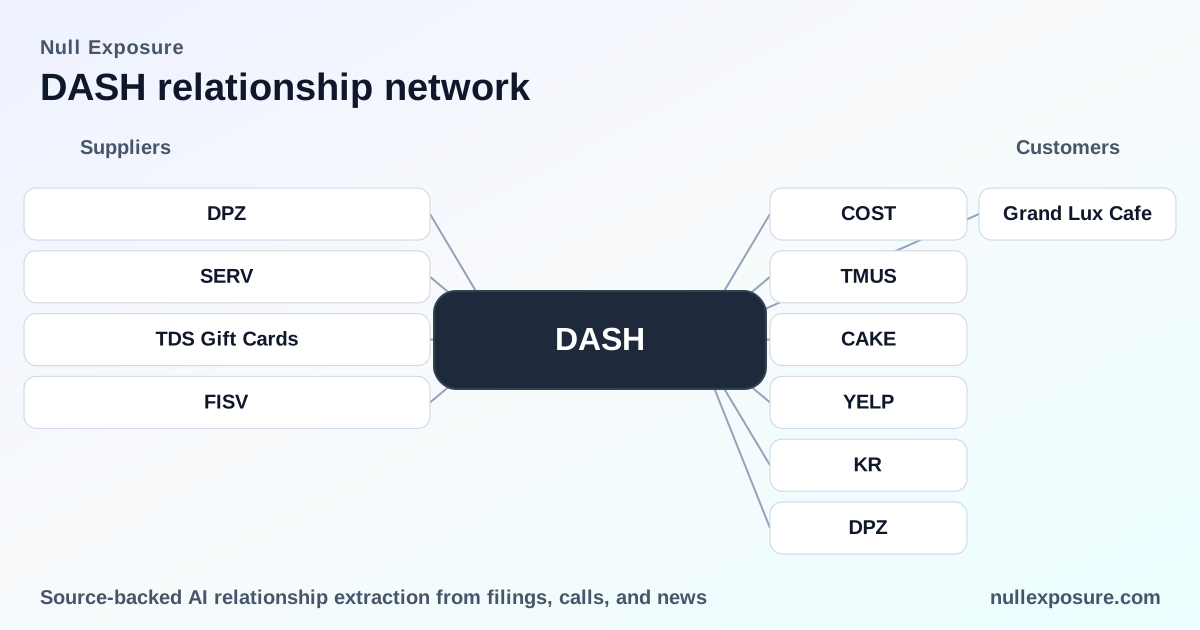
DoorDash (DASH) Supplier Landscape: Strategic partners that move revenue and operations
DoorDash operates a last-mile logistics and marketplace platform that connects consumers, merchants, and Dashers, monetizing through commissions, delivery and service fees, and platform solutions for merchants and consumers. The company’s revenue scale and margin profile are driven by two axes: merchant penetration and delivery density (which improve unit economics) and payments/infra integrations (which reduce friction and expand monetizable services). This note reviews supplier and partner relationships visible in recent reporting and news, highlights operating constraints that shape vendor posture, and draws practical implications for investors and operators evaluating exposure to DoorDash. For an up-to-date supplier intelligence view, visit https://nullexposure.com/.
What the relationship list tells investors: concentrated utility, strategic breadth
DoorDash’s supplier relationships in the recent signal set show a mix of merchant partnerships (revenue drivers), logistics automation partners (capacity and cost drivers), and payments/fintech providers (operational and monetization enablers). Each relationship contributes differently to growth, margin, and operational risk: merchant rollouts expand gross bookings; robotics partnerships increase asset efficiency; payments partners reduce settlement friction and enable additional revenue streams.
- Concentration and criticality: merchant deals with national chains can meaningfully shift order volume in specific categories; payment and hosting vendors underpin core platform availability and settlement.
- Contracting posture and maturity: evidence points to reliance on established service providers for payments and cloud hosting—a standard enterprise posture that prioritizes uptime and scale over DIY infrastructure.
- Operational leverage: robotics and payments integrations indicate a push to squeeze unit costs and expand monetizable services beyond pure delivery fees.
If you want a consolidated supplier risk profile and relationship map, explore our coverage at https://nullexposure.com/.
Supplier relationships: Domino’s, Serve Robotics, TDS Gift Cards, and Fiserv — what each means
Below are the relationships surfaced in recent public materials; each entry includes a plain-English summary and the source that reported it.
-
Domino’s Pizza Inc.: Domino’s reports that it expects continued growth on aggregator platforms and that its DoorDash rollout completed only in mid‑2025, implying incremental volume gains through 2026 as deployment matures. This positions DoorDash as an important merchant channel for large QSR players. (Domino’s Q4 FY2025 earnings call transcript via Benzinga, Mar 2026)
-
Serve Robotics: Serve’s robotic delivery units are powering deliveries for major restaurant partners through platforms including DoorDash, expanding autonomous delivery coverage and enabling multi‑platform asset utilization that improves delivery density. That partnership broadens DoorDash’s access to robotics-enabled cost reduction opportunities. (Serve Robotics press release via GlobeNewswire, Mar 2026; additional market commentary via TradingView/Zacks, Mar 2026)
-
TDS Gift Cards: TDS Gift Cards has signed deals servicing blue‑chip customers including DoorDash, indicating DoorDash’s inclusion in third‑party gift‑card and payment distribution networks that can increase transactional volume and prepayment flows. This supports non‑traditional revenue capture such as gift card breakage and embedded payments. (TDS partnership mention in earnings coverage via InsiderMonkey, Mar 2026)
-
Fiserv, Inc.: Fiserv closed deals that include DoorDash, signaling direct engagement with enterprise payments infrastructure providers for settlement, cash management, or other payment rails that are core to merchant and consumer flows. Strong fintech tie‑ins accelerate settlement velocity and productization of payments revenue. (MarketScreener coverage of Fiserv deal activity, Mar 2026)
Why these relationships matter for valuation and operations
Each supplier relationship maps to different value drivers:
- Merchant rollouts (Domino’s) increase gross order volume and can accelerate take-rate expansion if DoorDash captures order share; national chain rollouts translate into predictable, high-frequency orders that improve utilization and delivery density.
- Robotics partners (Serve Robotics) reduce variable delivery costs and create optionality around capital-light automation; expanding autonomous routes improves per-order contribution margin over time.
- Payments partners (Fiserv, TDS Gift Cards) shorten cash cycles, lower payment failures, and create avenues for adjacent revenue (merchant solutions, financing, gift-card services). Payments integrations also raise operational criticality because outages or disputes directly affect settlement flows.
- Service provider posture: evidence shows DoorDash relies on third‑party payment processors (Stripe, PayPal) and cloud hosting (AWS) for core operations, which is a typical enterprise outsourcing model that trades vendor concentration for scale and uptime. This is a company-level operational signal that underscores counterparty and concentration risk in payment and hosting vendors.
Operational constraints and what they imply for supplier risk
Available constraint excerpts give clear signals about DoorDash’s operating model:
- DoorDash relies on third‑party payment processors (explicit mentions of Stripe and PayPal) to process merchant and consumer payments, indicating payment processing is a critical outsourced function with vendor concentration and importance to cash flow and merchant trust.
- DoorDash hosts on AWS in a limited number of locations, which reflects a standard cloud-centric architecture but introduces regional and vendor concentration risk for platform availability and latency-sensitive services.
Presenting these as company-level signals: outsourced payments and cloud hosting increase operational dependency on a small set of service providers, which elevates counterparty risk in the event of outages, contract disputes, or price changes. Investors should treat payments and hosting relationships as strategically critical and monitor vendor SLAs and diversification efforts.
Tactical implications for investors and operators
- Investors: Value upside comes from higher merchant penetration and delivery density; monitor national chain rollouts (like Domino’s) and robotics deployments for margin inflection signals. Payments and hosting vendor concentration is a non-trivial risk to operational continuity and settlement; track contract disclosures and outages.
- Operators and partners: Prioritize integrations that improve settlement speed and reduce payment failure rates; robotics pilots should be optimized for routes where density supports autonomous vehicle economics.
For a consolidated view of supplier exposures and how they influence cash flow and operational risk, visit https://nullexposure.com/ for our supplier intelligence offerings.
Conclusion — what to watch next
DoorDash’s supplier footprint revealed through recent coverage is strategically balanced: merchant partnerships drive top-line growth, robotics can compress delivery cost, and payments/infra providers underpin reliability and settlement. Key risk vectors are vendor concentration in payments and cloud hosting and the execution risk of scaling robotics and large merchant rollouts. Track public merchant rollout disclosures (same-store volume and penetration), updates from Serve Robotics on production routes, and payment partner contract news for the next signs of revenue or margin inflection.
If you evaluate supplier counterparty risk or want a vendor-mapped risk scorecard tailored to DoorDash, our research tools at https://nullexposure.com/ provide the structured intelligence you need.