Day One Biopharmaceuticals (DAWN): supplier and advisor relationships that shape commercial scale-up
Day One Biopharmaceuticals develops targeted therapies for genetically defined cancers and monetizes through product sales, licensing, and strategic M&A to expand a commercial and clinical pipeline. The company commercialized OJEMDA in 2024 and has moved from pure development-stage economics to a hybrid model where manufacturing commitments, advisor fees, and acquisition-related counterparties materially influence near-term cash flow and operational risk.
Explore supplier risk intelligence and advisor tracking at https://nullexposure.com/ to monitor counterparties and contractual obligations.
Why suppliers and advisors matter for a commercializing biotech
Day One’s transition to a commercial company changes the economics of supplier relationships. Long-term leases and contracted manufacturing purchase obligations convert operational dependencies into predictable fixed costs, while acquisitions add integration, tender, and contingent-value-rights complexities that alter counterparty exposure. The firm reports reliance on a small set of third-party service providers — contract research organizations (CROs), contract manufacturing organizations (CMOs), and other vendors — which means supplier disruption scales straight to clinical and commercial risk.
Key signals from company disclosures and news coverage:
- Long-term contracting posture: Day One disclosed a ~7.4-year Brisbane office lease and material multi-year minimum purchase obligations under a manufacturing and supply agreement, which commit the company to cash outflows irrespective of demand.
- Geographic footprint: Manufacturing relationships include partners in North America and contract manufacturers in China, introducing mixed regional concentration and supply-chain complexity.
- Concentration and criticality: The company acknowledges a limited set of suppliers and sole-source dependencies for certain materials, making some vendors critical to both trials and commercial supply.
- Spend scale: The firm quantifies multi-year minimum purchase obligations (approximately $14.1 million remaining over five years as of Dec 31, 2024) and material CRO/CMO cost lines that sit in the mid‑single to double-digit millions range annually.
These signals position Day One as contractually committed, operationally concentrated, and commercially sensitive to supplier performance — characteristics investors should treat as second‑order drivers of valuation as revenue scales.
Who Day One is working with (the roll-call)
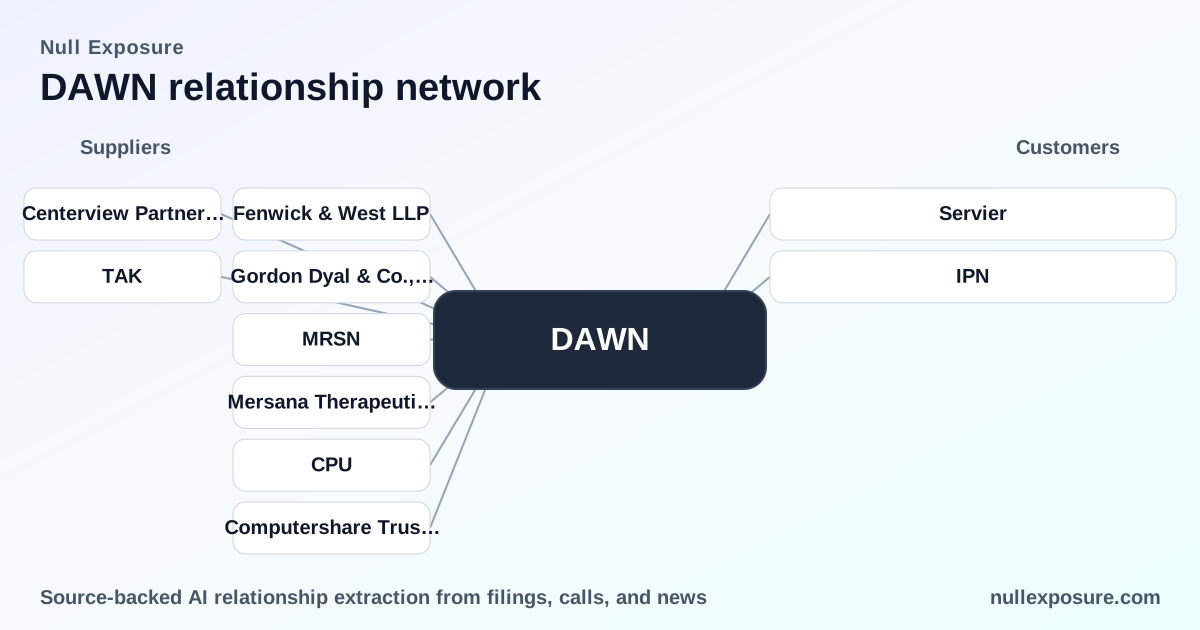
Below are every supplier, advisor, and counterparty identified in the available results, each summarized in plain English with source references.
- Fenwick & West LLP — Served as legal counsel to Day One during the company’s acquisition activity and advisor engagements. According to a GlobeNewswire press release on Jan 6, 2026, Fenwick & West LLP provided legal counsel in connection with the Mersana acquisition and related transactions.
- Gordon Dyal & Co., LLC — Acted as exclusive financial advisor to Day One on the Mersana acquisition. GlobeNewswire reported on Jan 6, 2026 that Gordon Dyal & Co. served as the exclusive financial advisor in that transaction.
- Mersana Therapeutics (MRSN) — Acquired by Day One in January 2026; the deal folded Mersana’s ADC program (Emi‑Le) into Day One’s pipeline and was described as part of Day One’s strategy to broaden rare‑oncology assets. Day One’s Q4 2025 earnings call and a GlobeNewswire release in early 2026 confirm the close and integration of the EMILY/Emi‑Le program.
- Computershare (CPU) — Named as the rights agent to administer contingent value rights (CVRs) tied to Day One’s transaction structures. A TradingView news item cited Computershare acting as the rights agent in the CVR agreement announced in 2026.
- Computershare Trust Company, N.A. — Served as the depositary for Day One’s tender offer in the Mersana transaction, reporting tender statistics used to satisfy offer conditions; GlobeNewswire’s Jan 6, 2026 press release provides the tender figures and depositary role.
- Centerview Partners LLC — Identified as the exclusive financial advisor to Day One in a separate Servier transaction announcement; GlobeNewswire’s March 6, 2026 press release lists Centerview in that advisory capacity alongside Fenwick & West LLP as counsel.
- Takeda — The originator of the program that became OJEMDA; trade coverage notes Day One was built around a program acquired from Takeda that developed into their commercial asset. BioSpace coverage of Day One’s strategic evolution references Takeda as the original source of that program.
What the relationships imply for investors
The advisor and supplier mix signals a company executing a buy-and-integrate growth strategy while simultaneously managing the fixed-cost profile of commercialization. Several investment implications follow:
- Operational leverage to suppliers: Contracted manufacturing minimums and sole‑source suppliers create downside exposure if production or testing partners underperform. The publicly disclosed $14.1 million of remaining purchase obligations over five years is a concrete example of committed spend that persists regardless of revenue cadence.
- Transaction complexity and integration risk: Multiple financial advisors (Gordon Dyal, Centerview) and legal counsel (Fenwick & West) indicate material transaction volume — acquisitions and tender offers — which bring integration costs and contingent obligations that investors must model explicitly.
- Administrative and securities mechanics matter: Use of Computershare as both rights agent and depositary reflects active CVR and tender mechanics; these instruments can produce contingent cash flows and administrative risk to shareholders during post‑deal periods.
For ongoing counterparty monitoring and supplier exposure scoring, visit https://nullexposure.com/ to see how these relationships translate into quantified concentration and criticality metrics.
Bottom line: balance pipeline expansion with supplier concentration
Day One has moved into a phase where advisor fees, manufacturing commitments, and acquisition counterparties are first‑order considerations for operational resilience and cash-flow management. The company’s commercial launch of OJEMDA, the purchase of Mersana and its ADC program, and the contractual commitments described in filings collectively increase both revenue opportunity and supplier-dependent risk.
If your thesis values pipeline expansion and strategic tuck‑ins, Day One’s recent activity supports upside; if your model discounts supplier disruption or integration shortfalls heavily, the same facts elevate downside risk. Track legal counsel, financial advisor and depositary roles alongside Q‑level disclosure of minimum purchase obligations to stay aligned with evolving counterparty exposure.
Continue monitoring counterparties and contract commitments at https://nullexposure.com/ to convert these relationship signals into actionable exposure analysis.