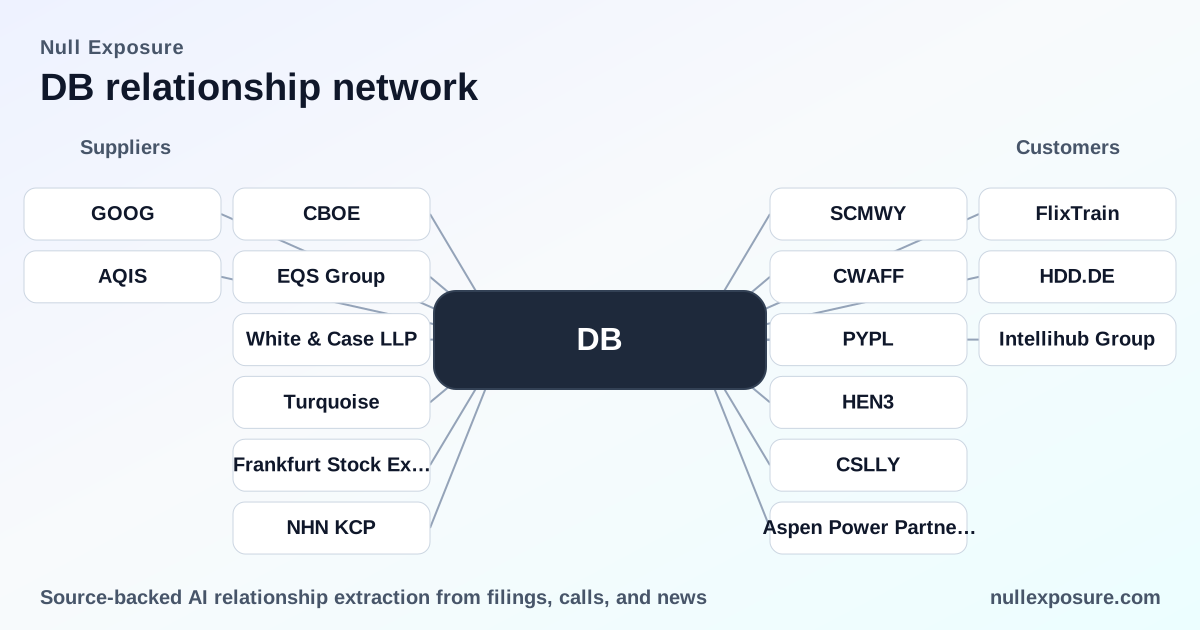
Deutsche Bank (DB) — supplier footprint and counterparty map investors need to know
Deutsche Bank is a global commercial and investment bank that monetizes through interest income, transaction and advisory fees, trading and prime brokerage services, and custody/asset-servicing products; its large institutional client base and market-making operations produce recurring fee and spread income while strategic partnerships extend payments and technology reach. Investors assessing supplier risk should treat DB as both a customer-facing platform and a procurement hub that contracts with market venues, law firms, cloud and systems integrators, and payments gateways—each relationship shapes counterparty concentration, operational resilience, and regulatory exposure.
If you want a concise supplier risk briefing and relationship tracking for portfolio positions, see our coverage at https://nullexposure.com/.
What the relationship list reveals about Deutsche Bank’s operating posture
Deutsche Bank’s supplier and partner mentions in public filings and press indicate four structural characteristics of its operating model:
- Flexible contracting posture: the bank uses brokers and multiple trading venues for buybacks and liquidity needs, and taps external law firms and payment gateway vendors for jurisdictional work.
- Wide supplier mix with concentrated counterparties: large market infrastructure providers and a handful of strategic technology partners dominate operational risk vectors.
- Operational criticality and scale: market-making, custody, and payment services tie DB into exchanges and cloud vendors whose outages would have immediate revenue and reputational impact.
- Mature vendor relationships: recurring press and regulatory notices show repeated use of the same services (news distribution, exchange venues, legal advisors), indicating established supplier maturity.
Read more supplier intelligence and counterparty summaries at https://nullexposure.com/.
Relationship roll call — what each mention means for investors
Below I summarize every relationship captured in the supplier-scope results and cite the underlying source for each claim.
SBET
SBET’s 2025 Q3 earnings call cited “banks like JPMorgan and Deutsche Bank” as participants building on Ethereum, signaling DB’s visibility in blockchain/crypto infrastructure conversations. Source: SBET 2025 Q3 earnings call (transcript, March 2026).
GOLD
GOLD’s FY2025 10‑K references Deutsche Bank in customer-related tagging (DeutscheBankAGCustomerMember) and notes items tied to secured loans and customer concentration risk, which indicates DB is named as a material counterparty in GOLD’s filings. Source: GOLD FY2025 10‑K (filed June 30, 2025).
White & Case LLP
White & Case announced it advised Deutsche Bank Luxembourg S.A. on a reorganisation, confirming the bank’s use of major international law firms for cross-border structural work. Source: White & Case press release (March 2026).
Equity Lifestyle Properties (ELS)
Deutsche Bank’s equities research upgraded Equity Lifestyle Properties from “hold” to “buy,” demonstrating DB’s active equity research coverage and sell-side advisory footprint. Source: MarketBeat summarizing Deutsche Bank research (report released April 2026).
Cboe (CBOE / CEUX)
Deutsche Bank’s capital markets notices list Cboe (CEUX) as a potential venue for share repurchases, showing DB’s use of multiple multilateral trading systems to execute buybacks. Source: Deutsche Bank capital market information transmitted via TradingView (March–May 2026).
EQS Group
EQS Group is used to disseminate Deutsche Bank’s regulatory and capital-market announcements, indicating reliance on third‑party disclosure platforms for compliance communications. Source: TradingView posts relaying EQS News transmissions (March–May 2026).
TRMD / Xtrackers ETFs (Deutsche Bank Passive products)
References to Xtrackers MSCI Europe Small Cap and other Xtrackers listings show Deutsche Bank’s ETF operations via its passive product suite, confirming asset‑management and index-product distribution as supplier-facing functions. Source: TradingView ETF pages (May 2026).
EPAM
EPAM’s Google Cloud partner award coverage cites a collaboration with Deutsche Bank on enterprise database migration and cloud adoption, highlighting DB’s outsourcing of large-scale data and cloud projects to systems integrators. Source: MyChesco news report on EPAM (May 2026).
Google (GOOG) / Gemini
Fortune reported on a Deutsche Bank experiment that used Google’s Gemini 2.5 Pro model to analyze sector outcomes, demonstrating DB’s engagement with Google AI products for research and modeling. Source: Fortune feature “What AI Says About AI Eating Itself and the World” (February 2026).
NHN KCP
Deutsche Bank announced a partnership with NHN KCP to deliver advanced payment solutions to Henkel Korea, confirming DB’s use of local payments gateway providers to scale regional payments capability. Source: Deutsche Bank press release (January 20, 2026).
Frankfurt Stock Exchange (Xetra)
Deutsche Bank’s public capital markets disclosures identify Xetra as the primary trading platform for its share repurchase activity, underscoring reliance on core national market infrastructure in Germany. Source: Deutsche Bank capital market information via TradingView (March–May 2026).
Turquoise (TQEX)
Turquoise is included among the multilateral trading systems that Deutsche Bank may use for repurchases, reinforcing a diversified execution footprint across European venues. Source: Deutsche Bank capital market information via TradingView (March–May 2026).
Aquis (AQEU / AQIS)
Aquis is listed as an alternative execution venue for DB buybacks, part of the bank’s multi‑venue execution strategy. Source: Deutsche Bank capital market information via TradingView (March–May 2026).
BNS (Bank of Nova Scotia)
TradingView ETF summaries that list Xtrackers holdings show BNS within ETFs managed under Deutsche Bank’s passive program, indicating DB’s ETF products carry exposures to Canadian banking equities. Source: TradingView ETF holdings pages (May 2026).
FLNT
Fluent’s 2025 Q3 earnings call referenced partnerships with Databricks and other industry partners; the excerpt in the results does not establish a direct supplier relationship between Fluent and Deutsche Bank based on that snippet. Source: FLNT 2025 Q3 earnings call (transcript, 2025).
BlackRock
Deutsche Bank’s Q1 2026 results announce an automated, scalable FX solution for clients through a HausFX partnership with BlackRock, showing DB’s collaboration with asset managers to build client-facing trading infrastructure. Source: Deutsche Bank Q1 2026 results (press release April 29, 2026).
Operational risk signals investors should price in
- Counterparty concentration: institutional ownership of DB stock is high (roughly 50.6% institutional), and the bank arranges business with a limited set of market infrastructures and global law firms; the supplier list therefore concentrates operational counterparty risk among a few critical vendors.
- Execution and liquidity dependencies: DB’s reliance on multiple trading venues and brokers for buybacks and market-making gives execution flexibility but creates exposure to venue outages and regulatory changes across jurisdictions.
- Technology and cloud outsourcing: projects with EPAM and experiments using Google AI underline increasing dependency on external cloud and AI providers for data-heavy workflows; operational resilience and contractual SLAs are material.
- Regulatory-comms maturity: repeated EQS Group use for disclosures indicates mature compliance distribution channels, reducing disclosure-related operational risk.
Bottom line — what investors need to act on
- Deutsche Bank runs a hybrid model that leans on a small set of high‑criticality suppliers (exchanges, cloud vendors, law firms, payment gateways). These relationships are operationally material and frequently visible in public filings and press.
- Monitor buyback notices and capital-market releases for changes in venue usage (Xetra/Cboe/Turquoise/Aquis) and watch technology partner announcements (Google, EPAM, BlackRock) for shifts in outsourcing that could change cost structure or operational risk.
For ongoing, structured supplier intelligence on banks and other major counterparties, visit our research hub at https://nullexposure.com/ — we track vendor footprints and regulatory disclosures that matter to investors.