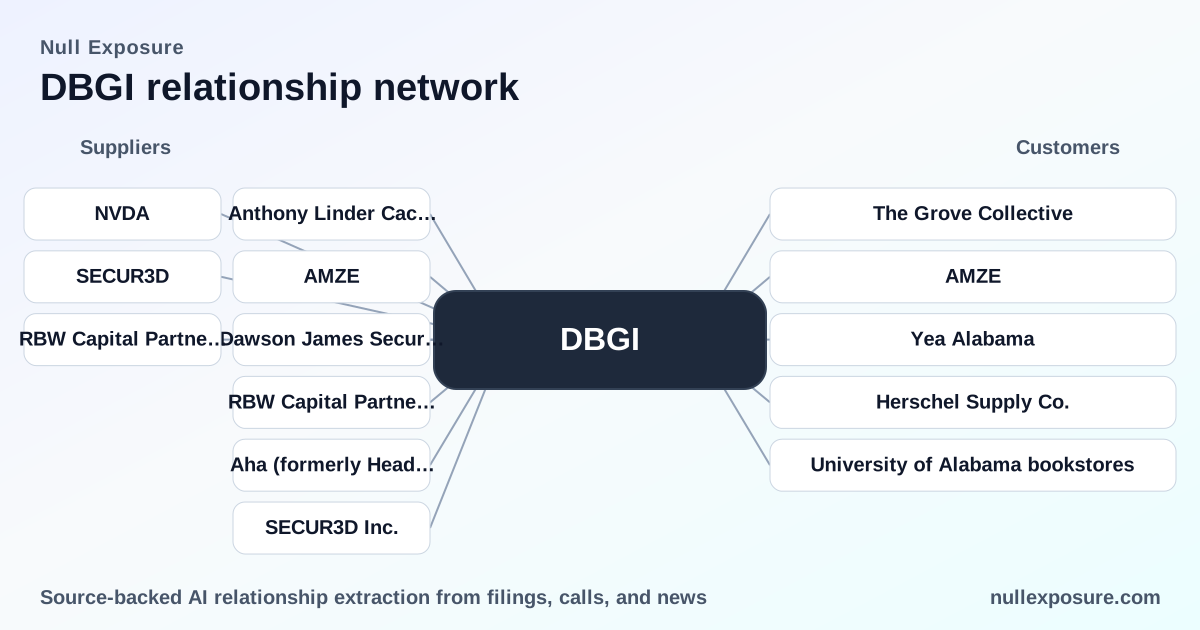
DBGI supplier relationships: a practical investor brief
Digital Brands Group, Inc. (NASDAQ: DBGI) operates as a digital-first apparel consolidator that monetizes by acquiring consumer apparel brands, driving direct‑to‑consumer and wholesale sales, and layering centralized services (marketing, brand protection, and technology) to compress costs and accelerate growth across portfolio brands. Revenue derives from product sales and margin capture through centralized vendor agreements and technology partnerships that lower per‑brand operating expense. For a quick second opinion or to benchmark supplier risk across peers, visit https://nullexposure.com/.
The supplier map in plain language
DBGI runs a hybrid operating model: it outsources manufacturing and a large portion of services to third parties, while contracting certain vendors for multi‑year services where scale and continuity matter. That posture produces mixed contracting patterns — both long‑term vendor engagements and short, month‑to‑month leases — and geographic manufacturing exposure split across North America, EMEA and APAC. The company’s supplier spend includes discrete engagements in the $1–10 million band, indicating material single‑vendor commitments that are large enough to influence near‑term cash flow. For deeper supplier analytics and verification, see https://nullexposure.com/.
Relationship-by-relationship breakdown (what investors need to know)
Below are all supplier/partner relationships captured in public reporting and news from FY2025–FY2026, summarized in plain English with source context.
Anthony Linder Cacomanolis PLLC
DBGI engaged Anthony Linder Cacomanolis PLLC to provide legal counsel in support of a secondary public offering, indicating use of external counsel for capital markets transactions. This engagement was reported during coverage of the company’s offering activity in March 2026 (SGB Online, March 2026).
Amaze Holdings, Inc. (AMZE)
DBGI became the first third‑party brand on Amaze’s Teespring Marketplace, expanding a domestic manufacturing and distribution channel to support on‑demand apparel sales. GlobeNewswire announced the partnership in September 2025 as part of DBGI’s efforts to strengthen U.S. apparel manufacturing ties (GlobeNewswire, Sept 2025).
Dawson James Securities, Inc.
Dawson James Securities, Inc. acted as the exclusive placement agent through RBW Capital Partners for DBGI’s secondary offering, reflecting the company’s reliance on boutique placement firms for capital raises. This role was disclosed in SGB Online coverage of the offering (SGB Online, March 2026).
RBW Capital Partners LLC
RBW Capital Partners LLC repeatedly served as a placement agent for DBGI financing, including PIPE and secondary offering transactions and an amended Series D PIPE placement that increased investment by $1.5 million. Multiple press notices and news summaries cited RBW’s placement role in FY2025 (GlobeNewswire, Sept 2025; Quiver Quant, Sept 2025; SGB Online, March 2026).
Aha (formerly HeadAI)
DBGI partnered with Aha to scale influencer marketing using AI‑driven creator networks, aligning brand growth with algorithmic audience targeting across campaigns. Aha’s platform integration was announced in December 2025 and summarized in news coverage, highlighting a marketing‑technology partnership for influencer activation (Yahoo Finance/GlobeNewswire, Dec 2025).
SECUR3D Inc. (SECUR3D)
SECUR3D was integrated as an early provider in DBGI’s AI‑powered brand protection ecosystem, supplying IP protection and counterfeit detection capabilities across digital marketplaces. GlobeNewswire detailed SECUR3D’s role in DBGI’s brand‑protection initiative in December 2025 (GlobeNewswire, Dec 2025).
NVIDIA (NVDA)
DBGI’s acceptance into NVIDIA’s Connect Program via its Technology Arm grants access to NVIDIA’s AI/ML resources and engineering ecosystem, strengthening DBGI’s technical stack for AI initiatives across brands. GlobeNewswire reported this milestone in September 2025 as a strategic technology collaboration (GlobeNewswire, Sept 2025).
What the constraints tell investors about DBGI’s operating model
Public disclosures and press releases reveal a supplier posture with specific characteristics that affect operational risk and scalability:
- Contracting posture: DBGI uses a mix of long‑term vendor agreements and short‑term arrangements. The company disclosed a vendor engagement with a five‑year term for comprehensive services (content, social, influencers), while simultaneously maintaining month‑to‑month leases and stating it does not have long‑term manufacturing contracts. This implies a deliberate balance between committed service relationships and flexible manufacturing arrangements to manage working capital and brand agility.
- Concentration and spend: DBGI reports single contract payments and merchant advances in the $1–10 million band (including a $3.0M vendor fee and principal merchant advance of ~$1.86M), indicating material, concentrated spend that can influence cash runway and negotiating leverage.
- Geographic manufacturing footprint: The company relies on third‑party manufacturers primarily in North America, Europe and the Asia‑Pacific region, while some brands (e.g., Stateside) emphasize U.S. manufacturing. Geographic diversification reduces single‑country production risk but introduces multi‑jurisdictional supply chain complexity.
- Relationship roles and criticality: DBGI’s partners span legal counsel, placement agents, marketing and AI providers, and brand‑protection vendors — a mix of service providers and technology partners that are operationally important but often replaceable. The absence of long‑term manufacturing contracts signals that product continuity depends on the ability to re‑source production rather than on captive capacity.
- Maturity and stage: The vendor base shows both mature, long‑standing supplier relationships and active, recently executed engagements (e.g., vendor agreement and placement agent roles in FY2025–FY2026), reflecting a company scaling through acquisitions while building centralized service contracts.
Risk vs. opportunity — concise takeaways
- Opportunity: Strategic technology and AI partnerships (NVIDIA, Aha, SECUR3D) are high‑value enablers that can improve marketing ROI and brand protection across the portfolio, increasing gross margin leverage if implemented effectively.
- Risk: Concentrated vendor spend in the $1–10M band and reliance on non‑owned manufacturing create cash‑flow and supply continuity exposure in periods of stress; month‑to‑month real estate leases increase operational flexibility but expose the company to rent volatility.
- Capital markets support: Use of boutique placement agents (RBW, Dawson James) and external counsel for offerings is consistent with a small‑cap company actively accessing capital; monitoring dilution from ongoing financings is critical.
If you need a prioritized supplier risk dashboard or benchmarking vs. peers, explore tailored research options at https://nullexposure.com/.
Bottom line for investors
DBGI’s supplier network blends strategic, multi‑year service contracts with flexible manufacturing sourcing, enabling rapid brand rollups while centralizing key capabilities in marketing and IP protection. That model produces meaningful upside from technology partnerships but also concentrated cash commitments and supply‑chain complexity that require active management. For a deeper supplier‑risk assessment and continuous monitoring of these relationships, start with https://nullexposure.com/.