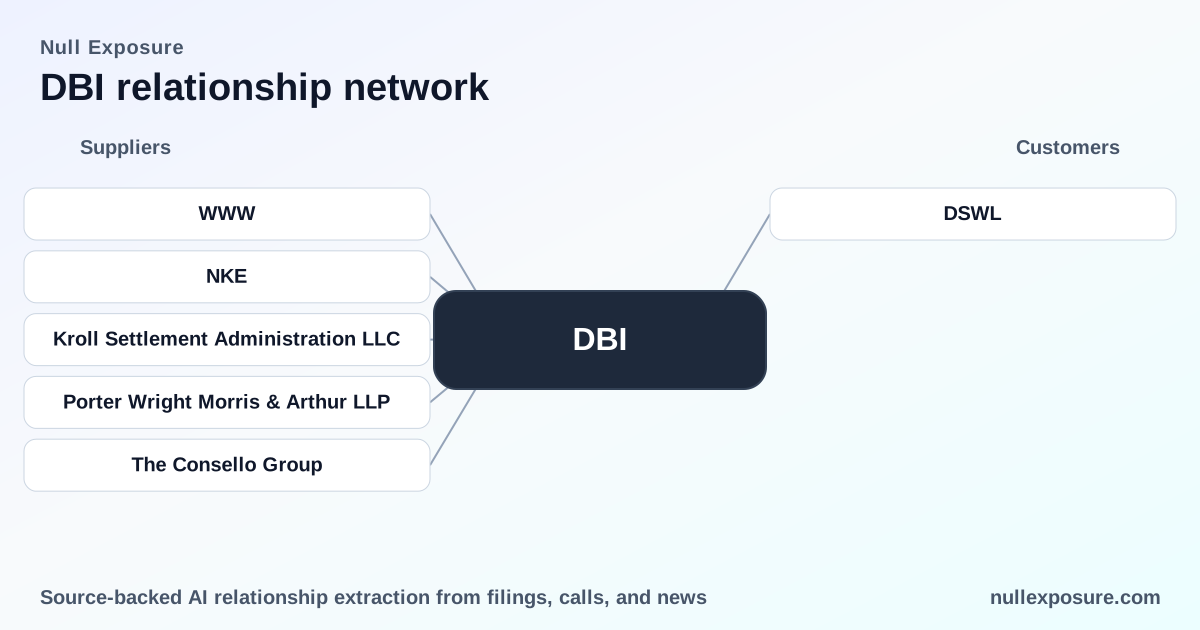
Designer Brands (DBI) — Supplier relationships that shape margins and inventory risk
Designer Brands monetizes by designing, sourcing and retailing footwear and accessories across North America, capturing margin through owned brands and national-brand assortments sold in DSW and other retail channels. Profitability depends on low-cost sourcing, control of owned brands, and scale in retail distribution; supplier arrangements and lease commitments are central levers for cash flow and margin management. Explore coverage and relationship mapping at https://nullexposure.com/.
The one-paragraph investment thesis every operator should start with
Designer Brands runs a hybrid model: it is a retailer that also develops owned brands and outsources manufacturing to third-party factories primarily in APAC; the company captures gross margin by converting large, imported merchandise flows into retail sales while carrying long-dated lease obligations for stores and distribution. Key drivers for investors are sourcing cost control, brand mix (owned vs. national), and the balance sheet impact of operating leases.
How the company sources and where concentration and risk live
Designer Brands’ Brand Portfolio does not own factories; the company relies heavily on third-party manufacturers and a China-based sourcing office. According to company reporting, 77% of Brand Portfolio units were sourced from China in 2024, underlining a concentrated APAC supply footprint and exposure to regional disruptions and freight/landed-cost volatility. The company also disclosed long-term lease commitments in a filing as of February 1, 2025, showing substantial operating lease liabilities (total operating lease liabilities reported at $795,000), which indicates a committed fixed-cost base tied to store and logistics capacity. Finally, Designer Brands notes that three national brand suppliers supplied roughly 25% of retail merchandise in 2024, a meaningful but not single-vendor concentration (no individual supplier exceeded 10%). These are company-level signals that shape contracting posture, supplier criticality, and concentration risk for investors.
Supplier and advisor relationships you should know (each one covered)
Below are every relationship surfaced in the available results, described in plain English with source context.
Wolverine Worldwide — sourcing transition reduced landed cost
Designer Brands transitioned certain production previously done by Wolverine Worldwide into Designer Brands’ own production in Q1, which drove a reduction in landed costs as the company internalized more manufacturing control. This was reported in an SGB Online article on Designer Brands’ Q1 performance (FY2025). Source: SGB Online coverage of DBI Q1 (FY2025).
Nike — national brand contribution to Canadian comps
In Canada, Designer Brands reported a comp sales uptick partly driven by strong performance in athletic and kids categories and reintroduction of Nike women’s casual, indicating that national-brand assortments (Nike) contribute meaningfully to regional category strength. Source: SGB Online recap of DBI Q4 results (FY2025).
Kroll Settlement Administration LLC — settlement administrator for class action
Kroll was named as the settlement administrator for a TCPA-related settlement involving Designer Brands, signaling a completed legal-administrative engagement for claims processing rather than an ongoing commercial supply role. Source: ClaimDepot settlement notice (FY2025).
Porter Wright Morris & Arthur LLP — legal advisor on Topo Athletic acquisition
Porter Wright served as Designer Brands’ legal advisor on the Topo Athletic acquisition, reflecting outside counsel involvement in M&A activity that supports the company’s owned-brand expansion strategy. Source: PR Newswire release announcing the Topo Athletic acquisition (2022).
The Consello Group — financial advisor on Topo Athletic deal
The Consello Group acted as financial advisor to Designer Brands for the Topo Athletic acquisition, indicating active use of external M&A advisory resources to accelerate owned-brand presence in a leading shoe-sales category. Source: PR Newswire release announcing the Topo Athletic acquisition (2022).
What these relationships and constraints tell investors about the operating model
Designer Brands’ supplier posture and advisory engagements reveal a coherent operating model with four investor-relevant characteristics:
- Contracting posture — long-term fixed commitments. The company reports material operating lease liabilities (as of February 1, 2025), which embed fixed costs into the P&L and reduce operational flexibility if retail demand weakens.
- Geographic concentration — APAC sourcing dominance creates cost leverage and geopolitical exposure. With 77% of Brand Portfolio units sourced from China in 2024, procurement advantages come with inventory and freight risk during regional disruptions.
- Concentration and criticality — notable but diversified supplier mix. Three national brand suppliers accounted for ~25% of retail merchandise in 2024, so national-brand sourcing matters materially but is not single-vendor-critical (no supplier >10%).
- Maturity and capability — reliance on third-party manufacturing plus in-house sourcing function. The Brand Portfolio’s use of third-party factories combined with a China sourcing office signals a mature, outsourced manufacturing model that scales cost-effectively but requires strong vendor management.
Investors should treat these features as linked: APAC sourcing concentration amplifies the impact of landed-cost improvements (or shocks), while long-term leases lock operating leverage that can magnify margin movements.
Explore more supplier mappings and relationship detail at https://nullexposure.com/.
Risk and opportunity vectors to watch
- Cost advantage vs. supply disruption: Heavy China sourcing delivers cost leverage when logistics are stable; a disruption would compress gross margins quickly.
- Lease-induced operating leverage: Long-term operating leases support store coverage and omnichannel fulfillment but raise fixed-cost risk during demand softness. Company lease disclosures as of Feb 1, 2025 reveal sizable multi-year commitments.
- Brand mix execution: Growth of owned brands (Topo Athletic acquisition advisory involvement underscores that strategy) reduces reliance on national brands but increases product-development and marketing execution risk.
Practical next steps for investors and operators
- For investors: stress-test scenarios for landed-cost inflation and store fixed-cost absorption given the lease schedule and APAC sourcing concentration.
- For procurement leaders: prioritize dual-sourcing in APAC and accelerate landed-cost analytics to protect gross margin.
- For corporate development: monitor owned-brand rollouts (Topo Athletic follow-through) to evaluate progress in reducing national-brand exposure.
Final takeaway: Designer Brands runs a leverage-sensitive retail model where sourcing strategy and lease structure jointly determine margin resilience. Map supplier exposure to lease-adjusted break-even, and track owned-brand cadence as a moderator of national-brand dependence.
Learn more about supplier risk and corporate supply-chain intelligence at https://nullexposure.com/.