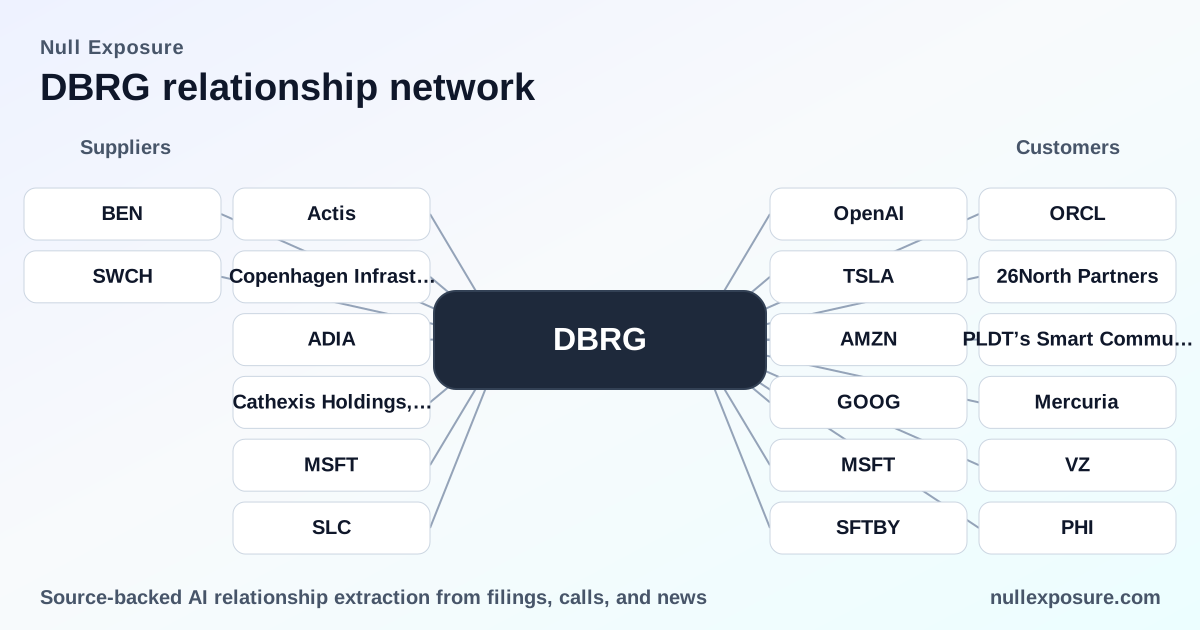
DigitalBridge (DBRG) — supplier map and what it means for investors
DigitalBridge operates as a globally focused digital infrastructure investment manager that builds and scales data centers, fiber and related platforms by forming capital partnerships and taking operating stakes; it monetizes through management fees, carried interest on successful exits and equity appreciation in controlled operating companies. The firm's strategy is to co-invest with long‑term institutional partners and scale platform businesses where DigitalBridge contributes capital and operating expertise, capturing both fee income and private‑market upside. For readers evaluating supplier relationships, this is a direct lens into how DigitalBridge converts partner access and operating scale into recurring cash flow and capital gains. Learn more about the platform at https://nullexposure.com/.
How partnerships translate into cash and control
DigitalBridge’s model is integration‑centric: the company sources large institutional capital (sovereign wealth, pensions, asset managers), aggregates assets into platform companies (data centers, fiber, hyperscale services), and then scales operations either through joint control or strategic acquisitions. Partnerships underpin both the capital base and the go‑to‑market access that drive asset-level revenue and valuation uplift—so supplier and investor relationships are critical operational levers, not peripheral announcements.
Below I walk through every supplier / partner cited in recent disclosures and public reporting and explain what each relationship signals for revenue, operations and concentration risk.
Strategic and operating relationships disclosed in recent public materials
Actis
DigitalBridge referenced working with Actis framed alongside General Atlantic’s sustainability expertise, indicating a co-investor relationship that brings renewable or sustainable infrastructure capabilities into DigitalBridge‑led platforms. According to DBRG’s Q3 2025 earnings call, Actis is a partnering investor that complements DigitalBridge’s capital with sustainability-focused infrastructure experience (DBRG Q3 2025 earnings call, March 2026). Takeaway: Actis provides greenfield infrastructure credibility that supports project-level execution and ESG positioning.
Copenhagen Infrastructure Partners
DBRG noted a partnership with Copenhagen Infrastructure Partners, described as the world’s largest dedicated greenfield energy fund manager—implying collaboration on energy supply or green energy sourcing for digital infrastructure assets. This was described on the Q3 2025 earnings call, positioning the firm as a strategic energy partner for scaling clean power at asset level (DBRG Q3 2025 earnings call, March 2026). Takeaway: Access to CIP’s greenfield expertise reduces energy sourcing risk for high-power assets like data centers.
ADIA (Abu Dhabi Investment Authority)
DigitalBridge announced that ADIA, together with GIC, is investing $1.6 billion to expand the Vantage Asia Pacific platform, signaling large sovereign capital commitments into DBRG’s hyperscale footprint in APAC. This funding disclosure appears in the Q3 2025 call commentary and shows direct sovereign co‑investment into a core operating platform (DBRG Q3 2025 earnings call, March 2026). Takeaway: ADIA’s capital materially increases balance sheet support and growth capacity in APAC.
Cathexis Holdings, L.P.
DigitalBridge, alongside La Caisse, completed the acquisition of Yondr Group from Cathexis Holdings, establishing joint control over a hyperscale data center developer and operator. Multiple press reports cover the completion of the deal in FY2025 (see Silicon Canals and DataCentre Magazine coverage, March 2026). Takeaway: The Yondr acquisition from Cathexis expands DBRG’s hyperscale capabilities and signals active M&A execution in the data center vertical.
- Silicon Canals reported the completion of the acquisition and the role of Cathexis as the seller (March 2026).
- DataCentre Magazine described the joint control structure between DigitalBridge and La Caisse (March 2026).
Microsoft
DigitalBridge stated it responds to the capacity needs of large cloud providers such as Microsoft and Oracle, indicating that hyperscale customers are direct demand drivers for DBRG‑managed capacity. This customer commentary was made on the Q3 2025 earnings call (DBRG Q3 2025 earnings call, March 2026). Takeaway: Hyperscalers like Microsoft are revenue‑critical tenants whose scale drives site expansion and utilization.
Superloop
DBRG’s Xenith IG fiber platform acquired initial conduit and fiber assets in Singapore and Hong Kong from Superloop (ASX: SLC), reflecting sub‑scale asset aggregation into a regional fiber platform originally seeded via an acquisition from Superloop in FY2022. The transaction history is noted in regional press covering the APAC fiber initiative (Economic Times / CIO SEA, FY2022 reporting). Takeaway: Superloop’s assets provided a fiber backbone to accelerate DBRG’s APAC network build‑out.
Franklin Templeton
DigitalBridge referenced a partnership formed with Franklin Templeton during the third quarter, indicating a capital‑partner / investor relationship expanding distribution and fund management capabilities. This partnership was discussed during the Q3 2025 earnings call (DBRG Q3 2025 earnings call, March 2026). Takeaway: Franklin Templeton expands fundraising channels and institutional distribution for DBRG funds and products.
Switch
DBRG cited Switch among North American operators scaling to serve differentiated customer segments, positioning Switch as a peer operator within DBRG’s competitive set that informs go‑to‑market segmentation. The mention comes from the Q3 2025 earnings call where North American operators were discussed (DBRG Q3 2025 earnings call, March 2026). Takeaway: Switch represents differentiated capacity competition in North America and underscores DBRG’s need to segment offerings by customer type.
Operational constraints and what investors should read into them
Company disclosures and evidence excerpts indicate structural features of DigitalBridge’s operating model that influence supplier relationships:
- Long-term contracting posture: the firm disclosed an extension of a CLO maturity to 2037, signaling a long-dated capital and financing structure supporting evergreen or multi‑decade asset horizons.
- Geographic breadth: disclosures note corporate locations and leased space across North America, EMEA and APAC, confirming a globally distributed operating footprint that requires local supplier and regulatory relationships.
- Service‑provider dependency: the company explicitly recognizes reliance on third‑party suppliers for power, network connectivity and IT services, and engages third parties for cybersecurity testing—this indicates outsourced operational elements are material and actively managed.
- Active third‑party engagement: DBRG engages external vendors for IT resiliency work and continues active partnerships, signaling current, active supplier relationships rather than purely passive investments.
These constraints are company‑level signals about contractual duration, geographic footprint and reliance on third‑party service providers that shape both operational risk and growth capacity.
For more context on how seller relationships and platform transactions affect valuation and capital deployment, visit https://nullexposure.com/.
Investment implications — what to watch next
- Capital durability: Sovereign and institutional co‑investors (ADIA, La Caisse, Franklin Templeton) materially strengthen DBRG’s balance sheet and support scale; monitor any changes in co‑investor appetite as a leading indicator for platform growth.
- Customer concentration: Hyperscaler demand (Microsoft, Oracle references) drives utilization and expansion, so tenant diversity and offtake terms should remain primary KPIs for revenue stability.
- Operational execution: Acquisitions such as Yondr and asset conversions from the Superloop transaction highlight execution risk; the ability to integrate assets and secure energy/network contracts will determine cash conversion.
- Outsourced service risk: Dependence on third‑party power and connectivity suppliers is explicit—investors should track outage history, supplier concentration and long‑term power contracts.
Before acting, review transaction notices and earning‑call transcripts for covenant detail and partner commitments. For a concise window into supplier exposure and how it influences platform value creation, return to https://nullexposure.com/.
Conclusion and next steps
DigitalBridge runs a partnership‑driven, capital‑intensive platform strategy where supplier and investor relationships are foundational to monetization. Large institutional partners, hyperscaler tenants and targeted asset acquisitions together create both the growth engine and the key operational risks for DBRG. For investors focused on exposure to digital infrastructure growth with institutional backing, DigitalBridge’s relationship map is a core part of the investment case.
Explore in-depth supplier and partner intelligence at https://nullexposure.com/.