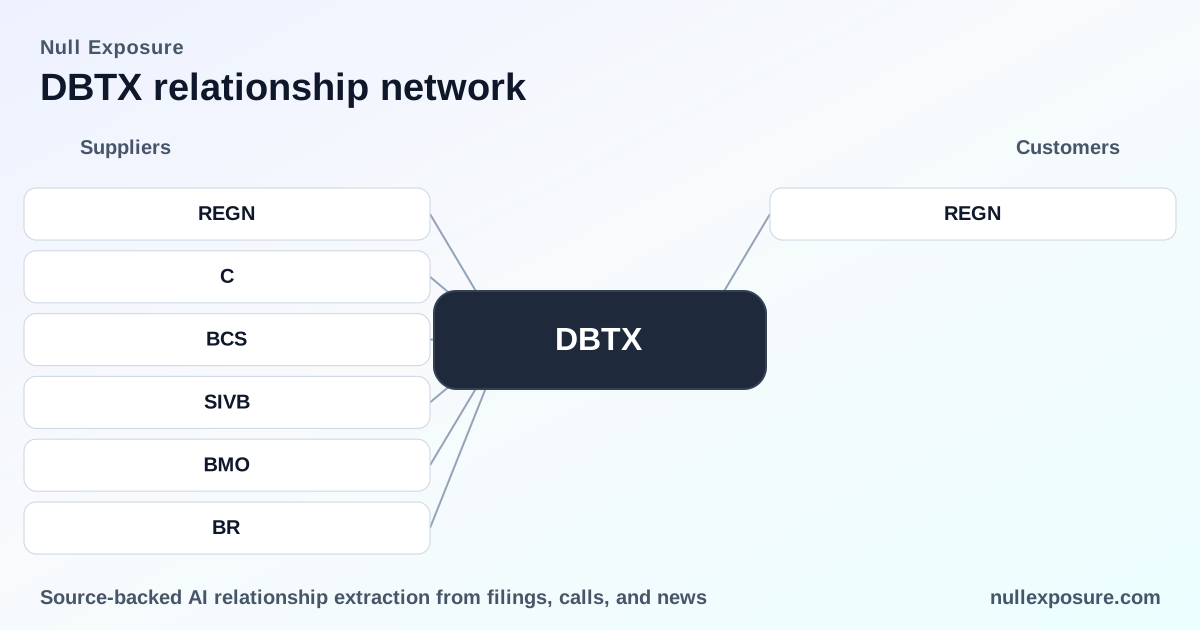
DBTX supplier relationships: what investors need to know
Decibel Therapeutics (DBTX) operates as a biotech developer that leverages external partners for both R&D capabilities and capital markets access, monetizing through clinical-stage asset development and equity financing events that fund long-shot therapeutics. The company’s supplier footprint in public records is concentrated into two functional buckets: strategic scientific collaborations that accelerate discovery and financial services firms that underwrote and supported its IPO and investor communications.
If you want a consolidated view of counterparties and implications for portfolio due diligence, start here and then review primary filings at the company site and regulator sources: https://nullexposure.com/.
The business model in plain English
Decibel’s value creation depends on scientific progress in hearing disorders and the ability to convert early-stage results into follow-on capital. That model requires two supplier types: tech and platform partners that supply proprietary methods or reagents and capital markets providers that deliver liquidity and distribution. Together these relationships reduce execution risk on the science and amplify access to public markets—each relationship is behavioral evidence of how management contracts out capability and shifts fixed costs into partner arrangements.
Strategic relationships you should price into DBTX
Below are the counterparties surfaced in public releases and the role each has played.
Regeneron Pharmaceuticals Inc.
Decibel entered a strategic collaboration under which Regeneron provided Decibel access to its proprietary suite of technologies to support discovery of novel hearing medicines. According to a joint press release, Regeneron committed broad access to its technology platform to accelerate Decibel’s drug discovery efforts (FY2017).
Citigroup / Citigroup Global Markets Inc.
Citigroup acted as a joint book-running manager for Decibel’s initial public offering and is listed as a distribution contact for the final prospectus, indicating a primary role in underwriting and investor outreach for the IPO. A GlobeNewswire release announcing the IPO pricing lists Citigroup among the lead underwriters and names Citigroup Global Markets Inc. as a prospectus contact (Feb 12, 2021).
Barclays
Barclays served as a joint book-running manager on Decibel’s IPO, sharing underwriting responsibilities with other major banks during the offering process. The IPO pricing release identifies Barclays as one of the joint book-runners (Feb 12, 2021).
SVB Leerink
SVB Leerink acted as a joint book-running manager for the IPO and was identified as a syndicate contact for prospectus distribution, reflecting a standard investment-banking engagement for a life-sciences issuer. The IPO announcement lists SVB Leerink among the joint book-runners and provides syndicate contact details (Feb 12, 2021).
BMO Capital Markets
BMO Capital Markets participated as a joint book-running manager on the IPO, providing underwriting capacity and distribution support typical for mid-market equity offerings in the life sciences sector. The GlobeNewswire IPO release includes BMO Capital Markets among the book-runners (Feb 12, 2021).
Broadridge Financial Solutions
Broadridge is named as a distribution channel for obtaining the final prospectus, indicating its role as a fulfillment and document-distribution supplier supporting the IPO process. The IPO prospectus notice referenced Broadridge as the point of contact for hard-copy prospectus requests (Feb 12, 2021).
Each relationship above is documented in the cited press release(s) and reflects standard engagements for a clinical-stage biotech pursuing technology partnerships and public-market financing.
For a consolidated portal to these relationship signals and more corporate intelligence, visit https://nullexposure.com/.
What the relationship set tells you about DBTX’s operating posture
The mix of counterparties indicates an operating model that outsources specialized capabilities rather than internalizing them:
- The collaboration with a major biopharma platform provider signals that Decibel bought access to proprietary scientific tools rather than developing every platform component in-house, consistent with a partnership-driven R&D posture.
- The roster of underwriters (Citigroup, Barclays, SVB Leerink, BMO) and distribution partners (Broadridge, Citigroup Global Markets) demonstrates a conventional, diversified capital markets approach when bringing the company public—multiple banks shared underwriting risk and distribution responsibilities.
These signals combine into practical constraints for investors: execution depends on partner integrations and continued access to capital markets; cash runway and program pacing are therefore jointly driven by clinical milestones and financing windows rather than by a single internal capability set.
Visit https://nullexposure.com/ for tools that map these dependencies into counterparty concentration and exposure metrics.
Contracting posture, concentration, criticality and maturity — firm-level signals
The public records include no explicit contractual constraints captured in this compilation, so the following are company-level signals inferred from the relationship types (not assigned to any single counterparty):
- Contracting posture: project-based, partnership-oriented—Decibel appears to execute through collaborations and service agreements rather than vertically integrating every capability. This reduces fixed-cost intensity but increases reliance on third-party performance.
- Concentration: moderate-to-low among financial service providers—multiple banks participated in the IPO which reduces single-counterparty underwriting concentration; however, a single strategic science partner model can create higher functional concentration if not diversified.
- Criticality: high for any partner that supplies unique platform technology—partners that provide proprietary discovery tools hold operational leverage that can accelerate or slow development timelines.
- Maturity: mixed—capital markets relationships are transactional and mature (IPO-era banks and distribution channels), while R&D collaborations are long-horizon and contingent on scientific milestones.
These constraints should be incorporated into valuation scenarios as non-linear risk multipliers rather than fixed line items.
How investors should act on this signal set
- Treat the Regeneron-style collaboration as a positive on the scientific acceleration axis and as a dependency for certain discovery activities; confirm contract scope and exclusivity in primary filings.
- Model financing risk with staged capital raises rather than assuming a single permanent liquidity source—underwriting was diversified at IPO, but future raises will test distribution appetite.
- Monitor counterparties for changes in posture (e.g., a partner withdrawing technology access or underwriters reducing coverage) as leading indicators of program friction.
If you want a mapped, counterparty-aware view of DBTX exposure that ties each supplier to valuation risk, explore the analysis tools at https://nullexposure.com/.
Final read
The public record for DBTX shows a classic biotech supplier mix: strategic scientific collaboration to accelerate discovery and a basket of investment banks and distribution channels for capital formation. Both categories are integral to execution—treat them as operational levers in model construction rather than peripheral vendors. For deeper counterparty mapping, benchmarking and primary-source aggregation, go to https://nullexposure.com/ and start a targeted supplier risk review.