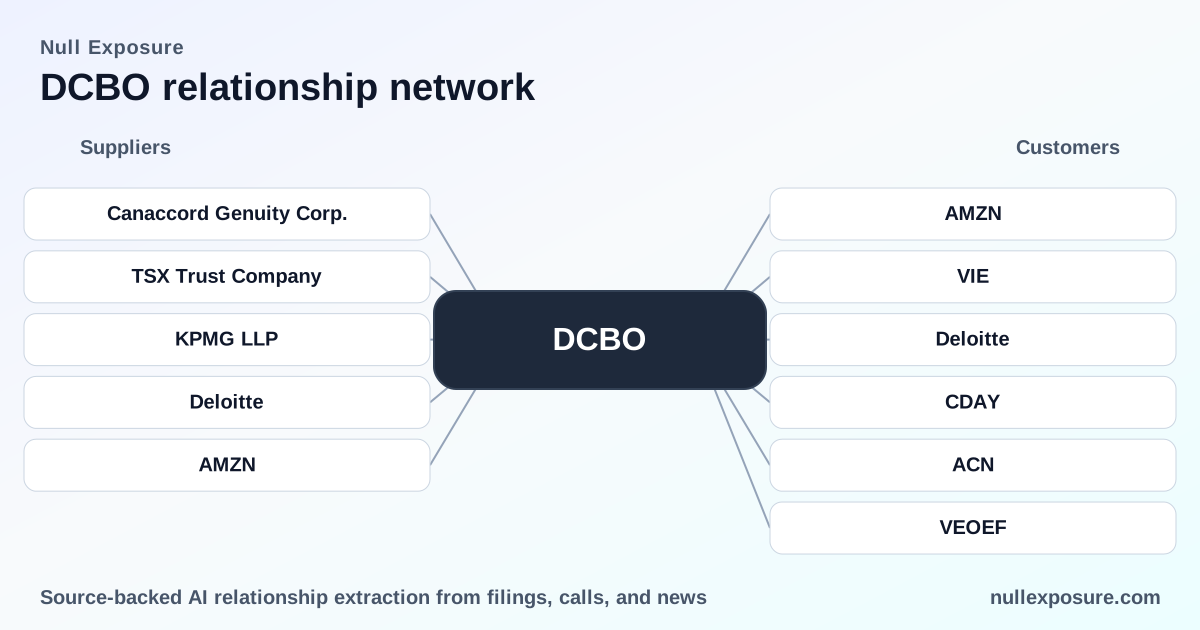
Docebo (DCBO) — Supplier relationships and what they mean for investors
Docebo operates a cloud-based learning management system (LMS) that generates recurring revenue through subscription licensing, implementation services, and platform add-ons for enterprise, partner, and public-sector customers. The company funds growth and capital return programs through a mix of operating cash flow and capital-marketing actions, and it leverages external advisors and infrastructure partners to execute transactions and scale operations. For investors evaluating supplier counterparty exposure, the most relevant relationships are its financial advisors, trustees, auditors, strategic systems partners, and professional services collaborators — each affecting capital allocation, control, compliance, and customer delivery. Learn more about supplier risk signals and competitive positioning at Null Exposure.
Executive snapshot: how the supplier list informs value and risk
Docebo’s financials show positive profitability (Profit Margin ~15.5%, Operating Margin ~15.4%), steady revenue (~$242.7M trailing twelve months) and modest multiples (Trailing PE ~15.5, EV/Revenue ~1.81). These numbers frame supplier relationships as operational levers rather than existential dependencies: advisors and trustees shape capital structure and buybacks, auditors validate reported results, while AWS and Deloitte influence product delivery and public-sector traction. Concentrated insider ownership (67% insiders) and 33% institutional ownership are material corporate-governance signals for counterparties evaluating negotiation posture and continuity. Visit Null Exposure for an expanded supplier-risk brief.
The relationships you need to know (plain-English summaries)
-
Canaccord Genuity Corp. — financial advisor for the issuer bid. Docebo engaged Canaccord to advise on a substantial issuer bid announced alongside its preliminary FY2025 results and 2026 guidance, indicating active capital return planning and an advisor-driven execution process. This was disclosed in the company’s March 2026 press release covered by The Globe and Mail.
Source: Globe and Mail press release on Docebo’s issuer bid and FY2025/FY2026 guidance (March 2026). -
TSX Trust Company — depositary for the issuer bid. TSX Trust is acting as depositary for Docebo’s offer, a standard trustee role that centralizes share handling and settlement for the buyback program and supports regulatory compliance on the TSX side. This role was described in the same March 2026 corporate announcement reported by The Globe and Mail.
Source: Globe and Mail press release on Docebo’s issuer bid and FY2025/FY2026 guidance (March 2026). -
KPMG LLP — external auditors completing the FY2025 audit. Docebo cited KPMG as the external auditor responsible for completing the audit of its consolidated financial statements for the year ended December 31, 2025, underscoring third‑party assurance of its reported results and any adjustments to preliminary figures. The auditor’s role is noted in Docebo’s year‑end disclosure summarized in March 2026 coverage.
Source: Globe and Mail press release referencing KPMG’s audit of FY2025 consolidated financial statements (March 2026). -
Deloitte — strategic partner on public-sector cyber training engagements. Docebo’s public‑sector team expanded presence with a Miami‑Dade win and an engagement in the Department of War Cyber Crime Center Cyber Training Academy in partnership with Deloitte, reflecting Docebo’s route-to-market in government and allied cyber training programs. The partnership was mentioned in Docebo’s Q4/FY2025 results reporting covered by AIjourn (March 2026).
Source: AIjourn report on Docebo’s Q4 and FY2025 results noting the Deloitte partnership (March 2026). -
Amazon Web Services (AWS) — infrastructure provider with measurable impact on retention metrics. Docebo reported a decline in net dollar retention to 99%, attributing part of the move to AWS-related impacts, indicating that cloud-hosting dynamics and partner service changes affect customer economics and platform availability. This operational linkage was discussed in commentary on Q4 2025 results covered by InsiderMonkey (March 2026).
Source: InsiderMonkey write-up on Docebo’s Q4 2025 performance and integration commentary highlighting AWS impacts (March 2026).
What these relationships say about Docebo’s operating model
- Contracting posture and governance: Engagement of an investment bank (Canaccord) and a formal depositary (TSX Trust) for an issuer bid signals disciplined capital allocation and an active shareholder‑return program executed through established capital-markets intermediaries. High insider ownership (67%) tightens control over strategic decisions and heightens the relevance of these advisors in executing lockstep capital strategies.
- Concentration and criticality: The AWS relationship is operationally critical because cloud infrastructure underpins product delivery; the reported AWS-related effect on net dollar retention makes this dependency material to customer lifetime value and margin sustainability. Professional services partners like Deloitte are strategic for sector penetration (public sector, cyber training), diversifying go-to-market risk.
- Maturity and external assurance: A Big Four auditor (KPMG) completing the FY2025 audit is consistent with enterprise maturity and supports investor confidence in reported profitability and cash flows. The selection of recognized trustees and advisors indicates standard corporate-market sophistication rather than bespoke or opaque arrangements.
Investment implications and risk profile
- Operational risk: Infrastructure reliance on AWS introduces single‑provider exposure; net dollar retention slip tied to AWS is a headline operational risk to monitor quarter-to-quarter. Investors should track SLA, cost pass-throughs, and multi-cloud strategy disclosures.
- Capital-allocation signal: The issuer bid, implemented with Canaccord and TSX Trust, is an explicit capital-return choice that reduces share float and concentrates ownership control while signaling confidence in free-cash-flow generation. Monitor buyback cadence and EPS accretion effects.
- Customer and sector diversification: Partnerships with Deloitte for public-sector cyber training confirm an institutional sales channel and potential for higher-margin services, supporting cross-sell to regulated buyers.
- Governance: High insider ownership is a double-edged sword—it stabilizes leadership and long-term thinking, but also concentrates decision-making power; third-party advisors and trustees become critical checks in that context.
Where to go from here
For investors and operators building counterparty matrices, prioritize monitoring: (1) AWS service terms, cost and availability disclosures; (2) progress on buyback execution and resulting float reduction; and (3) audit outcomes from KPMG as finalized financials replace preliminary figures. If you need a concise supplier-risk map for Docebo that aligns these relationships to credit and operational scenarios, start at Null Exposure for tailored analysis.
Bottom line
Docebo’s supplier roster combines capital‑markets intermediaries, a Big Four auditor, cloud infrastructure dependence, and strategic professional-services partners — a configuration that supports repeatable SaaS monetization but creates concentrated operational exposure to AWS and governance concentration under high insider ownership. Track the finalized FY2025 audit, the execution of the issuer bid, and AWS-related retention trends to evaluate near-term upside and downside for DCBO equity. For a deeper supplier-risk brief and scenario modeling, visit Null Exposure.