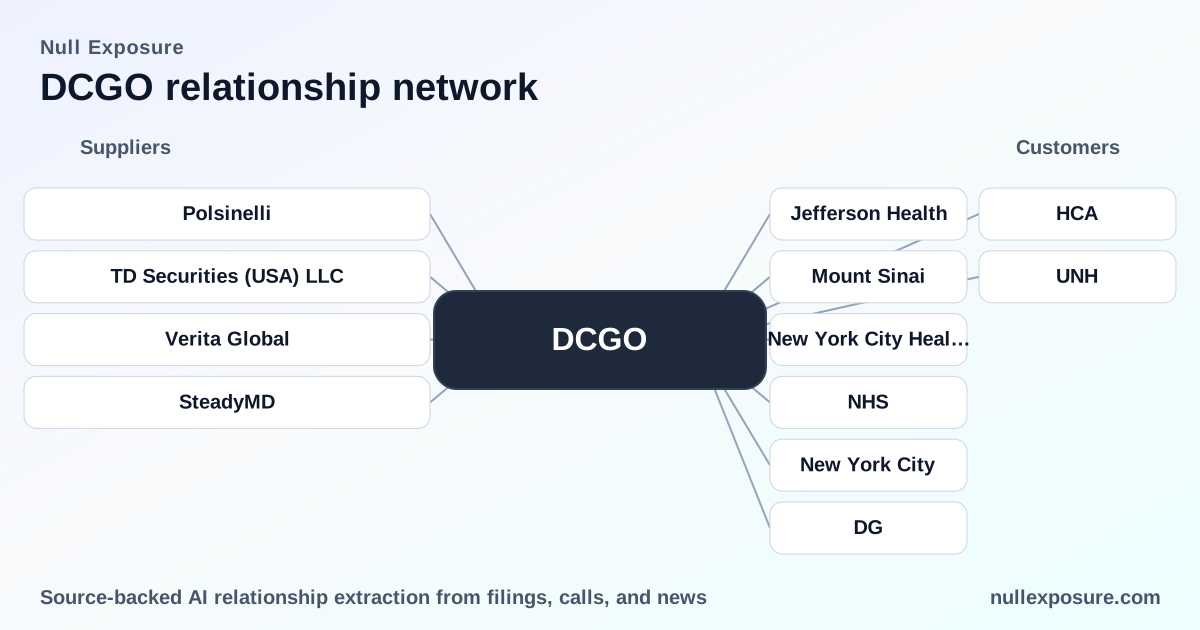
DocGo (DCGO): Supplier relationships that shape operating leverage and litigation exposure
DocGo operates a mobile healthcare and telehealth platform that monetizes by dispatching clinicians and diagnostics to non-traditional sites while layering recurring telehealth services and billing for clinical encounters. Revenue mixes between field services and virtual care drive unit economics, and DocGo leverages third-party advisors and service providers for transactions, legal support, and claims administration—costs and concentration in those relationships influence near-term margins and execution risk. For institutional investors evaluating counterparty risk and operational resilience, the supplier footprint reveals both standard corporate support functions and a notable vendor concentration that ties directly to cost structure.
Explore deeper supplier intelligence and counterparty scoring at https://nullexposure.com/ for a holistic view of DocGo’s third-party exposures.
What the supplier map tells investors about DocGo’s operating posture
DocGo’s supplier relationships reflect a company in growth mode that relies on external expertise for capital transactions, legal work, virtual care scale-up, and post-litigation administration. The supplier set is heavy on professional services and critical operational vendors, not on commodity inputs—this pattern fits a services-led healthtech model where partner quality and contract terms materially affect margins and service continuity.
Key profile signals:
- Contracting posture: DocGo contracts experienced advisors for discrete strategic events (financial advisor, legal counsel) and uses specialized administrators for securities litigation—this implies transactional vendor engagement punctuated by ongoing service providers for operations.
- Concentration: The company discloses one vendor accounted for roughly 12–17% of total cost over 2022–2024, a material concentration that increases supplier leverage on pricing and continuity.
- Criticality and segment: Third-party vendors provide services that underpin clinical delivery and platform operations, not peripheral commodities; these relationships are operationally critical.
- Maturity: The mix shows both mature, short-term advisory relationships tied to M&A/capital events and ongoing service-provider relationships that support IT, claims handling, and telehealth integration.
These are company-level signals drawn from recent disclosures and public reporting; they shape negotiation leverage, contingency planning, and margin volatility.
Who DocGo is working with — relationship-by-relationship review
Polsinelli
DocGo engaged Polsinelli as legal counsel tied to a major acquisition transaction; Polsinelli supported the company in the SteadyMD acquisition process reported in late 2025. According to HLTH’s coverage of the October 22, 2025 announcement, Polsinelli provided legal counsel while TD Securities served as exclusive financial advisor. (Source: HLTH, Oct 22, 2025 — https://hlth.com/insights/news/docgo-acquires-steadymd-to-expand-telehealth-services-nationwide-2025-10-22)
TD Securities (USA) LLC
TD Securities acted as DocGo’s exclusive financial advisor on the SteadyMD acquisition, positioning the firm as the deal’s lead transaction advisor and adviser on execution and valuation. HLTH reported TD Securities (USA) LLC’s exclusive financial advisory role in the October 2025 transaction announcement. (Source: HLTH, Oct 22, 2025 — https://hlth.com/insights/news/docgo-acquires-steadymd-to-expand-telehealth-services-nationwide-2025-10-22)
Verita Global (claims administrator) — ClaimDepot mention
Verita Global is serving as the claims administrator for the DocGo securities settlement, with public notices providing contact and mailing details for claimants; the role is administrative and tied to litigated securities matters. A claims portal listing sets out Verita Global’s post-marketing claims administration function. (Source: ClaimDepot settlement listing, 2025–2026 — https://www.claimdepot.com/settlements/docgo-securities-settlement)
Verita Global (claims administrator) — BizWire / Robbins Geller notice
Robbins Geller’s proposed settlement notice references Verita Global as DocGo’s Securities Settlement Claims Administrator and provides the same administrative contact points, confirming Verita Global’s role in settlements announced in December 2025. (Source: BizWire/WRAL via FinancialContent, Dec 16, 2025 — https://markets.financialcontent.com/wral/article/bizwire-2025-12-16-robbins-geller-rudman-and-dowd-llp-announces-proposed-settlement-in-the-docgo-securities-litigation)
SteadyMD
DocGo acquired SteadyMD to expand its virtual care network, enabling field clinicians to pair with a scaled virtual provider network and improving care coordination across mobile and virtual channels; the acquisition is central to DocGo’s strategy to combine on-site services with telehealth continuity. Healthcare IT Today summarized this strategic fit in early December 2025, describing SteadyMD’s network as enhancing DocGo’s delivery efficiency. (Source: Healthcare IT Today, Dec 4, 2025 — https://www.healthcareittoday.com/2025/12/04/docgo-acquires-virtual-care-platform-steadymd-findhelp-acquires-uno-health-vatica-health-has-merged-with-cozeva/)
Strategic implications investors should weigh
- Advisory and legal spend is event-driven but high-impact. The use of reputable advisors (TD Securities, Polsinelli) reduces execution risk for M&A but increases one-off costs that compress near-term margins; investors should track deal-related expenses as part of free-cash-flow sensitivity analysis.
- Settlement administration signals live litigation exposure. Verita Global’s presence as claims administrator confirms an active securities settlement process that can generate legal fees and potential payouts—monitor reserves and disclosures for impact on liquidity.
- Acquisition integration is now a leverage point for margin improvement. The SteadyMD acquisition is a functional fit that can lift utilization and per-encounter revenue if operational integration is executed cleanly; this is an execution-risk story rather than a technology gap.
Risk profile driven by supplier constraints
DocGo’s public disclosures provide company-level constraints that shape third-party risk:
- Material vendor concentration: One unnamed vendor historically accounted for ~17%, 14% and 12% of total cost in 2024–2022, respectively, and the company expects to maintain that relationship. This concentration creates pricing and continuity vulnerability that is not tied to any single named supplier in its disclosures but is clearly material to cost structure.
- Service-provider reliance: DocGo relies on third-party IT and operational vendors for secure processing of sensitive information and for service delivery, which elevates counterparty operational risk and compliance demands.
- Segment focus on services: The supplier set is predominately service-oriented (legal, advisory, claims administration, telehealth network), indicating supplier criticality is high because these partners affect both regulatory posture and patient-facing operations.
These constraints place a premium on contract terms, contingency plans, and vendor diversification for anyone assessing DocGo’s operational resilience.
Investment takeaways and recommended monitoring
- Short-term margin pressure is likely from transaction-related advisory fees and settlement-related costs; watch quarterly cash flow and legal reserve disclosures.
- Integration of SteadyMD is a potential margin inflection point if it drives higher clinician utilization and reduces referral leakage; monitor operational KPIs on virtual-to-field encounter ratios.
- Supplier concentration is a persistent risk—investors should require management commentary on replacement options and contractual protections for the top vendor that historically accounts for double-digit cost share.
For investors modelling counterparty and litigation risk or preparing vendor concentration scenarios, start with DocGo’s supplier disclosures and the relationship summaries above. For a practical, investor-grade supplier risk assessment and continuous monitoring, visit https://nullexposure.com/ to see how supplier intelligence maps to valuation and liquidity scenarios.
Concluding call-to-action: if you need a structured third-party risk view for DCGO or comparable healthtech names, learn more at https://nullexposure.com/ and request the supplier risk brief tailored to institutional analysis.