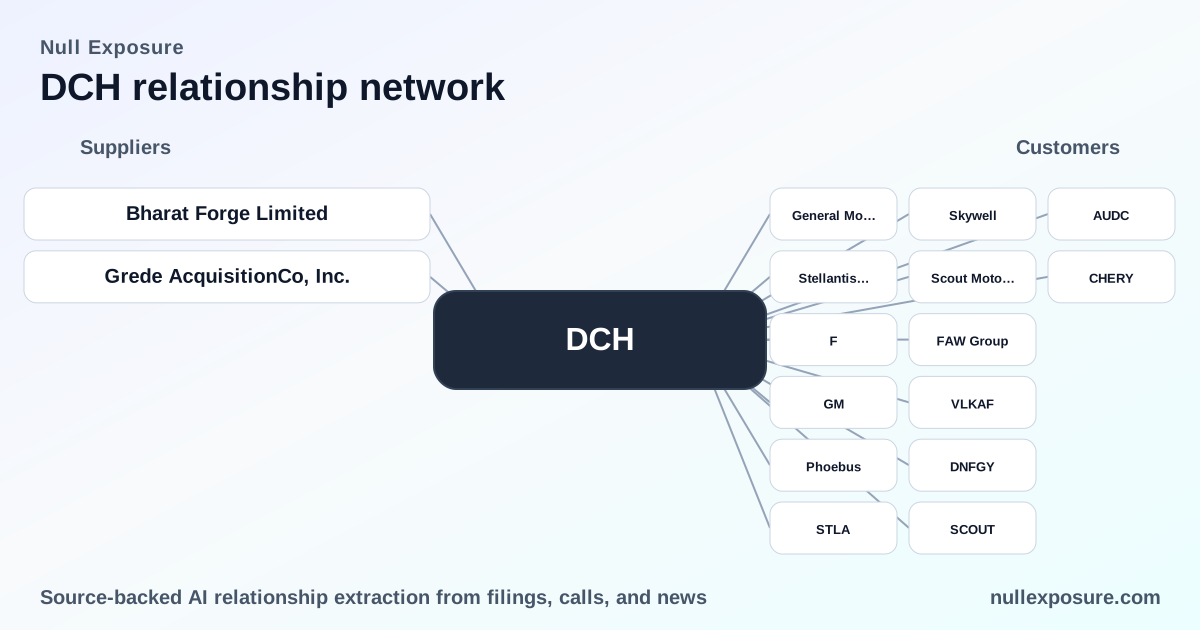
Dauch Corporation (DCH): supplier relationships that shape a driveline supplier’s transition
Dauch Corporation designs, engineers, and manufactures driveline and metal‑forming technologies sold to automotive original equipment manufacturers, monetizing through component sales, engineering contracts, and asset dispositions tied to portfolio optimization. Revenue is driven by OEM demand across ICE, hybrid, and electric powertrains, with material earnings exposure to cyclical auto production and selective non‑core asset sales. For investors evaluating supplier counterparties and downstream exposure, the FY2025 disclosures highlight both an active portfolio‑management posture and a set of stable, long‑standing service relationships that matter for governance and execution.
Explore vendor and counterparty signals at scale on the Null Exposure homepage: https://nullexposure.com/
A quick read on how Dauch runs the business and makes money
Dauch runs a manufacturing and engineering business that sells driveline components and metal‑forming systems to vehicle manufacturers; it recognizes product revenue and executes occasional strategic disposals to reallocate capital. FY2025 trailing revenue stood at about $5.84 billion with EBITDA near $687 million, indicating a manufacturing business with modest operating margin and meaningful scale in parts supply. Asset sales and contractual reference documents in the latest 10‑K show management actively reshaping geographic footprint and contractual exposures to improve returns.
If you are mapping supplier risk or counterparty concentration for procurement or investment, start here: https://nullexposure.com/
What the FY2025 filing names — the relationships that matter now
Bharat Forge Limited — strategic divestiture in India
Dauch disclosed the sale of its commercial vehicle axle business in India (AAM India Manufacturing Corporation Pvt., Ltd.) to Bharat Forge Limited (BFL) for approximately $65 million, net of closing adjustments during 2025. This is a clear disposal of a discrete, regionally concentrated manufacturing asset to an established Indian forging and component player, which reduces Dauch’s direct manufacturing footprint in that market. (According to the company's FY2025 10‑K filing.)
Grede AcquisitionCo, Inc. — legacy transactional reference
The FY2025 10‑K references a Unit Purchase Agreement dated September 18, 2019 involving American Axle & Manufacturing Holdings, Inc., Grede AcquisitionCo, Inc., and Grede TopCo, Inc., showing Dauch’s documents incorporate legacy transactional frameworks and counterparty agreements tied to prior strategic moves. This citation in the current filing underscores ongoing legal and contractual linkages to earlier industry consolidation activity. (According to the company's FY2025 10‑K filing.)
What those relationships reveal about Dauch’s operating model
These disclosures are concise but instructive for investors and procurement officers:
-
Contracting posture: Dauch executes definitive, asset‑level transactions (e.g., the India axle sale), indicating a willingness to use divestiture as a tool to sharpen the portfolio and reduce underperforming or non‑strategic exposures. The presence of historical purchase agreements in filings signals careful legal housekeeping and continuing contractual obligations tied to legacy deals.
-
Geographic and business concentration: The sale of the India axle business removes a regionally concentrated manufacturing line, reducing direct operational exposure in that market; Dauch remains a North American‑headquartered supplier with meaningful global revenue. Investors should view the transaction as a deliberate concentration management step, not an operational retreat.
-
Criticality and maturity of supplier relationships: Company disclosures include a long‑standing service relationship that speaks to a mature, low‑churn supplier posture. The filing text states, “We have served as the Company's auditor since 1998,” which is a company‑level signal of stable governance and enduring external service relationships rather than an indicator tied to any single commercial counterparty.
-
Operational maturity: The combination of explicit disposals and references to prior unit purchase agreements demonstrates mature transaction management — Dauch uses standard M&A tools and post‑deal legal frameworks to manage its supplier and counterparty footprint.
Implications for investors and operators
-
Risk reduction through disposals: The $65 million sale to Bharat Forge is a tangible example of capital redeployment; it reduces regional operational complexity and can free cash for higher‑ROIC investments. This is positive for balance‑sheet flexibility.
-
Legacy legal linkages matter: Citations of older unit purchase agreements indicate that legacy contractual obligations persist in disclosures — investors should model for potential contingent liabilities or ongoing indemnities tied to historic deals.
-
Governance stability: A service provider relationship in place since 1998 signals consistency in external oversight (audit and related controls), which reduces governance arbitrage risk often associated with rapidly changing suppliers.
-
Earnings sensitivity remains cyclical: Despite disposals and mature contracting, Dauch’s revenue base is tied to OEM production cycles. The firm’s operating margin profile is modest, and the company will continue to be sensitive to macro auto demand and commodity cost swings.
What to watch next — monitoring cadence for counterparties
- Monitor how proceeds from the Bharat Forge sale are used: reinvestment into higher‑margin EV driveline work would be a constructive capital allocation signal.
- Watch for any disclosed contingent liabilities tied to the 2019 unit purchase agreement language; those could surface in notes or in subsequent proxy filings.
- Track vendor concentration metrics in future 10‑Qs: large single‑supplier relationships or single‑OEM revenue concentration would change the risk profile materially.
If you want a structured view of Dauch’s counterparty map and transaction history, start your research at https://nullexposure.com/
Bottom line: what investors should price in
Dauch operates as a mature OEM supplier that uses asset sales and legal frameworks to manage footprint and risk. The FY2025 filings show active portfolio management (the India axle sale) and persistent, long‑standing external service relationships that support governance. For investors, the key tradeoff is between scale in driveline manufacturing and the cyclicality inherent to auto OEM demand; recent disposals reduce some regional complexity but do not remove core demand cyclicality.
For a deeper counterparty and supplier exposure analysis across filings and filings‑level references, visit https://nullexposure.com/ — a starting point for mapping counterparties, contracts, and material transaction history.