Dime Community Bancshares (DCOM): Funding relationships and supplier implications
Dime Community Bancshares operates as a regional commercial bank concentrated in the New York market, monetizing primarily through net interest margin on a loan and securities portfolio, fee income from deposit and mortgage services, and targeted wholesale funding strategies. The bank’s working capital model relies materially on wholesale borrowings (notably Federal Home Loan Bank advances) and short-term funding conduits such as repurchase agreements and the American Financial Exchange, which together shape counterparty exposure and supplier contracting posture. For a more detailed supplier-risk briefing, visit https://nullexposure.com/.
How Dime sources liquidity — a concise picture for investors and vendors
Dime combines customer deposits with sizeable wholesale advances to finance assets. The company’s latest public filings and earnings commentary show meaningful FHLB advances outstanding and routine short-term funding activity, which creates both scale opportunities and counterparty concentration risks for suppliers and vendors that integrate with the bank’s balance-sheet operations.
The Federal Home Loan Bank connections you must know
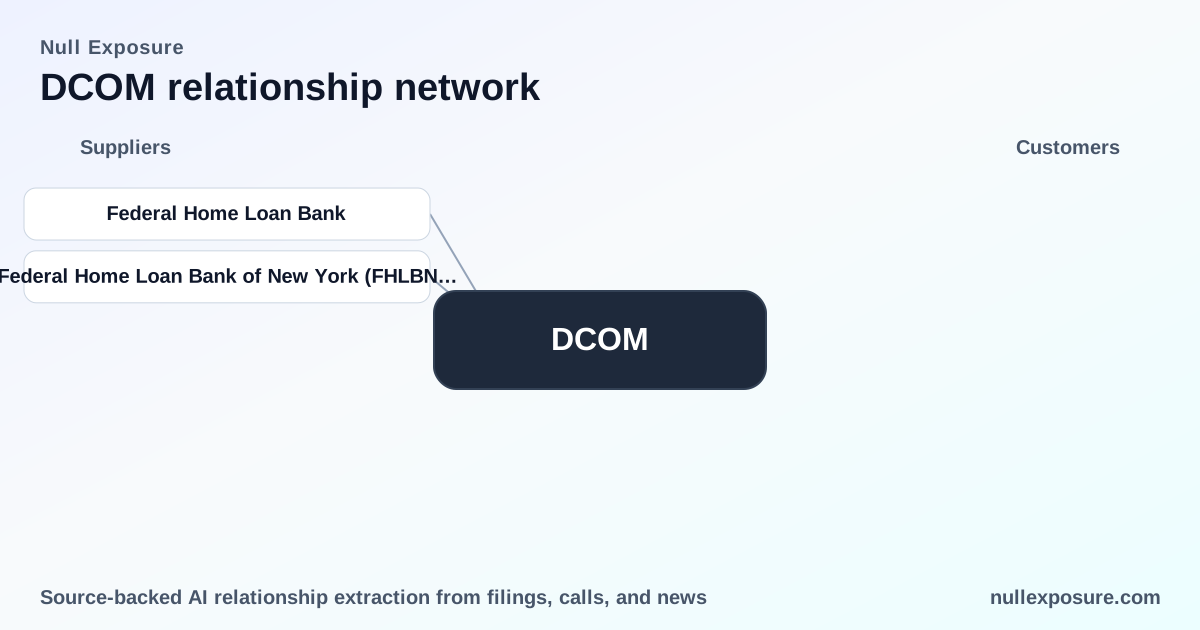
Federal Home Loan Bank
- Dime reports FHLB advances on its balance sheet as a material component of funding: total Federal Home Loan Bank advances were $508.0 million at December 31, 2025, unchanged from the prior quarter. According to Dime’s January 21, 2026 earnings release, this line item is a recurring, visible piece of the bank’s funding mix. (GlobeNewswire, Jan 21, 2026)
Federal Home Loan Bank of New York (FHLBNY)
- Dime specifically discloses advances from the Federal Home Loan Bank of New York, with historical balances of $608.0 million at December 31, 2024 and $1.31 billion at December 31, 2023, indicating large, multi‑quarter exposures to the FHLB system. This level of advances is documented in the company’s FY2026 earnings release and prior filings. (GlobeNewswire, Jan 21, 2026)
Takeaway: Both the FHLB system and the FHLBNY in particular are core wholesale counterparties for Dime; vendors that provide treasury, collateral management, or liquidity analytics should price for counterparty concentration and operational integration with FHLB processes.
Short-term funding profile: overnight and repo activity matter
Dime’s corporate disclosures identify a deliberate use of short-term instruments. The bank is a member of the American Financial Exchange (AFX) and engages in overnight/short-term borrowing and lending with other member institutions, while repurchase agreements are used to receive funds typically on an overnight basis and are collateralized by pass‑through mortgage securities. These practices shape Dime’s contracting posture toward counterparties as short-term and operationally active, rather than long-duration strategic commitments.
Implication for suppliers: Contract terms for treasury-related services, collateral custody, and liquidity lines should reflect high-frequency settlement and collateral rehypothecation needs; vendors should expect operational SLAs and rapid reconciliations.
Outsourcing and vendor role: where Dime is the buyer
Dime outsources servicing for a portion of its one‑to‑four family mortgage loan portfolio to unrelated third‑party sub‑servicers under sub‑servicing agreements. This establishes Dime clearly as a buyer of specialized mortgage servicing functions and implies third-party operational dependency for that asset class.
Implication for vendors: Mortgage servicers and related technology partners enter into a buyer-supplier dynamic where Dime requires compliance, performance metrics, and custody safeguards consistent with a regulated banking client.
Constraints that shape Dime’s operating model (company-level signals)
- Contracting posture — short-term orientation. Dime’s membership in AFX and routine repurchase agreements indicate a funding strategy that favors short-duration counterparty arrangements and overnight liquidity turnover. This operational posture requires counterparties to support fast settlement cycles and flexible collateral agreements.
- Spending and exposure scale — large wholesale advances. The bank’s disclosures showing hundreds of millions to over a billion in FHLB advances across recent years indicate a high spend/exposure band for wholesale funding partners, particularly the FHLBNY (explicitly named in company filings).
- Buyer role and outsourcing maturity. Dime’s use of sub-servicers for mortgage portfolios is a clear signal that the bank contracts out specialized operational functions rather than internalizing all processing — vendors will encounter a bank that acts as a sophisticated buyer with formal contracting and performance expectations.
When a constraint excerpt explicitly names a counterparty, it is appropriate to attach that signal to the relationship: Dime’s own disclosure identifies the FHLBNY advances ($608.0 million at Dec 31, 2024), which signals material exposure and criticality of that single counterparty to the bank’s funding mix.
What this means for investors and supplier negotiators
- Counterparty concentration is a tangible risk. Large, multi‑quarter advances from the FHLBNY create a single‑point funding relationship that can influence pricing, collateral requirements, and contingency plans.
- Operational demands favor short-term, high‑throughput partners. Treasury vendors, collateral managers, and trading counterparties must design systems for rapid settlement, frequent margining, and transparent reporting.
- Vendor selection will be process-driven. Given Dime’s buyer posture on mortgage servicing and its regulated status, expect formal RFPs, SLAs, and compliance-heavy contractual terms.
For an actionable supplier-risk profile and negotiation playbook tailored to Dime, see our coverage at https://nullexposure.com/.
Practical negotiation and risk-management checklist
- Ensure collateral and margining terms align with overnight repo and FHLB advance mechanics.
- Price services to reflect counterparty concentration risk when integrating with FHLBNY-related workflows.
- Build rapid reconciliation and dispute-resolution clauses into contracts to match Dime’s short-term liquidity cadence.
- Include regulatory compliance and audit support in contracts for mortgage sub‑servicing engagements.
Final assessment
Dime Community Bancshares operates with a hybrid funding model that combines retail deposits, substantial FHLB advances (notably FHLBNY), and short-term wholesale instruments. That combination produces scale benefits for the bank while concentrating exposure and operational demands on specific counterparties and vendors. For suppliers, the commercial opportunity is meaningful but conditional on operational readiness for short-term settlement, collateral handling, and tight contractual controls.
If you are evaluating a commercial relationship with Dime—whether as a treasury vendor, mortgage sub‑servicer, or liquidity provider—prioritize operational integration, collateral mechanics, and contractual protections. Learn more about supplier evaluation and counterparty intelligence at https://nullexposure.com/.