Dime Community Bancshares (DCOMP) — supplier relationship briefing for investors and operators
Dime Community Bancshares operates as the holding company for Dime Community Bank, monetizing primarily through commercial lending, deposit spreads and fee income across its New York franchise. The company’s economics show material net interest income leverage, a mid-single-digit return on equity and a visible dividend policy, while corporate actions (a rebrand and exchange transfer) and wholesale funding relationships define the near-term counterparty landscape for vendors and service providers. For a quick company-wide supplier risk view, see Null Exposure’s homepage: https://nullexposure.com/.
Strategic headline: rebrand and transfer to the NYSE — what changes for counterparties
Dime has announced a coordinated rebranding and a transfer of its securities to the New York Stock Exchange, effective around April 7, 2026. This is a liquidity- and visibility-driven move: listing on the NYSE improves access to institutional buy-side coverage and can change settlement and market-making dynamics that matter to treasury vendors, transfer agents and market-data suppliers. According to a GlobeNewswire correction and corroborating press coverage in The Globe and Mail, the company will align its name change and exchange move with a broader shift toward a commercial-banking identity (GlobeNewswire, Feb 23, 2026; The Globe and Mail, March 2026).
Key takeaway: vendors tied to capital markets activity (investor relations, transfer agencies, exchange-connected services) should expect an uptick in market-facing requirements and potentially stricter operational SLAs after the NYSE transfer.
Balance-sheet plumbing: the Federal Home Loan Bank connection
Dime reports stable use of Federal Home Loan Bank advances, with $508.0 million outstanding at multiple quarter-ends through September 30, 2025. That steady advance balance indicates an ongoing reliance on FHLB lines as a dependable wholesale funding source for asset-liability management and liquidity smoothing (GlobeNewswire earnings release, Oct 23, 2025).
Key takeaway: counterparties that provide liquidity, collateral management, or short-term funding services need to treat the FHLB relationship as a persistent, operationally important funding channel.
Complete relationship inventory — every relationship in the record
Below are every relationship flagged in the source material, summarized plainly with source citations.
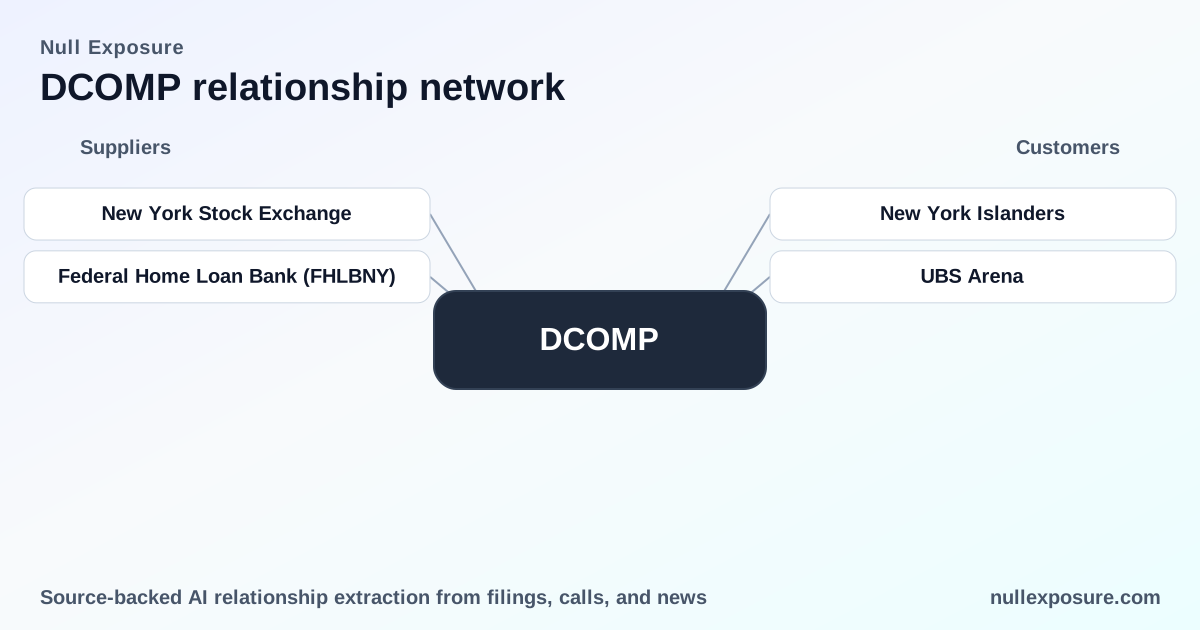
- New York Stock Exchange — Dime is transferring the listing of its securities to the NYSE on or around April 7, 2026 as part of a rebrand to emphasize commercial-banking focus; this was disclosed in a GlobeNewswire correction and noted in investor press (GlobeNewswire correction, Feb 23, 2026; The Globe and Mail coverage, March 2026).
- Federal Home Loan Bank (FHLBNY) — Dime carried $508.0 million of FHLB advances at September 30, 2025 (and the same amount at preceding quarter-end), reflecting a stable advanced balance used for funding (GlobeNewswire earnings release, Oct 23, 2025).
These entries reflect press and investor communications captured across FY2025–FY2026.
Contracting posture and maturity signals — company-level constraints explained
The available constraint evidence shows a short-term contracting posture in parts of Dime’s funding stack: at December 31, 2024 the Bank had $50.0 million of borrowings through an AFX facility recorded as other short-term borrowings. This is a company-level signal that the bank uses short-dated credit lines to manage liquidity flows, complementing the larger, more stable FHLB advances.
- Concentration: The existence of both FHLB advances and short-term AFX borrowings indicates a multi-source funding approach rather than single-provider concentration, but short-term facilities can introduce rollover risk.
- Criticality: Short-term borrowings and FHLB lines are operationally critical for intraday liquidity and mismatch management; vendors supporting payments, collateral, or treasury services should prioritize uptime and reconciliation accuracy.
- Maturity profile: The mix of a multi-quarter static FHLB balance and smaller short-term borrowings suggests a layered maturity ladder—stable medium-term capacity with tactical short-term lines.
What this profile means for vendors, operators and commercial partners
- Market-facing vendors (market data providers, investor relations firms, transfer agents) must prepare for increased scrutiny and higher visibility once Dime lists on the NYSE; expect more demanding reporting cadence and tighter execution windows.
- Treasury and liquidity vendors must account for the dual funding structure—longer-dated FHLB advances and tactical short-term AFX-style borrowings—requiring flexible collateral and settlement arrangements.
- Risk and operations teams at supplier firms should treat the combination of stable FHLB use and short-term borrowing as a sign to maintain conservative credit exposure limits and strengthen contingency procedures.
For a deeper supplier risk profile and recommender rules tailored to financial counterparties, visit Null Exposure: https://nullexposure.com/.
Investor implications and operational checklist
From an investor-supplier perspective, the combination of NYSE listing, steady FHLB reliance, and short-term borrowing use creates a predictable yet active counterparties environment. Execution items for vendors and risk teams:
- Confirm settlement and market data connectivity align with NYSE standards ahead of the April 2026 transfer.
- Map margining and collateral flows to accommodate a persistent FHLB advance balance and short-term liquidity draws.
- Re-evaluate credit limits and monitoring frequency for counterparty exposure given the short-term facility evidence.
If you manage supplier relationships to regional banks, this is a time-sensitive window to lock in contracts and operational SLAs—Null Exposure helps institutional teams operationalize these checks: https://nullexposure.com/.
Bottom line
Dime Community Bancshares is repositioning itself publicly while maintaining predictable wholesale funding channels. For suppliers and investors, the move to the NYSE increases operational demands, and the coexistence of FHLB advances with short-term borrowings creates both stability and rollover risk that require active management. Align vendor controls to exchange-grade requirements, confirm liquidity corridors, and update contingency playbooks ahead of the listed-date transition.