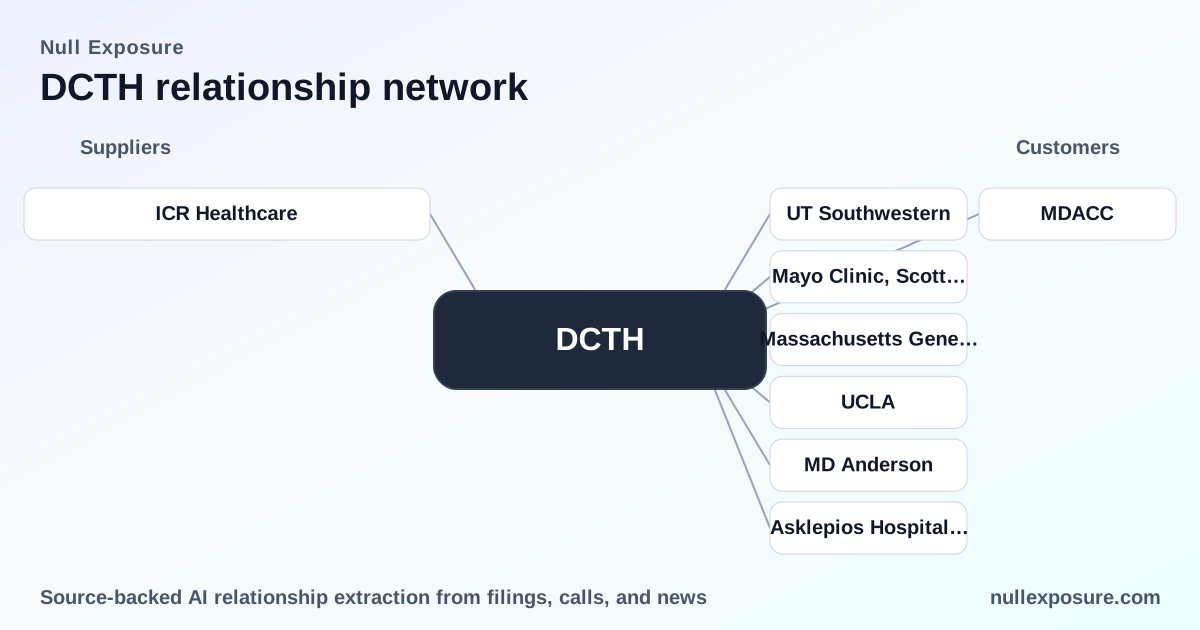
Delcath Systems (DCTH) — supplier relationship profile and implications for investors
Delcath Systems operates as an interventional oncology medical-device company that commercializes percutaneous hepatic perfusion technologies (CHEMOSAT/HEPZATO) to treat primary and metastatic liver cancers. The company monetizes through the sale of procedure-specific devices and consumables, service and training for interventional suites, and associated clinical/procedural revenue; fiscal 12‑month revenue was roughly $85.2 million and market capitalization is about $346 million. For investors and operators evaluating supplier exposure, the critical commercial dependency is the supply chain for melphalan and related components, while public filings and press releases show investor‑relations activity routed through a third‑party firm. For a vendor‑ and counterparty view across the capital and clinical stack, see https://nullexposure.com/.
Why supplier relationships matter for Delcath’s commercial trajectory
Delcath’s product economics depend on continuity of device supply and availability of the chemotherapy agent melphalan used in its hepatic perfusion procedures. Operational continuity requires long‑dated contracts, predictable spend, and multiple qualified manufacturers for key inputs; any disruption translates directly into constrained procedure throughput and revenue impact. The company reports modest profitability metrics versus valuation multiples that discount for clinical and supply risk — revenue TTM was $85.2M with a slim profit margin, while forward multiples reflect growth expectations rather than margin resilience.
Explore supplier risk frameworks and counterparty mapping at https://nullexposure.com/ if you require a consolidated supplier analysis.
What the relationship records actually show: repeated investor‑relations contact entries
The dataset of supplier‑scope results captured repeated press releases where ICR Healthcare is listed as Delcath’s investor relations contact. Each item is an investor‑communications or clinical/publication announcement rather than a procurement vendor record. Below I list every result provided, one by one, with a plain‑English summary and source.
-
Delcath announced participation in investor conferences (press release title: “Delcath Systems to Participate in Upcoming November 2025 Investor Conferences”); ICR Healthcare is the investor relations contact. Source: BioSpace press release (filed March 2026) — https://www.biospace.com/press-releases/delcath-systems-to-participate-in-upcoming-november-2025-investor-conferences
-
A press release announced publication of an expert narrative review on percutaneous hepatic perfusion for uveal melanoma; the release lists ICR Healthcare as investor relations. Source: BioSpace press release (March 2026) — https://www.biospace.com/press-releases/delcath-systems-announces-publication-of-expert-narrative-review-on-percutaneous-hepatic-perfusion-for-liver-metastases-from-uveal-melanoma
-
Delcath reported fourth‑quarter and full‑year 2025 financial results and listed ICR Healthcare as the investor relations contact. Source: BioSpace press release (March 2026) — https://www.biospace.com/press-releases/delcath-systems-reports-fourth-quarter-and-full-year-2025-results
-
The company released third‑quarter 2025 results and business highlights with ICR Healthcare listed for investor relations contact. Source: BioSpace press release (March 2026) — https://www.biospace.com/press-releases/delcath-systems-reports-third-quarter-2025-results-and-business-highlights
-
A preliminary fourth‑quarter and full‑year 2025 financial results announcement included ICR Healthcare as investor relations contact. Source: AIJourn (republishing the release; March 2026) — https://aijourn.com/delcath-systems-announces-preliminary-fourth-quarter-and-full-year-2025-financial-results/
-
Delcath announced publication of a 10‑year single‑center experience with percutaneous hepatic perfusion in metastatic uveal melanoma; the release references ICR Healthcare for investor relations. Source: BioSpace press release (March 2026) — https://www.biospace.com/press-releases/delcath-systems-announces-publication-of-10-year-single-center-experience-with-percutaneous-hepatic-perfusion-in-liver-dominant-metastatic-uveal-melanoma
-
An inducement grant under Nasdaq listing rule 5635(c)(4) was announced and ICR Healthcare is listed as the investor relations contact. Source: BioSpace press release (filed November 14, 2025; republished March 2026) — https://www.biospace.com/press-releases/delcath-systems-inc-announces-inducement-grants-under-nasdaq-listing-rule-5635c4-november-14-2025
-
A notice that the company will host its fourth‑quarter and full‑year 2025 earnings call lists ICR Healthcare for investor relations. Source: BioSpace press release (March 2026) — https://www.biospace.com/press-releases/delcath-systems-to-host-fourth-quarter-and-full-year-2025-earnings-call
Each of the above records consistently lists ICR Healthcare as the contact for investor relations; none of the items are documented purchase orders, supply contracts, or manufacturing partner announcements.
Company‑level supply constraints and what they imply for commercial risk
The extracted constraint signals give direct insight into Delcath’s supplier posture and the economics of its supplies:
-
Long‑term contracting posture: The company disclosed an amendment to a Supply Agreement (effective May 1, 2024) that extends the agreement through December 31, 2028 with options to renew in five‑year periods. This is a company‑level signal that Delcath structures multi‑year vendor commitments for key inputs and prefers contractual tenure sufficient to support commercialization timelines.
-
Criticality of inputs: Management explicitly frames melphalan and other components as critical to commercialization of HEPZATO in the U.S. and CHEMOSAT in the EU, making supply continuity a critical operational dependency.
-
Manufacturer role and market structure: The company notes there are multiple approved manufacturers of melphalan in some EU jurisdictions, which signals a supplier market with a few qualified producers rather than broad commoditization. That affects bargaining leverage and qualification lead times.
-
Committed spend scale: Delcath disclosed a committed purchase of $2.5 million of melphalan in calendar 2025, placing the supplier spend in the $1M–$10M band and indicating material but not massive single‑year procurement volume.
Taken together, these constraints paint a picture of a company with formalized long‑term sourcing, high operational dependence on a small set of critical components, and measurable committed spend that supports production planning.
Investor implications and recommended due diligence actions
-
Concentration and continuity risk: Given melphalan’s critical role and the relatively small supplier universe, investors should treat supply availability as a top line and clinical execution risk. Request evidence of dual sourcing, safety‑stock policies, and regulatory contingencies in the event a manufacturer becomes unavailable.
-
Contract maturity and renegotiation windows: The multi‑year supply agreement through 2028 reduces near‑term renegotiation risk but concentrates counterparty exposure into a known horizon. Model potential margin volatility should input prices or availability change at the 2028 renewal window.
-
Procurement visibility for operators: Hospital partners and commercial operators should confirm lead times, pricing terms, and allocation mechanics for melphalan and procedure consumables to avoid cancellation risk for scheduled perfusion procedures.
If you need a consolidated supplier‑risk briefing and counterparty playbook for DCTH, start with a tailored report at https://nullexposure.com/.
Bottom line: where the risks and strengths sit
Delcath’s commercial model is productized and procedure‑dependent, with revenue driven by consumable sales and procedure adoption; supply continuity for melphalan is a critical single factor for revenue realization. Press‑release records in the public feed primarily reflect investor‑relations communications through ICR Healthcare and do not substitute for procurement or manufacturing disclosures. Investors should therefore prioritize supplier diligence — contract terms, alternative manufacturers, and committed spend — as part of any valuation or counterparty exposure assessment.
For a full third‑party supplier exposure analysis and a checklist you can use in diligence calls, visit https://nullexposure.com/.