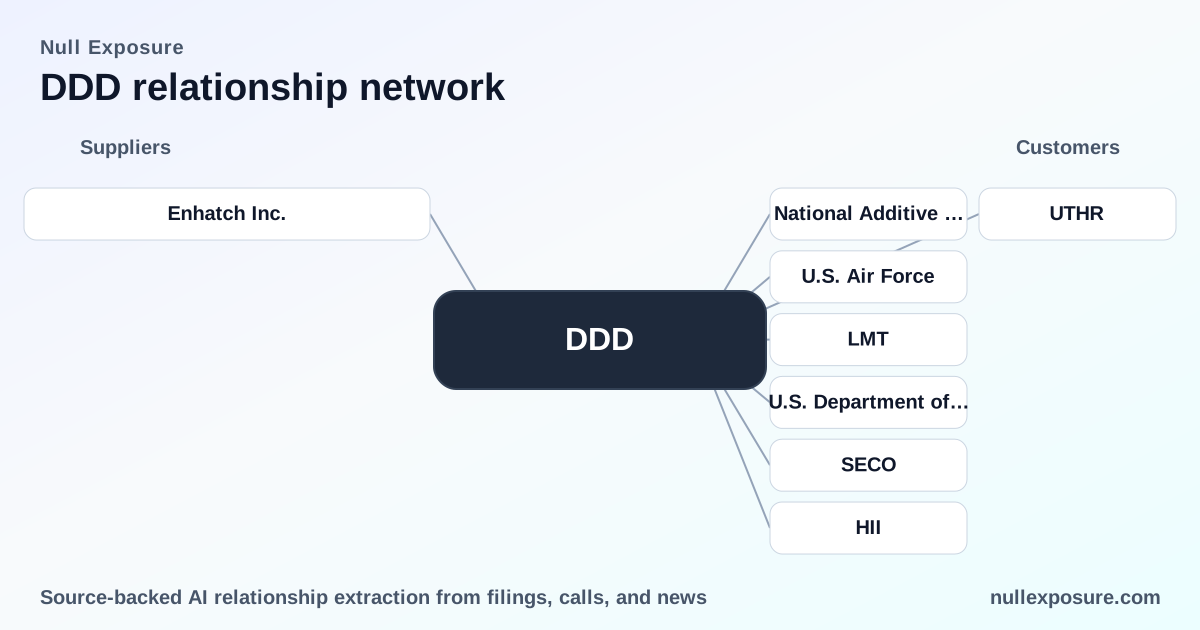
3D Systems (DDD) — supplier posture, cash commitments, and what investors should price in
3D Systems operates a vertically integrated 3D printing and digital manufacturing business that sells printers, materials, software and related services. The company monetizes through upfront hardware sales, recurring consumable and license revenues, and service/contract-manufacturing arrangements that capture post-sale revenue streams. For investors evaluating supplier relationships, the relevant signals are predictable: moderate multi-year purchase commitments, selective outsourcing for assembly, and a strategic footprint expansion into EMEA that creates both fixed obligations and operational optionality.
Learn more about supplier exposures and supplier intelligence at the Null Exposure homepage: https://nullexposure.com/
How to read the supplier picture in plain language
3D Systems reports a mix of in-house assembly and limited external manufacturing. That operating stance produces two competing dynamics: control over product quality through internal assembly, and cost/scale flexibility from outsourced manufacturing where needed. Public filings show purchase commitments and lease obligations that are material to cash planning but not existential relative to revenue.
- 3D Systems reported purchase commitments totaling $15.4 million as of December 31, 2024, with $9.3 million due within the next 12 months. This places supplier cash flow as a manageable but non-trivial line item against TTM revenue of roughly $387 million.
- The company uses a contract manufacturer in Belgium for some finished-printer assemblies and refurbishment, reflecting a deliberate partial outsourcing posture rather than full reliance on third parties.
- The company has taken a longer-term real estate posture in EMEA, including a lease for a new Frankfurt facility with a five‑year term once construction is complete.
These are company-level operational signals drawn from the FY2024 Form 10‑K disclosures and other filings. They inform negotiating leverage, concentration risk, and capital allocation priorities.
Supplier relationships you need to know about
Enhatch Inc.
3D Systems purchased $0.7 million from Enhatch in FY2024, up from $0.2 million in FY2023, indicating a rising but still modest vendor relationship in dollar terms. According to 3D Systems’ FY2024 Form 10‑K, Enhatch is recorded in the company’s purchase history and represents a small supplier line item relative to overall purchase commitments. (Source: 3D Systems 2024 Form 10‑K, FY2024 disclosure.)
Every named supplier in the results set is covered above; Enhatch is the sole explicitly quantified supplier in the public FY2024 filing.
What the constraints in filings reveal about operating model and risk
The filing excerpts produce multiple cross-cutting signals that investors should treat as structural features of the business rather than isolated facts.
- Contracting posture — longer-term fixed obligations. The filings include a lease with a five-year term that begins upon substantial completion of construction, pointing to multi-year fixed-cost exposure as the company expands its EMEA footprint. (Source: FY2024 10‑K lease disclosures.)
- Geographic expansion and regional commitments. 3D Systems entered a lease for a new building in Frankfurt, Germany, to house operations, with construction funded in part by the lessor. That is a deliberate push into EMEA capacity and customer servicing. (Source: FY2024 10‑K.)
- Materiality to cash planning. The company labels its contractual commitments and purchase obligations as material cash requirements; purchase commitments totaled $15.4 million with $9.3 million due within the next year, making supplier commitments a clear line item in short-term liquidity planning. (Source: FY2024 10‑K.)
- Manufacturing stance — limited outsourcing. 3D Systems uses a combination of in-house production and a limited contract manufacturing arrangement in Belgium for finished printers and refurbishment, indicating strategic outsourcing rather than full supply-chain dependency. (Source: FY2024 10‑K.)
These constraints translate into practical investor takeaways: fixed-cost leverage in EMEA, predictable near-term supplier cash outflows, and moderate third-party reliance for hardware assembly. None of the constraints explicitly name a major single-vendor concentration beyond the individual Enhatch entries, so the supplier base appears diversified at the level that the company reports.
Explore supplier-level risk breakdowns and contract exposure mapping at the Null Exposure homepage: https://nullexposure.com/
Investment implications — what to price in now
3D Systems’ supplier disclosures and related constraints shape three concrete investment implications:
- Liquidity planning must account for near-term purchase obligations. With $9.3 million due within 12 months, treasury and working capital management are active governance priorities even though the absolute amount is moderate versus TTM revenue.
- EMEA expansion increases fixed-cost sensitivity but supports revenue diversification. The Frankfurt lease represents both an up-front fixed obligation and a route to deeper EMEA market penetration that can lift aftermarket and service revenue over time.
- Partial outsourcing reduces capital intensity but requires vendor governance. The use of a contract manufacturer in Belgium reduces assembly capital needs while increasing the need for quality controls and supply security; this is a managed trade-off consistent with mid‑market hardware manufacturers.
From a valuation lens, these supplier signals support a view that operational risk is controlled but non-trivial: purchase commitments and leases are material enough to affect near-term cash flow, yet the spend scale (mid-single-digit percent of revenue) does not imply immediate solvency pressure. Investors should price in execution risk around EMEA rollout and the company’s ability to convert capital investments into recurring consumable and services revenue.
Practical next steps for operators and investors
- For investors: request vendor concentration schedules and a short-run cash flow sensitivity analysis around purchase commitments and lease start dates. Focus questions on the timeline and margin accretion from the Frankfurt facility.
- For operators: prioritize vendor scorecards for outsourced assembly in Belgium and tighten demand forecasting to avoid inventory-backed cash strain.
Final note: 3D Systems uses sourcing that blends in-house control and selective outsourcing while carrying manageable but material contractual commitments. That combination is consistent with a growth posture that requires careful liquidity and supplier governance.
For a deeper supplier exposure analysis and comparative benchmarking, visit Null Exposure: https://nullexposure.com/
Read 3D Systems’ FY2024 Form 10‑K for the original disclosures referenced here and for complete line-item detail.