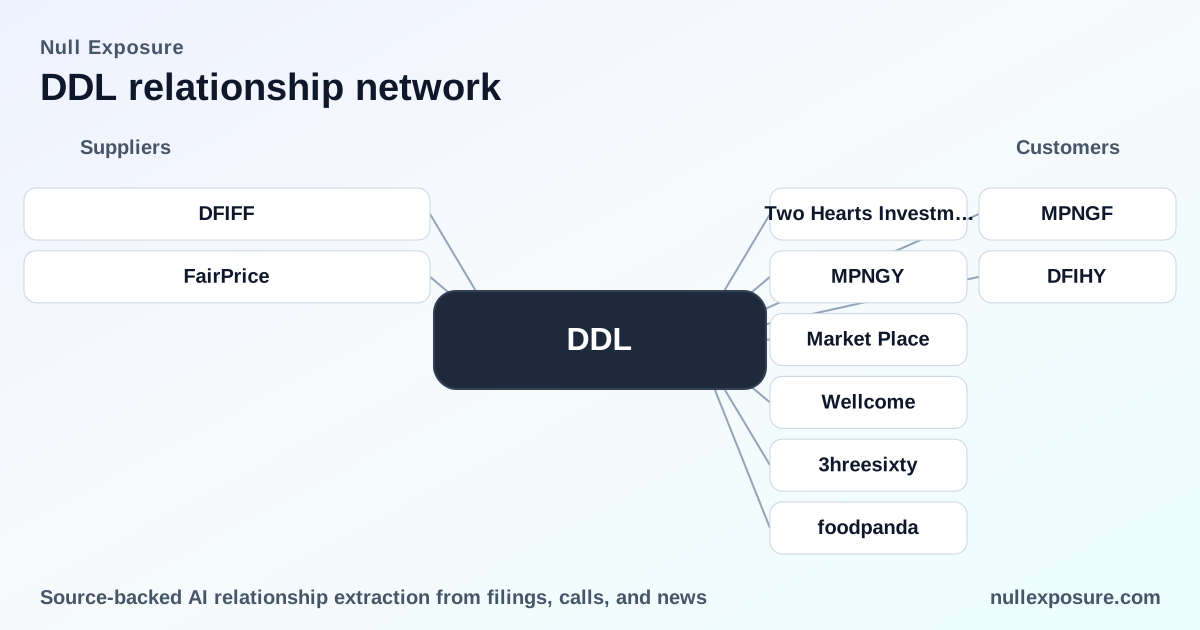
Dingdong (DDL): How supplier partnerships widen footprint and what investors should price in
Dingdong (Cayman) Limited (NYSE: DDL) operates a China-focused e‑commerce grocery platform that monetizes through rapid fulfillment, platform commissions and incremental margins on FMCG assortments, capturing revenue from both direct retail sales and merchant services. The company scales by embedding its logistics and marketplace capabilities with large regional supermarket chains, converting supply partnerships into higher order frequency and lower fulfillment cost per order. For an investor, the critical lens is how those supplier relationships translate into durable unit economics and geographic expansion. Learn more about supplier mapping and commercial signals at https://nullexposure.com/.
Why supplier partnerships matter to DDL’s unit economics
Dingdong’s public metrics show significant revenue scale (TTM revenue $24.02B) but relatively thin operating margins (Operating margin TTM 0.89%). The path to sustainable profitability relies on three interlinked commercial drivers: faster inventory turnover through partner assortments, lower per-order logistics cost driven by density, and marketplace fees or co-promotion revenues from retail partners. Supplier and retail partnerships are therefore strategic levers that compress fulfillment cost and unlock cross-border or regional growth. According to the company’s most recent disclosures (latest quarter 2025-06-30), investors should treat supplier relationships as operationally material to margin improvement and customer retention.
How the company actually contracts and scales suppliers
DDL’s operating posture is consistent with a platform-plus-logistics model rather than a wholesale inventory-only retailer. That posture implies:
- Contracting posture: commercial partnerships with established brick-and-mortar retailers and supermarket chains to broaden assortment and customer reach.
- Concentration signal: public commentary emphasizes alliances with a small set of “top-tier” partners, suggesting a moderate concentration of strategic supplier/partner relationships.
- Criticality: these relationships are operationally important to improving fulfillment economics and geographic diversification.
- Maturity: collaboration with established grocery names indicates a deliberate move from pure-play online retail toward an omnichannel aggregation strategy.
There are no company-level constraint disclosures in the supplier constraints feed for DDL, which is itself a signal: no formal constraints were parsed from supplier regulatory filings in the available sources, meaning investors must rely on narrative disclosures and call transcripts to assess supplier risk.
The relationship map investors need to know
Below are the supplier and retail partner mentions captured in public commentary; every relationship identified in the available reporting is summarized with source attribution.
DFI (DFIFF) — Hong Kong supermarket partner
Dingdong named DFI among its “top-tier partners,” indicating a commercial arrangement to extend Dingdong’s grocery assortment and presence in Hong Kong through an established supermarket operator. According to the Q3 2025 earnings call transcript reported on InsiderMonkey (published March 9, 2026), DFI is explicitly cited as a strategic partner. Source: InsiderMonkey earnings call transcript, Q3 2025 (reported Mar 9, 2026).
FairPrice — Singapore supermarket partner
FairPrice in Singapore was listed alongside other top-tier partners in Dingdong’s public earnings commentary, signaling collaborative distribution or cross-border assortment agreements to serve regional customers. The same Q3 2025 earnings call transcript on InsiderMonkey (published March 9, 2026) mentions FairPrice as part of Dingdong’s partner network. Source: InsiderMonkey earnings call transcript, Q3 2025 (reported Mar 9, 2026).
What these relationships imply for revenue durability and risk
The two partner mentions, both major supermarket brands in Southeast Asia, support a thesis that Dingdong is leveraging incumbent retail networks to accelerate expansion while controlling logistics spend. For investors, that has three concrete implications:
- Growth channel diversification: partnerships with established retailers provide immediate assortment breadth and trusted brands that can accelerate customer adoption outside Dingdong’s core geographies.
- Improved fulfillment economics: by tapping supermarket supply lines and local inventory, Dingdong reduces long-haul inventory costs and increases order density—key to lifting per-order margins.
- Counterparty concentration risk: public commentary references a handful of “top-tier” partners, implying some concentration risk where loss or deterioration of a major partner relationship could have outsized operational impact.
For deeper partner diligence and contract-level exposure, visit https://nullexposure.com/ to map counterparty concentration and criticality.
Financial context that frames supplier importance
Use the following company metrics as the backdrop when evaluating supplier relationships: Market capitalization $368.5M, Revenue TTM $24.02B, Operating margin TTM 0.89%, and Return on Equity TTM 30.3%. The combination of high revenue and thin operating margins underscores why supplier and logistics partnerships are central to any margin‑improvement thesis. Analyst consensus shows a mix of recommendations (strong buy/buy/sell split), and a forward P/E of 3.34 embeds significant near-term earnings expectations; supplier-driven cost improvements would materially affect that valuation assumption.
Risk checklist for supplier-driven expansion
- Execution risk: integrating retail partners operationally is complex; promised cost benefits are realized only after fulfillment and inventory choreography improves.
- Concentration risk: the public narrative highlights a few top partners—monitor for dependency on any single counterparty.
- Regulatory and cross-border friction: partnerships that span Hong Kong, Singapore and mainland China introduce multi-jurisdictional operational and compliance complexity.
- Margin sensitivity: until fulfillment density improves, revenue growth will not necessarily translate into proportionate operating profit gains.
Bottom line and next steps for investors
Dingdong’s supplier relationships with DFI and FairPrice are strategic and operationally material — they are a central pillar of the company’s path to improved unit economics and geographic scale. The company’s growth story now reads as a logistics-plus-partner rollout where retail alliances are the lever for margin recovery.
If you evaluate counterparty concentration, contractual terms, or economic dependency as part of your investment process, start with the public call transcripts and partner announcements captured on industry trackers. For a consolidated view of supplier exposures and to run scenario analyses on counterparty concentration, see https://nullexposure.com/.
Act now: map partner criticality, quantify fulfillment leverage, and align valuation sensitivity to supplier-driven margin improvements — learn how at https://nullexposure.com/.