Dillard’s supplier map: what investors and operators need to know
Dillard’s operates a classic department-store model: large-format retail outlets across the U.S. Sunbelt and Midwest, integrated e‑commerce, exclusive private brands, and a private‑label credit program that locks in customer economics. The company monetizes primarily through merchandise sales and a credit-card relationship that drives customer retention and financing income, while an in‑house contracting arm (CDI Contractors, LLC) reduces external build/renovation spend. For investors evaluating supplier and partner risk, the key dynamics are bargaining leverage rooted in scale and margin profile, the company’s buyer contracting posture, and the strategic value of exclusives and the card program. Learn more about how we synthesize partner signals at https://nullexposure.com/.
What the operating model says about Dillard’s supplier posture
Dillard’s is a large, financially healthy buyer with $6.56 billion in trailing revenue and a gross profit cushion of roughly $2.65 billion, giving the company purchasing leverage across merchandising categories. Company filings state that Dillard’s “purchases merchandise from many sources and does not believe that the Company was dependent on any one supplier during fiscal 2024,” which signals a deliberate strategy of supplier diversification and low single‑vendor concentration. That same filing also makes clear the company acts as a buyer for merchandise and a service operator through its in‑house construction business, CDI Contractors, LLC, which handles store construction and remodeling.
- Contracting posture: buyer-first, diversified sourcing — this supports disciplined vendor terms and mitigates supplier lock-in.
- Concentration: explicitly described as immaterial at the company level — no single supplier dependence.
- Criticality: low for individual vendors, higher for category-level exclusive brands and the private‑label card partner, which influence traffic and customer lifetime value.
- Maturity: stable merchandising relationships supplemented by periodic re-contracting for financial services (see card partner change below).
If you want a consolidated vantage on supplier risk across retail portfolios, visit https://nullexposure.com/ for practical scoring and monitoring.
The explicit third‑party relationships to track
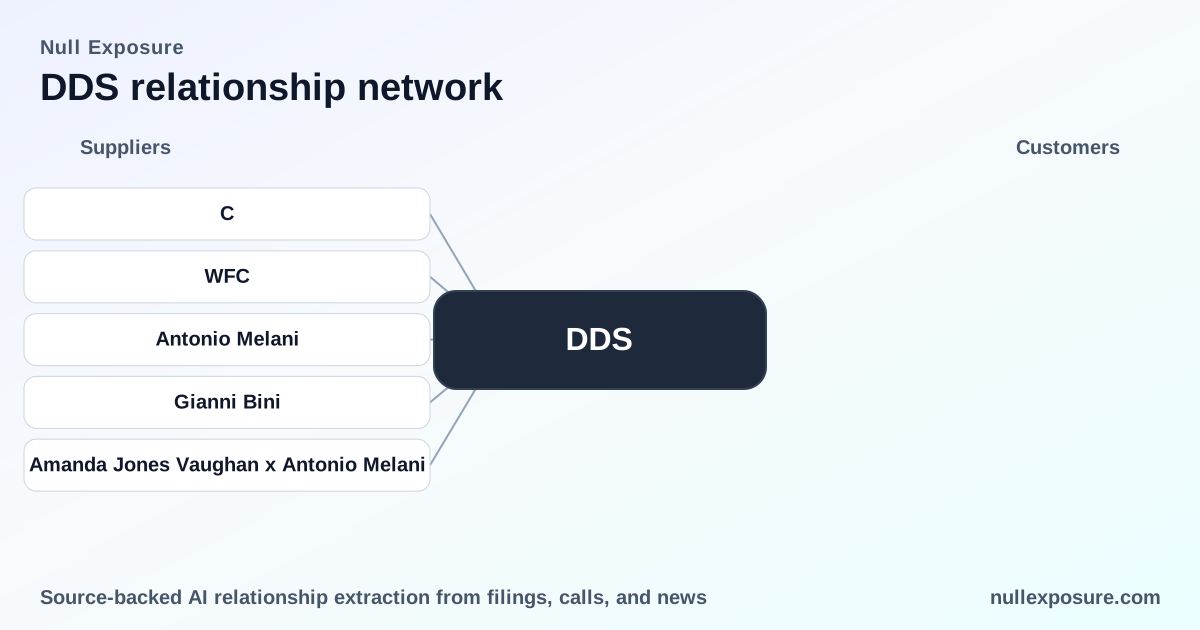
Citibank, N.A.
Dillard’s transitioned the servicing and issuance of its private‑label credit card from Wells Fargo to Citibank, with the new agreement beginning in August 2024 — a move that centralizes financing, marketing, and loyalty mechanics under a new card issuer relationship. According to a Quartz earnings recap (March 2026), this change is an active element of the company’s loyalty and financing strategy.
Wells Fargo
Wells Fargo was the prior private‑label issuer for Dillard’s and was replaced by Citibank in the August 2024 arrangement; the transition demonstrates Dillard’s ability to renegotiate or reassign card issuer relationships when commercial terms or strategic alignment shifts. Quartz noted the August 2024 change in a March 2026 earnings summary.
Antonio Melani
Antonio Melani is an apparel brand carried across Dillard’s store footprint and online at dillards.com, giving the retailer margin control on an owned/partner brand that helps differentiate assortments and protect unit economics. A Sahm Capital release (March 2, 2026) confirms the brand’s nationwide availability at Dillard’s.
Gianni Bini
A limited, exclusive assortment — the Sydney Silverman x Gianni Bini collaboration — is sold exclusively at Dillard’s, which speaks to the company’s strategy of using exclusive capsule collections to drive store traffic and direct margin capture. Sahm Capital reported the exclusivity in a November 14, 2025 announcement.
Amanda Jones Vaughan x Antonio Melani
The Amanda Jones Vaughan x Antonio Melani dresses are available exclusively at Dillard’s, reinforcing the importance of exclusive partnerships that support differentiated merchandise and pricing power. The exclusivity detail is in a Sahm Capital press release (March 2, 2026).
Reading the constraints: what they imply for supplier strategy
The constraint signals from company disclosures are company‑level, not tied to a single supplier. They communicate that Dillard’s treats suppliers as fungible across most merchandise categories, which reduces operational supplier risk. The materiality constraint labels supplier concentration as immaterial, a clear signal that single‑vendor shock is unlikely to materially disrupt results.
At the same time, the firm acknowledges dual roles: buyer (primary) and service provider via CDI. That internal contracting capability is an operational lever: by keeping store construction in‑house, Dillard’s lowers reliance on third‑party contractors for critical capital projects, improves schedule control, and likely reduces vendor markup. Those capabilities are structural advantages that improve negotiating leverage with vendors and contractors.
Operational implications for suppliers, operators, and investors
Dillard’s commercial choices create a predictable set of supplier priorities:
- Exclusive brand deals are high strategic value — they are low in count but high in customer impact, and therefore deserve heightened monitoring for sell‑through and margin performance.
- The private‑label card relationship is systemically important for transaction economics and loyalty; the August 2024 switch to Citibank demonstrates that Dillard’s will reassign financial services partnerships to optimize economics.
- In‑house construction via CDI reduces external contractor spend and gives control over store capital rollouts, which changes how vendors bid on remodel and construction work.
Financial strength supports these positions: Dillard’s posts a profit margin of 8.69% and a return on equity above 30%, implying robust cash generation and supplier bargaining power. Track changes in card revenues, exclusive-brand sell‑through, and CDI utilization as leading indicators of supplier risk and opportunity.
If you want structured monitoring on these signals, see how we score exposures at https://nullexposure.com/.
Investor takeaways and monitoring checklist
- Monitor private‑label card economics: issuer fees, receivable performance, and any public commentary around the Citibank agreement.
- Track exclusive‑brand rollouts and sales cadence for partnerships like Antonio Melani and Gianni Bini to assess traffic lift versus inventory risk.
- Watch capital expenditure cadence and CDI activity for timing of store remodels and how that affects vendor demand.
- Review future 10‑K/10‑Q disclosures for any change to the “no single‑supplier dependence” posture.
Bottom line
Dillard’s combines diversified buying power, selective exclusive merchandising, and a strategic private‑label credit program to defend margins and customer loyalty. The August 2024 issuer transition from Wells Fargo to Citibank is the clearest example of management actively optimizing partner economics, while in‑house contracting through CDI reduces reliance on outside construction vendors. For investors and operators, the priorities are clear: focus on card‑program metrics, exclusive‑brand performance, and capital‑project cadence as the primary drivers of supplier‑related risk and opportunity. For a consolidated view of supplier exposure across retail portfolios, visit https://nullexposure.com/ for actionable insights.