DDSQ: How the product is built, who it relies on, and what investors should price in
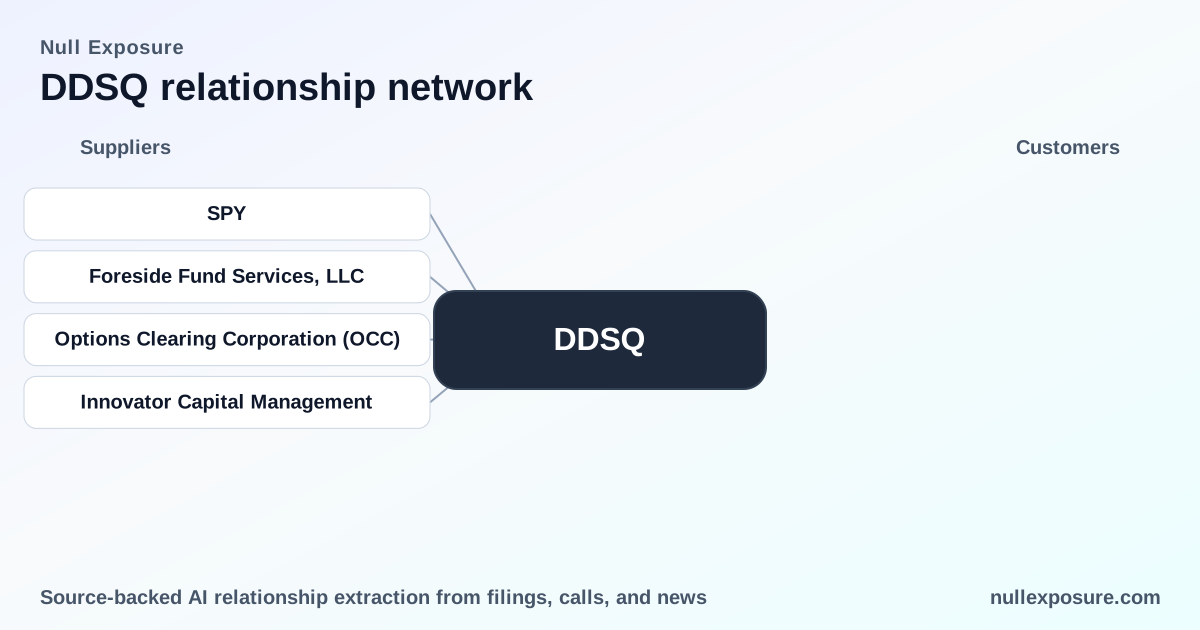
DDSQ is an ETF product structured by Innovator Capital Management that delivers a quarterly, dual-directional outcome tied to the S&P 500 through exposure to the SPDR S&P 500 ETF Trust (SPY). The issuer monetizes the strategy through fund management and distribution economics: fee income on assets under management and the commercial relationships needed to originate outcome payoffs (options structured and cleared through third parties and distributed via intermediary firms). For investors evaluating supplier risk, the commercial picture is concentrated and operationally straightforward: one large underlying ETF, a single distributor, a standard clearing counterparty, and the originating manager. Learn more about supplier exposure and counterparty mapping at https://nullexposure.com/.
How DDSQ is structured and where the fees come from
DDSQ is presented as a packaged outcome product that uses the S&P 500 as its economic anchor by linking to SPY for underlying reference. Innovator structures option-based payoffs across quarterly periods and captures revenues through ongoing management and distribution fees charged to the fund. The product’s economics rest on three pillars: underlying reference liquidity (SPY), options execution and clearing capacity (OCC/FLEX), and distribution reach (Foreside and intermediary channels). That combination is typical for outcome-oriented ETFs and creates predictable fee streams as long as asset inflows persist.
- Commercial simplicity is a strength: the fund relies on established market infrastructure rather than bespoke bilateral contracts.
- Fee capture is recurring: management and distribution economics scale with AUM, making investor flows the primary performance lever rather than trading alpha.
If you want a complete view of counterparty mappings and supplier signals for investment due diligence, visit https://nullexposure.com/.
The commercial network: the four counterparty relationships you must know
SPDR S&P 500 ETF Trust (SPY)
DDSQ is tied to the S&P 500 through the SPDR S&P 500 ETF Trust, which provides the underlying benchmark exposure for the fund’s outcome structure. According to a Benzinga report in March 2026, DDSQ uses SPY as the anchor for its S&P 500 linkage. (Benzinga, March 9, 2026)
Innovator Capital Management
Innovator Capital Management is the fund sponsor and architect of the dual-directional, quarterly outcome design that defines DDSQ’s product economics. Benzinga and issuer press commentary in early 2026 describe Innovator as the originator of the industry-first quarterly dual-directional ETFs. (Benzinga, March 9, 2026)
Foreside Fund Services, LLC
Distribution for Innovator’s ETFs, including these outcome structures, is handled by Foreside Fund Services, LLC, which acts as the distributor and intermediary to broker-dealer channels and financial advisors. ETFGI’s January 2026 note on the launch states that Innovator ETFs are distributed by Foreside. (ETFGI, January 2026)
Options Clearing Corporation (OCC)
The funds utilize FLEX Options that are issued and guaranteed for settlement by the Options Clearing Corporation, providing standardized clearing and settlement mechanics for the bespoke option positions that underlie the outcome payoffs. ETFGI’s product note confirms the use of OCC-cleared FLEX Options in the funds’ construction. (ETFGI, January 2026)
Operational and business-model signals investors should underwrite
No explicit supplier constraints were reported in the available relationship data set; treat the absence of formal constraints as a company-level signal rather than an endorsement. From the relationship map, several operating characteristics are evident:
- Contracting posture: The fund operates within standard industry contracting frameworks—issuer-distributor-clearing—rather than bespoke counterparty arrangements. That posture reduces negotiation frictions and enables fast market access.
- Concentration: Commercial exposure is concentrated across a small set of highly standardized counterparties — SPY as the underlying reference, the OCC for clearing, and Foreside for distribution — which creates single-point dependencies that investors must price.
- Criticality: Each relationship is operationally critical but functionally mature. Loss or disruption of any single counterparty would materially impede the fund’s ability to execute the outcome strategy (for example, loss of OCC clearing would prevent settlement of the FLEX Options).
- Maturity: The counterparties are established market participants with deep infrastructure; Innovator is leveraging standard market plumbing rather than experimental clearing or distribution arrangements.
These signals point to a business model that is operationally simple, commercially concentrated, and heavily dependent on market plumbing—a combination that supports predictable fee capture but also concentrates operational risk. For a deeper supplier-risk readout and mapping to enterprise risk metrics, see https://nullexposure.com/.
Investment implications and risk checklist
Investors evaluating DDSQ supplier relationships should incorporate three practical implications into valuation and operational due diligence:
- Operational dependence is concentrated. The fund’s performance mechanics and operational continuity are tied to a limited number of third parties (SPY, Foreside, OCC, Innovator). That concentration increases single-point counterparty risk even though the counterparties themselves are large and mature.
- Infrastructure risk is real and immediate. Clearing and settlement disruptions, distribution interruptions, or changes in SPY liquidity/structure would have direct impact on replication and investor flows.
- Commercial upside is tied to distribution and market acceptance. Fee income is a function of assets under management; distribution effectiveness through Foreside and Innovator’s product marketing will determine scale.
Key items for investor diligence:
- Confirm contractual terms with the distributor and manager around fee sharing and liquidity support;
- Evaluate clearing contingency plans and the use of alternative option execution venues;
- Stress-test cash flows under scenarios of SPY tracing deviations or market draws where options premiums spike.
Major takeaway: the supplier stack is lean and uses market-standard providers—this provides predictability but concentrates operational exposure.
Final view and next steps
DDSQ’s supplier ecosystem is straightforward: an established manager (Innovator) running an outcome product that references SPY, distributes through Foreside, and settles options via the OCC. That structure supports clear monetization through management and distribution fees but concentrates practical reliance on three mature counterparties. Investors should underwrite single-point supplier risk and focus diligence on distribution scalability and clearing contingencies before committing substantial capital.
If you want a full counterparty exposure report or a supplier-risk scorecard tailored to your portfolio, start here: https://nullexposure.com/. For continuous monitoring of supplier relationships and market implications, visit https://nullexposure.com/ for the latest updates and bespoke reports.