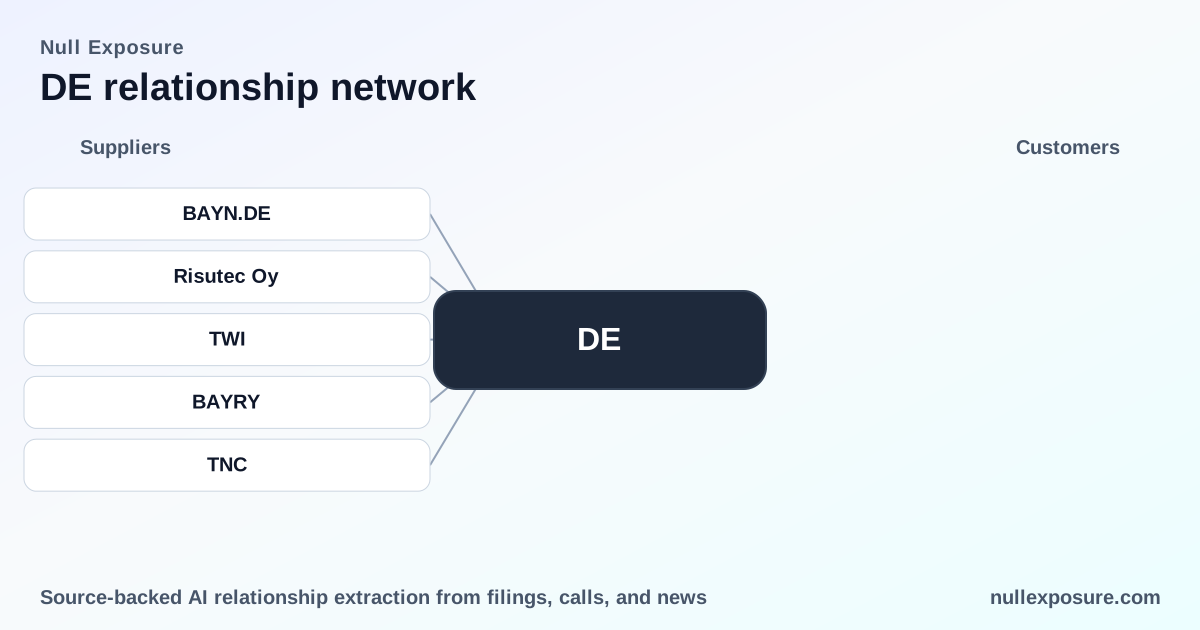
Deere & Company (DE) — supplier relationships and what they reveal for investors
John Deere manufactures and sells agricultural, construction and forestry equipment, drivetrains and related services, and it monetizes through equipment sales, parts & service revenue and software-enabled precision solutions that increase lifetime revenue per machine. With FY2026 revenue of $46.7B and a profit margin near 10%, Deere combines capital goods volume with recurring parts and data-linked services to extract higher-margin aftermarket economics. Explore supplier risk and partnership signals at https://nullexposure.com/ for a deeper supplier-centric view.
How Deere’s operating model converts suppliers into a competitive advantage
Deere’s economics rest on three linked engines: high-ticket durable equipment, aftermarket parts & service, and increasingly, precision agriculture software and data partnerships that increase machine productivity and customer switching costs. Financials show this mix: Revenue TTM $46.7B, Gross Profit $12.27B, Operating Margin ~9.3%, and Return on Equity ~19.6%, which is consistent with a capital-intensive manufacturer that captures aftermarket margins.
Strategically, Deere runs a procurement posture that is actively risk-managed: the company prioritizes allocations with its supply base, multi-sources selected parts, enters long-term contracts for critical components, and uses alternative freight to expedite delivery. That operational posture signals mature supplier management aimed at availability and continuity, not ad-hoc sourcing. For sourcing diligence and supplier-tracking tools, see https://nullexposure.com/.
Recent supplier and partner relationships investors should know about
Bayer — closing the loop between agronomics and machine execution
Deere expanded a technology tie-up with Bayer to integrate FieldView and agronomic data with Deere’s precision platforms, tightening the link between crop inputs and machine-level execution. This is a strategic revenue multiplier for Deere’s services and precision product roadmap. (According to Simply Wall St, March 9, 2026.)
A second coverage note emphasized the same Bayer integration as a driver of Deere’s precision-ag catalyst, reinforcing that the partnership is complementary to Deere’s own R&D rather than a substitute. (Simply Wall St, March 9, 2026.)
Risutec Oy — targeted acquisition of tree-planting IP
Deere acquired intellectual property and related assets from Finland-based Risutec Oy for tree-planting equipment, expanding Deere’s product set in specialized forestry planting tools. The move is a bolt-on capability play that reduces time-to-market for niche forestry equipment. (Reported in FinViz, March 9, 2026; also covered via TradingView/Zacks, March 9, 2026.)
Titan International, Inc. — supplier/peer mention around tariff exposure
Titan International referenced Deere as one of its customers when discussing tariff estimates for 2025, signaling Deere’s material sourcing and customer role within the tire and wheel ecosystem for heavy equipment. This mention highlights the indirect supplier/market exposure Deere creates for parts vendors and confirms Deere’s scale in procurement conversations. (InsiderMonkey transcript reference, March 9, 2026.)
Tenna — bringing construction telematics in-house through acquisition
Deere acquired Tenna, a construction-technology firm, in February 2026, folding asset-tracking and telematics capabilities into the construction equipment stack. This acquisition accelerates Deere’s ability to monetize fleet telematics and integrate construction workflows with its machines. (TradingView/Zacks coverage and FinViz, March 9, 2026.)
What the constraint signal tells you about Deere’s supply chain posture
The available constraint signal is company-level and not tied to a particular supplier: Deere is using long-term contracts for critical components, multi-sourcing, allocation prioritization, and alternative freight to maintain material availability. Interpreted as an operating characteristic, this means Deere’s procurement is proactive and layered, using contractual duration and supplier diversification to reduce disruption risk and protect production continuity. The net effect for investors is lower near-term disruption probability but higher fixed-cost commitments and supplier concentration oversight required.
Investment implications — where supplier signals change the investment case
- Precision partnerships (Bayer) amplify recurring-margin potential: integrating agronomic inputs into Deere’s machine controls increases the value of Deere’s software subscriptions and services. This elevates lifetime customer value beyond hardware sales.
- Bolt-on acquisitions (Risutec, Tenna) show a deliberate strategy to buy capability rather than build for certain niche and telematics functions; this accelerates go-to-market but compresses near-term free cash flow due to acquisition spend.
- Procurement discipline via long-term contracts reduces supply interruptions but raises exposure to fixed-price or volume commitments during demand swings.
- Supply-side externalities such as tariffs (flagged via Titan International’s comments) remain a residual risk that affects input cost and margins.
For portfolio managers and operators focused on supplier due diligence, these signals imply a balanced operating model: Deere protects production through contracting and multi-sourcing while using targeted acquisitions and partnerships to enhance product breadth and sticky recurring revenue.
Explore supplier-specific risk dashboards and relationship timelines at https://nullexposure.com/ to track how these relationships evolve.
Practical risk checklist for DE investors
- Confirm how Deere’s long-term contracts are structured: duration, indexation to commodity or FX, and termination rights.
- Monitor integration KPIs post-acquisition (Tenna, Risutec): time-to-revenue, cross-sell rate, and R&D cost savings.
- Watch precision partnership monetization metrics: subscription ARPU, attach rates on new equipment, and data-sharing economics with partners like Bayer.
- Track trade and tariff developments for components where Deere is a major buyer; supplier mentions (Titan) signal potential cost pass-through or margin pressure.
These items separate durable structural upside (precision services, aftermarket) from cyclical and policy-driven risks (tariffs, component shortages).
For an ongoing supplier intelligence feed and tailored alerts, visit https://nullexposure.com/ — essential for investors who treat supplier relationships as predictive indicators.
Bottom line: supplier moves are strategic, not incidental
Deere’s recent activity—software partnerships with Bayer, targeted IP and tech acquisitions (Risutec, Tenna), and the procurement posture indicated by long-term contracting—signal a company deliberately converting its supply network into a competitive moat. The strategy increases recurring revenue potential and resilience but also embeds contractual and integration risks that require active monitoring. For investors and operators, the next questions are execution speed on integration and the transparency of contract exposure; both will determine whether Deere’s supplier strategy translates into sustained EPS upside. For continuous monitoring of these supplier dynamics and relationship-level analytics, go to https://nullexposure.com/.