Easterly Government Properties (DEA): Supplier and Rating Relationships that Shape Risk and Cost of Capital
Easterly Government Properties (NYSE: DEA) operates as a specialized REIT that acquires, develops and manages Class A commercial properties leased predominantly to the U.S. government, monetizing through long-term lease cash flows, development and selective dispositions, and dividend distributions to shareholders. Scale is modest but institutional: market capitalization near $1.15 billion and trailing revenue around $343 million, and the company’s financial profile is materially influenced by its tenant mix and its credit standing. If you evaluate supplier relationships or contracting posture for DEA, focus on counterparty quality, lease tenor and the company’s credit profile — each drives financing costs and vendor terms. For more supplier-level intelligence, visit https://nullexposure.com/.
Why third-party relationships and ratings matter to investors and operators
Ratings and vendor relationships translate directly into financing economics and operational flexibility for a REIT focused on government tenants. An investment-grade affirmation from a recognized agency reduces borrowing costs, improves access to capital markets and strengthens supplier negotiation leverage for construction, property management and professional services. Conversely, concentrated geography or buyer-side lease commitments change supplier exposure: vendors are dealing with an owner who values stability of cash flow and long-term performance over opportunistic turnover.
Public relationship entries for DEA (what’s on record)
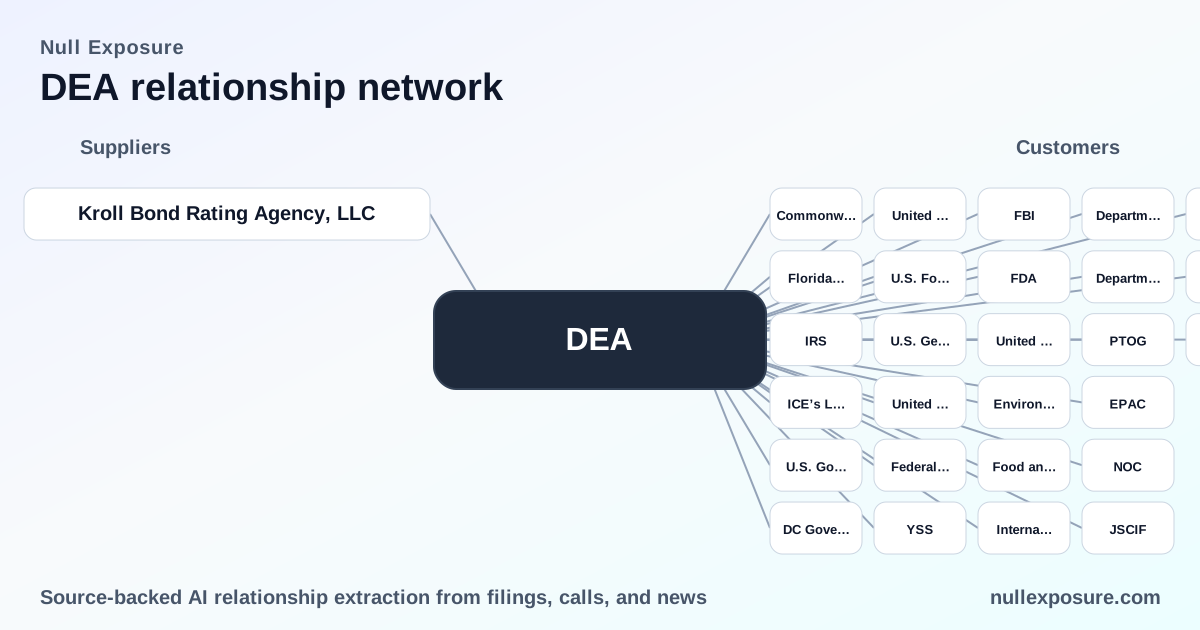
The public relationship records for DEA in our review are limited to interactions with a credit rating agency; both items below reference the same provider and reflect consistent messaging across fiscal periods.
- Kroll Bond Rating Agency, LLC — MarketScreener reported on March 9, 2026 that KBRA affirmed Easterly’s BBB issuer and securities ratings with a Stable Outlook for FY2025, underscoring the rating agency’s view of the company’s credit profile. According to the MarketScreener note, KBRA’s affirmation reflects the REIT’s alignment with investment-grade metrics and cash flow predictability. (MarketScreener, March 9, 2026)
- Kroll Bond Rating Agency, LLC — A TradingView news item on March 9, 2026 repeated that KBRA reaffirmed an investment-grade issuer credit rating of BBB with a Stable Outlook in connection with Easterly’s FY2026 reporting, indicating continuity in rating posture across reporting periods. The TradingView coverage cites the company’s reported results alongside the KBRA reaffirmation. (TradingView, March 9, 2026)
Both entries point to the same external counterparty — a formal rating relationship with Kroll Bond Rating Agency — recorded in separate public notices tied to adjacent fiscal reporting. These affirmations are publicly documented and signal that external credit analysis supports the REIT’s investment-grade label.
What the KBRA affirmations mean for supplier relationships and contracting posture
The consistent BBB Stable assessment from KBRA is consequential for suppliers and counterparties:
- Lower borrowing cost and predictable liquidity: An investment-grade rating reduces the enterprise’s weighted-average cost of capital, which in turn stabilizes vendor payment risk and supports longer contract terms with larger counterparties.
- Stronger negotiating position for multiyear contracts: Suppliers negotiating property services, construction or professional engagements encounter a counterparty whose financing is more secure than non-investment-grade peers.
- Operational implications for capital-intensive projects: Rating stability enables more disciplined capital deployment for development or redevelopment projects and reduces the probability that supplier payments become constrained in a downturn.
These implications are practical: vendors should price long-duration service contracts and performance bonds with the rating benefit in mind, while operators should recognize that rating affirmations are also a monitor for covenant flexibility in debt facilities.
Company-level constraints and what they reveal about vendor exposure
Company disclosures contain two actionable constraints that apply across DEA’s supplier universe:
- Geography: DEA reports leasing corporate office space in Washington, D.C. and San Diego, CA, signaling a U.S.-centric footprint and regional concentration for corporate operations rather than a globally diversified landlord model. The excerpt reads: “We lease corporate office space under operating lease arrangements in Washington, D.C. and San Diego, CA.” This is a company-level signal about where counterparties (professional services, local vendors) will be engaged.
- Relationship role: The firm discloses that it is a buyer under operating lease arrangements for its own corporate offices, indicating that DEA engages the market as a contracting party for property leases and ancillary services rather than primarily as a service provider in those contexts. The same lease excerpt supports this classification.
Taken together, these constraints shape supplier strategy: prioritize U.S.-based partners familiar with federal-tenant operating requirements, and price contracts for a counterparty whose administrative offices and coordination will be concentrated on the East and West coasts.
Operational maturity, concentration and criticality — a narrative assessment
Easterly’s model combines concentrated government tenancy with formal credit recognition. This produces a distinct set of supplier-facing characteristics:
- Contracting posture: Long-term, stable leases with government tenants produce predictable cash flows that favor multiyear supplier contracts and performance-based service models.
- Concentration: Tenant concentration to U.S. government leases is a double-edged sword — high credit quality but single-sector risk, which shifts supplier exposure from tenant credit risk to policy and appropriation risk at the federal level.
- Criticality: Properties leased to government agencies are operationally critical; vendors supplying security, systems, and maintenance are essential and can command stricter SLAs and prioritized payments.
- Maturity: The REIT’s investment-grade affirmations and steady revenue profile reflect a mature operating platform, which reduces counterparty onboarding friction for institutional suppliers.
Investor and operator takeaways
- Credit affirmation by KBRA is a positive signal for suppliers and lenders: expect more favorable financing and bonding terms relative to unrated or high-yield REIT peers.
- Regionally concentrated corporate operations require local market knowledge from vendors and may limit bargaining leverage in non-local service categories.
- For strategic suppliers, DEA represents a stable, lower-risk counterparty for long-term contracts, but pricing should reflect federal-tenant concentration risk and any potential policy-driven revenue shocks.
For deeper supplier risk scoring, contract benchmarking and counterparty exposure analysis, explore strategic intelligence and supplier profiles at https://nullexposure.com/.
If you are an operator or investor assessing vendor engagements with DEA, prioritize counterparties that understand government lease performance requirements, can offer multiyear pricing stability, and are capitalized to support mission-critical facilities. For tailored supplier diligence and to map counterparties against credit posture, start with https://nullexposure.com/.
Final recommendation: treat Easterly as a credit-stable, government-tenant focused REIT whose supplier strategy should emphasize long-term operational reliability and localized service capability; KBRA’s BBB Stable ratings reinforce that posture and materially affect supplier economics.