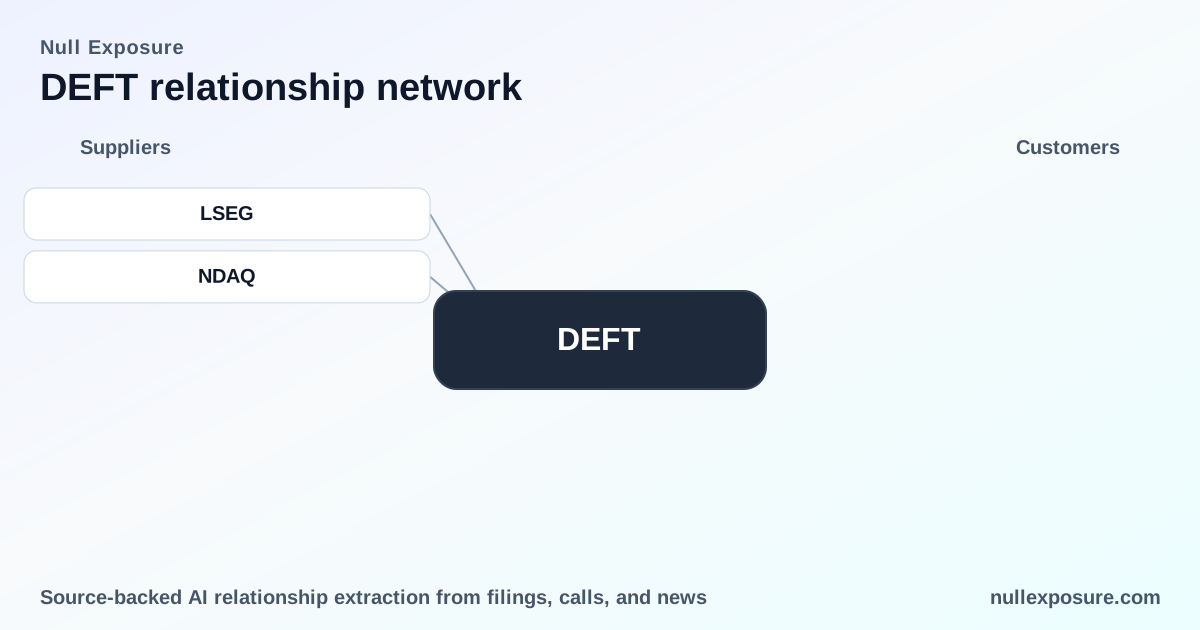
DeFi Technologies (DEFT): Exchange relationships that shape distribution and listing risk
DeFi Technologies develops and distributes exchange-traded products (ETPs) that synthetically track the value of single or baskets of decentralized finance protocols; the company monetizes through product issuance and the fees and spreads associated with managing and distributing those ETPs across public exchanges. Revenue is driven by ETP assets under management and the breadth of exchange distribution, while market value and capital access are directly affected by listing status and secondary-market liquidity. For investors evaluating supplier and partner exposure, the company’s relationships with major exchanges and regulators are the primary operational levers to watch. Learn more about how we map supplier relationships at NullExposure: https://nullexposure.com/.
Market-facing relationships matter for DeFi Technologies because they are the delivery channels for product sales, regulatory clearance, and share-market liquidity. Below I lay out the explicit exchange links surfaced in public reporting, explain company-level constraints and operating posture, and draw the investor implications for partnerships and risk management.
Why the exchange layer is the business lifeline
DeFi’s commercial model is straightforward: package synthetic ETPs, list them where institutional and retail investors can buy, and collect fees while scaling assets under management. Exchange partners are therefore both distribution outlets and regulatory gatekeepers. When an exchange or its regulator changes access rules or takes action on listings, DeFi’s go-to-market and valuation are immediately impacted. Recent public reports show both the upside of expanded distribution and the downside of listing-related scrutiny.
What the public record shows: the company’s reported exchange relationships
A London gateway opened for retail ETP sales
According to a corporate news release published in March 2026, Valour ETPs received FCA approval and began offering select yield-bearing crypto ETPs to UK retail investors through the London Stock Exchange starting January 26, 2026, expanding DeFi’s distribution into a major European venue. (EQS News corporate release, March 2026 — https://www.eqs-news.com/news/corporate-news/defi-technologies-announces-valour-receives-uk-regulatory-approval-and-begins-offering-select-yield-bearing-crypto-etps-to-uk-retail-investors-via-the-london-stock-exchange/af543ec4-147b-4d8f-baa1-94af8c36aac6)
Nasdaq warning highlights listing risk and secondary-market dynamics
A March 2026 news report noted that Nasdaq issued a warning after DeFi’s shares fell below $1, while confirming that trading under ticker DEFT continued and that the notice did not immediately affect listing or trading; this underscores direct listing risk tied to share-price thresholds on a primary U.S. exchange. (AmbCrypto news report, March 2026 — https://ambcrypto.com/defi-technologies-gets-nasdaq-warning-after-shares-fall-below-1/)
Company-level constraints and operating posture (signals for investors)
NullExposure’s relationship extraction returned no explicit constraint excerpts tied to these relationships, which itself is a signal: there are no disclosed contractual limitations or vendor constraints extracted by the service. Treat that absence as a company-level data point rather than proof of absence—operational and regulatory dependencies are nonetheless evident from other public facts.
From a business-model perspective the operating characteristics are as follows:
- Contracting posture: DeFi operates as a product issuer that depends on third-party exchange approvals and regulatory clearances to access retail and institutional markets. Contracts with exchanges and custodians will shape distribution economics and compliance obligations.
- Concentration: Distribution is concentrated through a small number of major exchanges; the London Stock Exchange approval materially increases reach, while Nasdaq remains the primary U.S. listing venue for the equity. Concentration in a few channels amplifies counterparty and regulatory risk.
- Criticality: Exchange relationships are critical to both revenue and market liquidity. Loss or restriction of an exchange channel would have an outsized impact on AUM growth and share-market sentiment.
- Maturity: The product portfolio is commercially live and expanding internationally (London listing for UK retail), but the company’s high beta, steep 52-week range, and share-price sensitivity imply that overall market maturity is still early; public equity is subject to listing rules that can force remediation steps.
These are company-level observations derived from the corporate description and the exchange-related disclosures; no constraint explicitly names either exchange in the constraint dataset you provided.
What investors need to watch next
- Distribution expansion vs. regulatory exposure. The LSE/FCA approval opens retail channels in Europe and should drive AUM growth for qualifying ETPs; however, broader product rollouts will require continued regulator and exchange cooperation.
- Listing-health indicators. Nasdaq’s shareholder-value threshold enforcement is a near-term corporate governance and capital-access risk; a continued share-price deficit could trigger delisting proceedings or remediation obligations.
- Concentration risk mitigation. Management should diversify distribution partners and shore up retail custody/clearing arrangements to reduce single-exchange dependencies.
- Operational transparency and disclosures. For suppliers and counterparties, clear contractual terms with exchanges and counterparties will be decisive; for investors, monitor filings that disclose remediation plans, capital raises, or programmatic product rollouts.
If you track suppliers and exchange counterparties, our platform maps these relationships across news and filings—explore the full supplier view at https://nullexposure.com/ to see connections and historical changes.
Quick, actionable takeaways for portfolio and operations teams
- Positive distribution signal: LSE + FCA clearance for Valour products materially expands UK retail access and should support AUM growth for qualifying ETPs. (EQS News, March 2026)
- Immediate listing risk: Nasdaq’s warning over the sub-$1 share price is a governance-triggered risk that directly affects equity liquidity and access to U.S. capital markets. (AmbCrypto, March 2026)
- Business reliance on exchanges: Exchange approvals function both as enablers and chokepoints—operational resilience requires multiple distribution channels and proactive regulatory engagement.
For a deeper supplier-level intelligence package on DEFT’s exchange and custody partners, see our research hub: https://nullexposure.com/.
Bottom line
DeFi Technologies has demonstrated the ability to expand distribution via major exchanges—evidence of product-market fit in the ETP channel—but the company’s market value and operational runway are tightly coupled to exchange approvals and the health of its public listing. Investors and operational partners should treat exchanges as strategic suppliers: they provide distribution at scale but also impose regulatory and listing constraints that can rapidly alter the company’s capital and growth trajectory. Conduct counterparty diligence that focuses on contractual terms with exchanges, remediation plans for listing risks, and diversification of distribution to avoid single-channel exposure.