Denny’s (DENN) supplier relationships after the sale: who advises the buyer and what it means for investors
Denny’s Corporation operates and monetizes as a franchised full‑service restaurant chain that generates revenue from a mix of company‑operated locations, franchise royalties and ancillary services; the company’s economics are driven by steady restaurant sales, franchise fee flows and a durable brand with modest margin expansion potential. In January 2026 Denny’s completed a strategic sale to a trio of investment firms, and the company lined up top‑tier legal, financial and communications advisers to execute and close the transaction—an arrangement that frames near‑term governance and counterparty risk for operators and vendors. For a quick look at how these relationships affect supplier and investment decisions, visit https://nullexposure.com/.
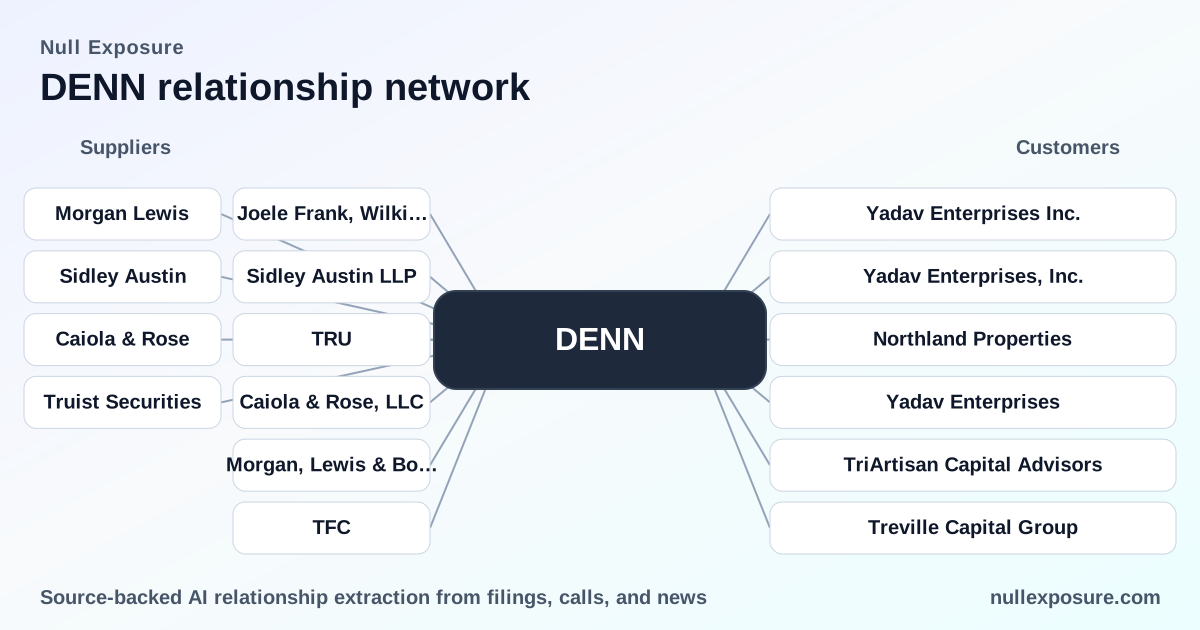
Deal context and why the adviser roster matters Denny’s announced completion of its acquisition in a GlobeNewswire release dated January 16, 2026, confirming the company’s transition to private ownership under TriArtisan Capital Advisors, Treville Capital Group and Yadav Enterprises. The adviser roster is concentrated among large, established firms: Truist Securities as financial advisor, Morgan Lewis and Sidley Austin as legal counsel, Caiola & Rose as boutique co‑counsel, and Joele Frank for strategic communications. That mix defines the contracting posture during and immediately after the sale—transactional, legally robust, and communication‑focused—rather than a shift in operational suppliers to restaurants. Read the company announcement at the investor release on GlobeNewswire (January 16, 2026) or the earlier transaction notice (November 3, 2025) for timeline details.
Supplier/adviser roll call — what each relationship is and why it matters Below are the firms the company used in the sale process with concise, investor‑grade summaries and source context.
Joele Frank, Wilkinson Brimmer Katcher
Joele Frank served as strategic communications advisor to Denny’s during the sale process, managing public messaging and investor communications around the transaction. According to Denny’s January 16, 2026 press release on GlobeNewswire, Joele Frank was retained to guide the company’s external narrative during closing.
Sidley Austin LLP
Sidley Austin acted as lead legal advisor on the sale, providing international law firm resources for transaction documentation and regulatory review. The firm’s role is documented in the GlobeNewswire announcement (January 16, 2026), and reported independently in ICLG coverage of the sale as Sidley’s advisory engagement on the transaction (FY2025–FY2026).
Truist Securities
Truist Securities served as financial advisor to Denny’s for the sale, overseeing valuation, buyer coordination and deal execution. The engagement is cited in the company’s January 16, 2026 GlobeNewswire release and in the earlier November 3, 2025 transaction notice; Truist’s involvement signals use of a full‑service investment bank to manage pricing and sale mechanics.
Caiola & Rose, LLC
Caiola & Rose provided boutique legal co‑counsel alongside larger firms, supporting transactional legal work likely focused on US securities and deal minutiae. The company’s role appears in the January 16, 2026 GlobeNewswire announcement and in the transaction disclosures published November 3, 2025.
Morgan, Lewis & Bockius LLP (Morgan Lewis)
Morgan Lewis served as additional legal co‑counsel, reinforcing the company’s legal coverage with global firm resources during the sale process. The firm’s participation is included in Denny’s GlobeNewswire release (January 16, 2026) and noted in legal trade coverage discussing Sidley’s lead role on the transaction (FY2025).
What the adviser list signals about Denny’s operating and contracting posture
- Contracting posture: transactional and defense‑grade. The selection of major legal houses and a national investment bank indicates Denny’s prioritized structured, document‑driven contracting to manage transfer of ownership risk and compliance obligations during the sale. This posture reduces legal and regulatory tail‑risk for the buyer and vendors engaged in the closing.
- Supplier concentration is low but advisory intensity is high. The roster is concentrated among a small set of advisers for a discrete transaction rather than a broad operational supplier list; these relationships are critical to closing but not directly material to day‑to‑day restaurant operations.
- Criticality: high for governance, limited for operations. Legal and financial advisors were critical to execution and valuation; their role is time‑bounded. For restaurant operators and supply chain partners, operational continuity depends more on franchise agreements and supply contracts than on the adviser roster.
- Maturity: corporate governance at private equity standards. Use of international law firms and a recognized investment bank signals governance maturity expected by private equity buyers and positions the company to standardize vendor contracts and franchise oversight post‑close.
Company-level constraint signals (what to watch) The dataset contains no explicit vendor or supplier constraints disclosed in the capture provided. That absence is itself a signal: there were no public supplier exclusivity, performance covenant, or material vendor constraints recorded in the sources tied to the sale. Investors should treat that as a neutral to positive indicator for vendor flexibility, but should validate contract terms directly with the company if supply continuity or exclusivity is a concern.
Operational and financial implications for investors and operators
- Revenue base and margins: Denny’s reported trailing revenues around $457.2M with gross profit near $176.9M and operating margin close to 9.4% (TTM); the private equity buyers bought a business with stable top‑line flows and modest operating leverage. Those public metrics set the baseline for any cost rationalization or capital investments the new owners will pursue.
- Franchise and vendor negotiations: The sale and adviser engagement likely precede a period of contract reviews and renegotiations. Operators and vendors should prepare for standardization requests, consolidated procurement, or revised credit terms as private owners pursue margin improvements.
- Governance and reporting: Expect heightened legal oversight and standardized reporting from franchisees and suppliers consistent with private equity governance practices introduced by major advisers.
Actionable recommendations
- For investors: reevaluate counterparty risk and contractual exposure in light of the ownership change and adviser‑led closing; examine franchise agreements and supply contracts for change‑of‑control provisions.
- For suppliers/operators: confirm continuity clauses and payment terms with franchisees and corporate procurement to avoid interruption during integration and any post‑closing procurement consolidation.
If you want a concise supplier risk brief or a tailored relationship map for Denny’s post‑close, start here: https://nullexposure.com/.
Closing note The adviser roster on Denny’s sale is high quality, transaction‑focused, and consistent with a private equity playbook—Truist managed valuation and sale mechanics, Sidley and Morgan Lewis managed legal risk, Caiola & Rose supported specialized counsel needs, and Joele Frank controlled messaging. That combination reduces execution risk from an investor perspective while signaling an imminent period of contract standardization that suppliers and operators should proactively prepare for. Learn more about relationship risk and supplier exposure at https://nullexposure.com/.