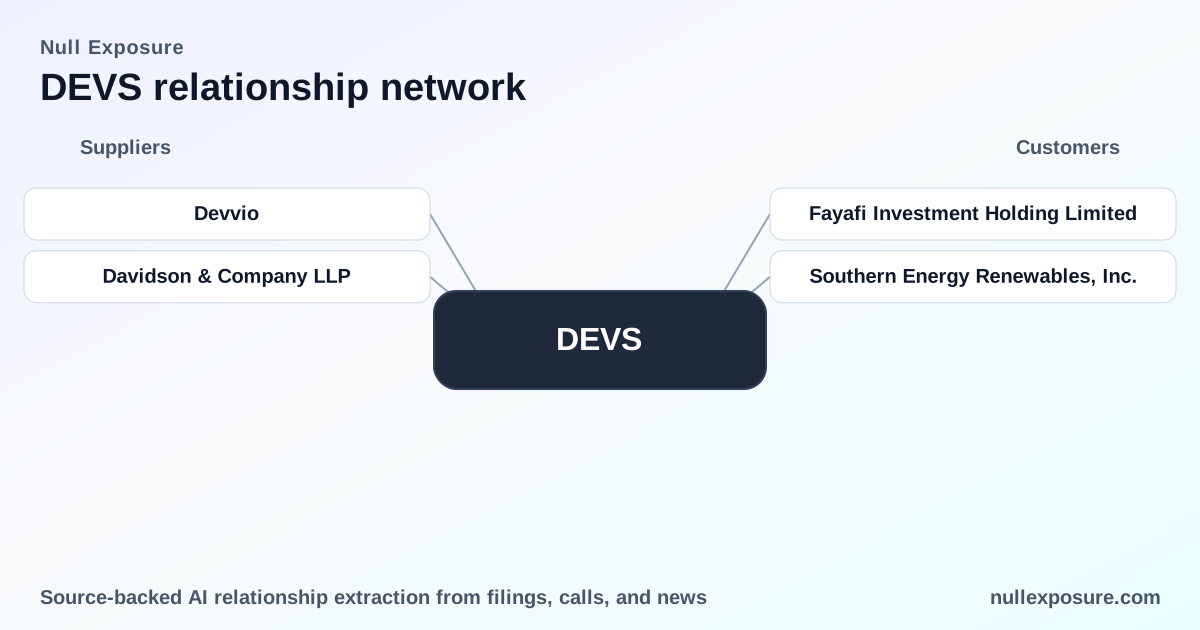
DevvStream (DEVS) supplier footprint — what investors need to know
DevvStream operates as a low-revenue, high‑leverage carbon credit originator and monetizer, generating value by certifying, aggregating and selling renewable energy attributes and carbon credits while licensing and buying technologies and services to scale its platform. Revenue is currently negligible versus operating losses, so supplier relationships—licensing deals, consulting retainers, custody arrangements and trading partnerships—function as the company’s operational backbone and the principal drivers of near-term cash burn and execution risk. For investors evaluating counterparty exposure and governance, the supplier map is as important as project inventories. Learn more at https://nullexposure.com/.
How supplier choices reveal the business model
DevvStream’s commercial model relies on three monetization levers: (1) originating and certifying carbon and renewable energy attributes, (2) licensing and using third‑party technology to tokenize or record attributes, and (3) accessing trading venues and custodians to monetize credits. That mix explains why the company both signs licensing agreements with smaller technology providers and retains sizable consulting contracts and trading platform relationships.
- Large consulting retainers and multi‑year agreements indicate a contracting posture that prioritizes strategic services over in‑house build, which concentrates execution risk with a few service providers.
- Licensing and custody relationships are operationally critical: technology fees and custody diversification directly influence ability to list, trade and settle carbon assets.
- Spend concentration is meaningful for a microcap with a market cap of roughly $3.56 million and negative EBITDA of about $8.68 million; single contracts in the $100k–$1m band or above are economically significant.
The relationships in the filings — line by line
Below are the supplier and auditor relationships identified in the public record for DEVS, each with a concise plain‑English summary and the source.
Devvio
DevvStream signed an amended strategic partnership agreement with Devvio during the year ended July 31, 2024, positioning Devvio as a named strategic partner in the company’s FY2025 disclosures. According to the company’s FY2025 Form 10‑K, this amended partnership is part of the firm’s efforts to scale platform capabilities and commercial channels (FY2025 10‑K filing).
Davidson & Company LLP
Shareholders ratified Davidson & Company LLP as independent auditors for the fiscal year ending July 31, 2026, reflecting shareholder approval of current governance and oversight; the appointment was reported in a March 2026 press release published via The Globe and Mail (press release, March 2026).
Contracting posture, criticality and maturity — what the constraints reveal
The disclosure set contains several contractual and operational constraints that form a coherent operating profile for DevvStream. These are company‑level signals unless the excerpt names a counterparty.
- Long‑term and auto‑renewing contracts are in place. The strategic consulting agreement described in filings carries a three‑year initial term with automatic one‑year renewals unless 120 days’ notice is given, which locks in a predictable but material annual cash commitment of $500,000 payable quarterly (FY2025 filing). This is a structural cost for a company with near‑zero revenue.
- Shorter financings and instrument maturities exist. The company issued tranches with an 18‑month maturity at 8% interest and an 8% issuance discount, underscoring a reliance on short to medium‑term capital instruments to fund operations (FY2025 filing).
- Licensing commitments impose fixed annual fees. DevvStream entered a licensing agreement with Greenlines Technology Inc., including a near‑term payment of $42,000 and an annual fee of $12,000 starting 2025, establishing an obligatory recurring expense tied directly to third‑party tech (FY2025 filing).
- Service providers are operationally critical. The company uses custodians for digital tokens and plans diversification across custodians; BitGo is explicitly named as its current custody partner, which creates custody concentration risk unless diversified (FY2025 filing).
- Trading and liquidity partnerships are strategic. DevvStream identified Xpansiv DataSystems Inc. as its intended trading venue for sustainability‑inclusive products, which is a primary channel for monetizing credits and therefore a key operational dependency (FY2025 filing).
- Terminations and legacy arrangements reduce certain counterparty risks but signal volatility. In June 2025 DevvStream terminated a prior carbon‑credit purchase‑for‑shares agreement with Companhia de Desenvolvimento de Serviços Ambientais do Acre S/A (CDSA) and VBH, cancelling all previously issued common shares tied to those agreements in July 2025, demonstrating active contract rebalancing (FY2025/2026 filings).
- Spend concentration is material for a microcap. Disclosed engagements include a $500,000 annual consulting fee (Focus Impact Partners), a $125,000 issuance commitment to Helena I settled with shares, and a roughly $1.14 million carbon purchase agreement with Karbon‑X Corp., placing certain counterparties in the $100k–$1m and $1m+ spend bands and exposing the company to counterparty and funding risk (FY2025 filings).
Operational risks and governance implications
Given the company’s small market capitalization, negative operating results and a supplier footprint weighted to a few sizable agreements, execution and counterparty risk are the principal near‑term investor concerns. Key observations:
- Concentration risk is elevated. A handful of service providers and trading/custody partners are critical to revenue realization and settlement.
- Contract maturity mismatch creates refinancing pressure. Short‑to‑medium‑term financing instruments and large annual consulting fees increase the probability of needing additional capital within 18 months.
- Governance is partially validated by auditor ratification. Shareholder ratification of Davidson & Company LLP in March 2026 signals basic governance continuity, but it does not mitigate operational dependency on third‑party services (press release, March 2026).
If you want a deeper counterparty‑by‑counterparty breakdown or a tailored risk memo for investment committees, visit https://nullexposure.com/ for bespoke research and relationship mapping.
Tactical takeaways for investors and operators
- Prioritize monitoring of custody and trading counterparties (BitGo, Xpansiv) because these entities are the pathway to monetizing credits and represent operational single points of failure.
- Quantify the cash runway impact of the $500k annual consulting commitment and the 18‑month financing tranches; these are immediate liquidity levers.
- Track contract renewals and terminations (for example the CDSA/VBH cancellation) as early indicators of strategy shifts or stress.
For investors considering position sizing or engagement, request the latest contract schedules and a cash runway update from management; you can start that process at https://nullexposure.com/.
Bottom line
DevvStream is a microcap carbon‑credit originator whose supplier relationships—long‑dated consulting retainers, named custody and trading partners, and a mix of licensing and purchase commitments—drive both its ability to monetize assets and its funding needs. Supplier concentration, fixed recurring fees and short‑term financing tranches are the dominant operational risks. Investors should insist on clarity around custody diversification, liquidity pathways via trading partners, and the company’s forward financing plan before increasing exposure.