DeFi Development Corp. Warrant (DFDVW): What investors need to know
DeFi Development Corp. issues warrants (ticker DFDVW) tied to a business whose public positioning is a treasury strategy built to accumulate and compound Solana (SOL); the company monetizes by operating the treasury, managing crypto exposures, and through corporate actions tied to its common equity and dividend-warrants. The warrant itself trades on the Nasdaq Capital Market, providing investors liquid exposure to the company’s upside without an equity position. For deeper supplier and counterparty intelligence, review our homepage for structured profiles and filings: https://nullexposure.com/
What the listing tells us: warrants are live on Nasdaq
The most material recent development for DFDVW is that the dividend-warrants began trading on the Nasdaq Capital Market under the symbol DFDVW. According to a GlobeNewswire press release (November 6, 2025), the warrants are now listed and trading on Nasdaq’s Capital Market. The same announcement was syndicated through The Globe and Mail, which quoted the company noting that the warrants declared October 8, 2025, began trading following the company’s public notice. These listings create a tradable instrument for investors seeking leveraged or time-limited exposure to DeFi Development Corp.’s strategy; the presence of a Nasdaq listing also raises baseline regulatory and disclosure expectations for the issuer. (GlobeNewswire, Nov 6, 2025; The Globe and Mail, Nov 2025)
Supplier and counterparty relationships — the full set
Below I cover every relationship returned in the supplier scan.
-
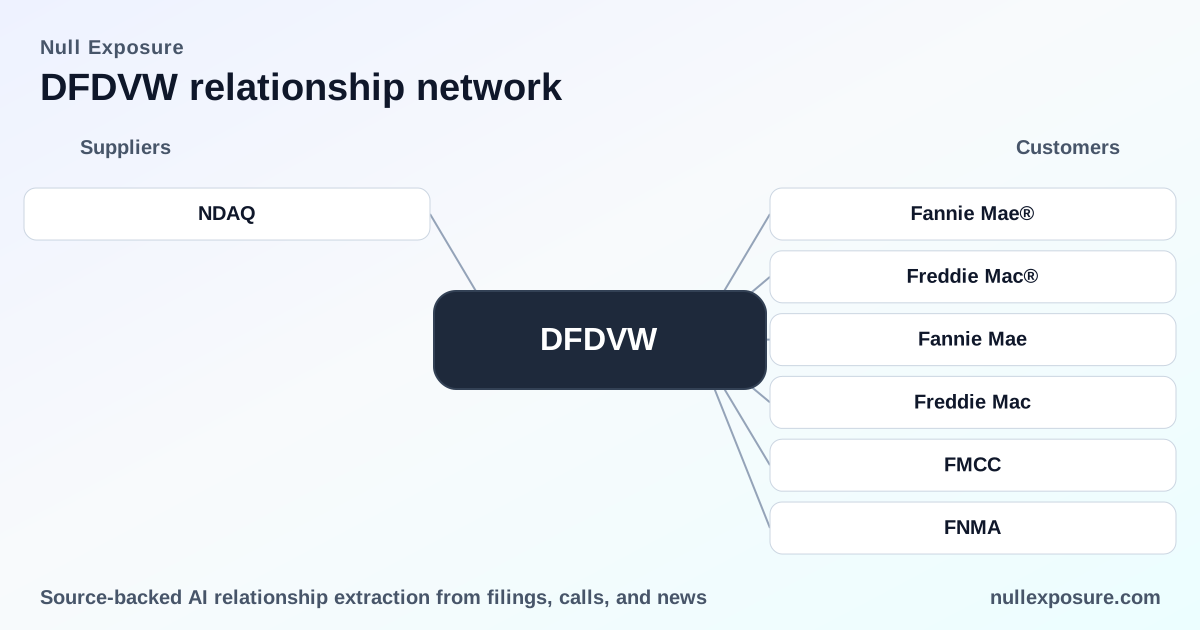
Nasdaq Capital Market / NDAQ: The warrants were listed and are trading on the Nasdaq Capital Market under ticker DFDVW, which establishes market access and continuous trading for the instrument. (GlobeNewswire press release, Nov 6, 2025)
-
Nasdaq (syndicated reporting) / NDAQ: The Globe and Mail reported the company’s announcement that dividend-warrants declared October 8, 2025, are listed and trading under DFDVW, corroborating the Nasdaq listing and investor communications. (The Globe and Mail, syndicated report of company release, Nov 2025)
What the supplier signals reveal about operating posture
The supplier relationships are straightforward: Nasdaq provides the exchange venue and public market plumbing for the warrant instrument, which is necessary but not strategically differentiating beyond enabling liquidity and compliance. The listing itself increases investor access and reduces execution friction for holders, which is meaningful for a warrant product whose raison d’être is tradability.
Beyond the exchange tie, the company’s filing excerpts expose two operational supplier dynamics that inform risk and contract posture:
-
The company leases office space under a lease that began April 1, 2022 and expires March 31, 2026, with a monthly base rent averaging approximately $4,700. This lease is a company-level fixed-cost commitment that will require renegotiation or renewal in the near term, creating a predictable but time-bound occupancy obligation. (Company filings, 2024 disclosures)
-
The company disclosed payments to two service providers tied to insiders: Innovar Consulting Corporation (wholly owned by a director nominee) received approximately $12,000 in 2023 and $0 in 2024 for consulting services; Blake Elliot, Inc. (wholly owned by Mr. Janover) received approximately $128,000 in 2023 and $0 in 2024 for services rendered. These are vendor relationships with historical spend concentrated in 2023, and both are categorized as service provider engagements in the filings. (Company filings, 2023–2024 disclosures)
Interpreting contract characteristics and supplier risk
From the combined evidence, draw these practical signals about the business model and supplier posture:
-
Contracting posture: The firm maintains routine commercial contracts (office lease) and has engaged third-party consultants tied to executive-level individuals. The lease is short-term in the corporate calendar and will require action in 2026; consultant relationships show episodic spend, not long-term retainer commitments.
-
Concentration and criticality: Exchange services (Nasdaq) are mission-critical but commoditized — necessary for liquidity but not a single-vendor strategic lock. Consulting spend historically concentrated among a small set of related vendors suggests low diversification of advisory services in prior years, though spend dropped to zero in 2024 for both named vendors.
-
Maturity and operational scale: Reported financials show positive gross profit and reported EBITDA, indicating operating activity beyond a shell. Key balance-sheet indicators — including reported RevenueTTM and GrossProfitTTM — demonstrate operational revenue, while shares reporting (SharesOutstanding listed as 0 and SharesFloat ~23 million) reflect the warrant-specific capital structure. The company’s public filing posture and Nasdaq listing reflect a regulated, market-facing maturity stage rather than an early-stage private startup.
-
Governance and related-party exposure: Payments to entities owned by insiders are explicit in filings and therefore a governance consideration for investors assessing conflicts of interest or related-party reliance. The documented reductions to zero in 2024 lessen current cash-flow dependency on those vendors, but historical ties and vendor ownership require ongoing disclosure monitoring.
Risk and upside — concise takeaways
-
Upside: Listing of DFDVW on Nasdaq creates liquidity and price discovery for warrants tied to the company’s Solana-focused treasury strategy, enabling more efficient investor access and valuation mechanisms. Public market presence amplifies optionality for corporate actions and investor exits.
-
Key risks: Near-term lease renegotiation (expires March 31, 2026) and historical concentration of consulting spend toward insiders are governance and operational risks that require active monitoring. The warrant structure itself imposes time and leverage constraints on investors, and trading dynamics will reflect both crypto treasury performance and broader warrant market sentiment.
If you want a concise, actionable supplier map and the primary filings pulled into one place, visit our analysis hub: https://nullexposure.com/
How to use this intelligence as an investor or operator
For investors: prioritize monitoring ongoing disclosure around the Solana treasury (performance, custody, and valuation), Nasdaq filing updates, related-party transactions, and lease renewal outcomes. For operators: manage vendor diversification and formalize board disclosures to reduce perceived governance risk tied to insider-owned suppliers.
For a deeper, cross-checked supplier and filing dossier on DFDV and related instruments, see our research portal: https://nullexposure.com/
Final view
DeFi Development Corp.’s warrant listing under DFDVW on Nasdaq transforms a treasury strategy into a tradable instrument, giving investors liquid exposure to the company’s Solana accumulation thesis. Exchange access is secured; supplier relationships are small in number and concentrated historically, with a near-term lease maturity and related-party service payments that deserve active monitoring. The company’s filings and public notices are the primary sources for these signals; maintain vigilance on subsequent disclosures to track treasury performance and any change in vendor posture. For ongoing supplier-level diligence and faster updates, return to our hub at https://nullexposure.com/