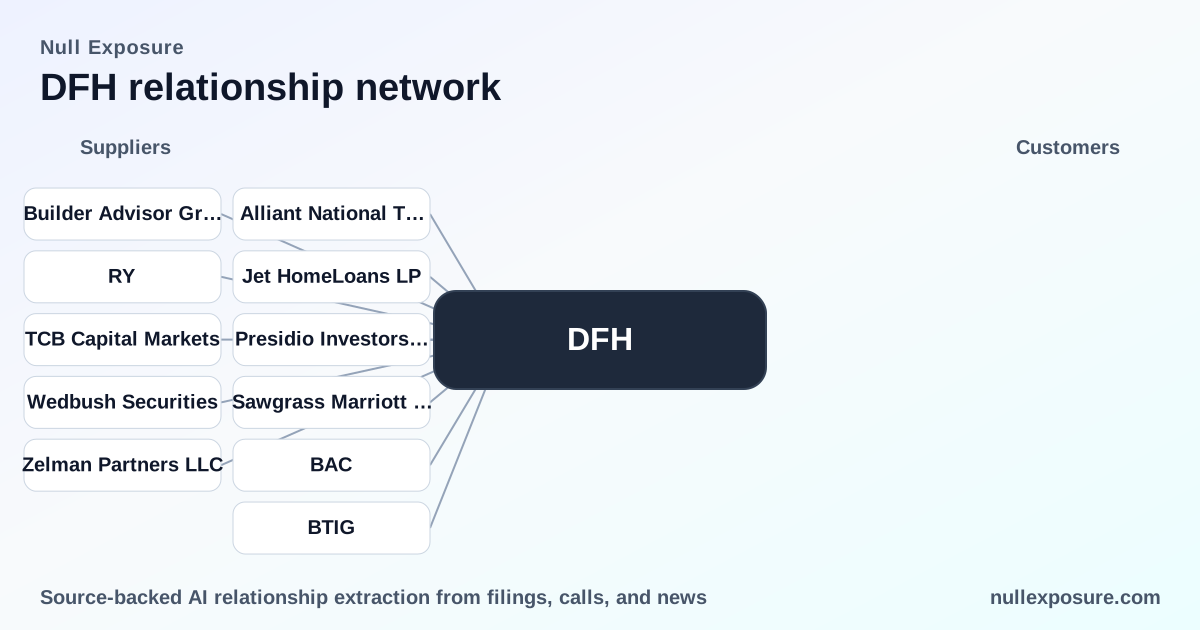
Dream Finders Homes (DFH): Supplier relationships that reshape a homebuilder’s margins and risk profile
Dream Finders Homes builds and sells single-family homes and monetizes through land development, home construction margins, and ancillary services (mortgage and title). The company increasingly acquires adjacent businesses—title and lending—and funds its lot and land positions with large option deposits, creating both upside from vertical integration and concentrated capital exposure to land and municipal counterparty arrangements. For investors evaluating supplier and partner risk, the recent acquisitions and legacy financing relationships recast DFH from a pure builder into an operator with in-house mortgage and title capability and significant balance-sheet commitments to land. Learn more on the homepage: https://nullexposure.com/
Business model and operating signals: DFH sells homes for cash and mortgage-backed purchases, earns construction margins and ancillary income (mortgage origination, title fees), and scales by buying or optioning finished lots to match selling pace.
Why these partner moves matter to investors
Dream Finders’ acquisitions of mortgage and title assets convert recurring third-party supplier fees into internal revenue streams, compressing customer acquisition and closing costs while increasing operational control. That control boosts margins but also concentrates execution risk on newly acquired businesses and on the company’s large lot-deposit exposures. The firm’s public filings and transaction notices show a deliberate push to capture value across the closing lifecycle: land → construction → mortgage → title.
If you are benchmarking DFH supplier risk or sourcing exposure intelligence for portfolio diligence, get a concise view at https://nullexposure.com/
Constraints and what they reveal about DFH’s operating posture
- Contracting posture: DFH signs finished-lot option contracts and places sizeable deposits with land sellers and bankers, indicating a model that requires significant upfront capital to secure future inventory. This is not a vendor credit model; it is an inventory acquisition posture that locks capital early.
- Concentration of spend and balance-sheet intensity: Lot deposits reported at $458 million as of December 31, 2024 establish a spend band well into the $100M+ range and signal high capital concentration in land holdings rather than pay-as-you-go supplier payments.
- Counterparty profile and criticality: The company uses surety bonds and letters of credit with local municipalities and government agencies, which makes municipal relationships operationally critical and subjects DFH to government counterparty terms and timing.
- Maturity and strategic direction: The acquisition activity into title and mortgage is a maturity signal—DFH is moving from build-only to a vertically integrated platform, changing supplier exposure from fee-based vendors to owned service lines.
These are company-level signals drawn from DFH disclosures about lot deposits, surety arrangements, and option contracts; they should shape how investors assess supplier risk and capital flexibility.
Detailed partner roll‑call — what each relationship means for DFH investors
Alliant National Title Insurance Company, Inc.
Dream Finders entered a definitive agreement to acquire Alliant National Title Insurance Company, indicating a strategic move to internalize title operations and capture closing fee revenue. This reduces reliance on external title providers and increases control over closing timelines and costs (reported October 24, FY2025 via Simply Wall St).
Jet HomeLoans LP
DFH acquired the remaining 40% stake in Jet HomeLoans LP for $9.3 million, consolidating mortgage origination capacity under the company umbrella and converting an external cost center into an owned profit center (reported August 2, FY2025 via Simply Wall St).
Presidio Investors Atc Holdco, LLC
Presidio Investors Atc Holdco, LLC is the seller in the Alliant National title deal; their role is as the divesting private-equity owner for that title business, and the transaction represents DFH’s buyout of a previously third-party title provider (transaction noted October 24, FY2025 via Simply Wall St).
Sawgrass Marriott Golf Resort & Spa
DFH participated alongside Ssp GP Fund II, LP and Pat Battle in acquiring the Sawgrass Marriott Golf Resort & Spa for approximately $150 million, demonstrating that DFH occasionally pursues non-core real estate investments and joint ventures that diversify cash flow and capitalize on local real estate upside (reported November 8, FY2025 via Simply Wall St).
BofA Securities (BAC)
BofA Securities served as one of the joint book-running managers for DFH’s initial public offering, establishing underwriting and capital markets capacity at IPO that underpins DFH’s public equity access and investor distribution channels (GlobeNewswire press release, January 21, 2021).
BTIG
BTIG acted as a joint book-running manager for the IPO, contributing to syndicate bank relationships that enabled DFH’s public listing and subsequent capital markets engagement (GlobeNewswire, January 21, 2021).
Builder Advisor Group, LLC
Builder Advisor Group was a joint lead manager for DFH’s IPO, reflecting a boutique advisory role tailored to builder operations and industry distribution during the offering process (GlobeNewswire, January 21, 2021).
RBC Capital Markets (RY)
RBC Capital Markets joined BofA and BTIG as a joint book-running manager on the IPO, providing institutional reach and liquidity support that remains relevant for future capital raises and secondary market placement (GlobeNewswire, January 21, 2021).
TCB Capital Markets
TCB Capital Markets served as a co-manager on the IPO, expanding DFH’s underwriter base and signaling engagement with regional brokers during its listing (GlobeNewswire, January 21, 2021).
Wedbush Securities
Wedbush Securities co-managed the IPO, contributing distribution to investor channels and licensing DFH’s access to retail and institutional accounts through syndicate coverage (GlobeNewswire, January 21, 2021).
Zelman Partners LLC
Zelman Partners LLC acted as a joint lead manager on the IPO, bringing sector-specific equity capital markets expertise which is important given DFH’s specialized residential construction business (GlobeNewswire, January 21, 2021).
Strategic implications for investors and operators
- Vertical integration is real and material: Title and mortgage acquisitions shift recurring supplier costs into revenue lines, improving gross margins but increasing operational complexity and integration risk.
- Balance-sheet liquidity is a core risk: With lot deposits north of $400 million, DFH runs a capital-intensive model that depends on land-positioning and municipal relationships—investors should monitor working capital, commitments, and bond/LC arrangements.
- Underwriter and capital-market relationships are established: The IPO syndicate roster demonstrates institutional distribution capability, which supports future equity access if needed.
- Non-core investments signal opportunistic capital deployment: The Sawgrass acquisition shows DFH is willing to co-invest in hospitality/real estate assets, diversifying returns but widening the risk set.
If you evaluate supplier exposure, land commitments, or vertical-integration risk for DFH, prioritize diligence on the newly acquired mortgage and title operations, and on the maturity profile of lot option deposits. For a succinct commercial-grade supplier risk report and ongoing monitoring, visit https://nullexposure.com/
Bottom line
Dream Finders Homes is transforming from a homebuilder into an integrated platform that owns mortgage and title capabilities while maintaining a heavy balance-sheet posture toward land. That strategy improves margin capture but concentrates capital in land and government-facing obligations, so investors should balance the margin thesis with the company’s large lot deposits and municipal counterparty exposure. For further briefing and supplier-risk tracking tools tailored to investment teams, see https://nullexposure.com/