Dragonfly Energy (DFLIW) — supplier relationships, concentration and what investors should price in
Dragonfly Energy designs and sells lithium-iron-phosphate (LFP) battery systems and related battery management technology, monetizing through direct product sales to end markets (recreation vehicles, marine, industrial) and through OEM supply agreements and capital markets raises that fund scale. Revenue is driven by hardware sales and OEM contracts, while working capital and access to capital markets drive near-term liquidity and growth. Learn more or track supplier risk on the company profile at https://nullexposure.com/.
Quick map: the relationships that matter today
Below I list each relationship found in public filings and news for DFLIW with a short, plain-English takeaway and the source context.
-
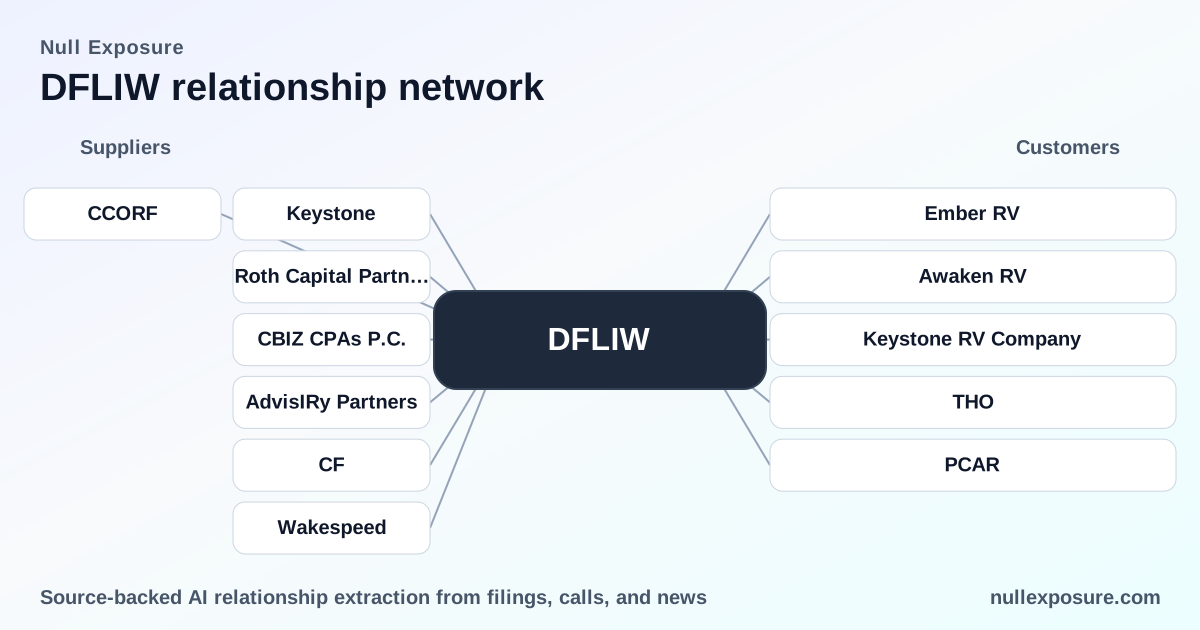
Keystone — Dragonfly has a formal long-term Manufacturing Supply Agreement making Dragonfly the exclusive supplier for certain LFP battery requirements to Keystone, North America’s largest towable RV OEM (THOR group). This is an OEM commitment that supports recurring demand and product placement in RV channels. Source: company Form 10‑K, FY2024 (filed 2024-12-31).
-
Canaccord Genuity — Served as the sole bookrunner for Dragonfly’s $55.4 million public offering in FY2025, indicating a lead capital markets role and distribution responsibility for equity placement. Source: news report on the offering, FY2025 (public release, March 2026 coverage).
-
Roth Capital Partners — Acting as co-manager on the same FY2025 public offering, supporting distribution and investor outreach alongside the bookrunner. Source: news release on the public offering, FY2025 (March 2026 coverage).
-
CBIZ CPAs P.C. — Ratified as Dragonfly’s independent auditor for 2025, which formalizes the company’s external financial reporting relationship for that fiscal year. Source: SEC filing coverage aggregated by StockTitan/SEC page, FY2025 (March 2026).
-
AdvisIRy Partners — Listed as Dragonfly’s investor relations contact and service provider in the offering materials, providing external IR communications and investor outreach. Source: offering materials and news release, FY2025 (March 2026).
-
Wakespeed — Referenced in FY2026 press coverage as integrating Battle Born LiFePO4 batteries with its charge control technology in truck sleeper cabs; this represents channel/technology cooperation and product placement in commercial vehicle applications. Source: news coverage of awards and product integrations, FY2026 (March 2026).
(Note: multiple press items repeat the same financing and IR relationships — Canaccord, Roth and AdvisIRy are referenced across the FY2025 offering announcements and related press.)
What the contract language and constraints tell investors
Dragonfly’s public statements present a mixed contracting posture: a combination of targeted long-term OEM supply agreements and broad supplier relationships that are operationally concentrated. The company explicitly documents a long-term Manufacturing Supply Agreement with Keystone, which is a clear commercial anchor and confirms recurring OEM revenue potential. At the same time, company disclosures state that for many supplier relationships there are no significant long-term contracts, creating a mix of committed OEM demand and operational flexibility on upstream inputs.
Company-level signals from filings include:
- Geographic concentration in APAC: Dragonfly sources LFP cells and its battery management system components from a small set of suppliers located in China — a deliberate supply choice that supports cost and quality control but concentrates geopolitical and logistics risk.
- Supplier criticality: The company labels these relationships as critical; any disruption to the cell or BMS suppliers would materially affect production and go‑to‑market ability.
- Role and maturity: Suppliers are primarily manufacturers (cells and BMS) and the relationships are described as active and mature, reflecting long-standing vendor selection and repeat sourcing. Dragonfly outsources logistics and delivery functions to third-party service providers rather than maintaining its own fleet.
- Contract mix: Filings convey both short-term purchasing flexibility across many suppliers and explicit long-term purchase commitments where they exist (e.g., minimum annual purchase obligations described in supply contracts).
Where concentration creates risk — and where the company has defensive advantages
Concentration and contract structure drive the two most important operational risk trade-offs:
- Risk: supplier concentration and geopolitical exposure. Dragonfly relies on two Chinese cell manufacturers and a single BMS manufacturer; this creates single‑point supply risk for key battery components, exposure to shipping or tariff disruption, and potential inventory or lead-time volatility.
- Defense: OEM placement and exclusivity. The Keystone long-term Manufacturing Supply Agreement gives Dragonfly retail channel leverage and recurring revenue visibility into a large RV OEM’s pipeline, improving forecastability on the demand side and reducing commercialization risk for specific product lines.
- Capital dependency: The FY2025 equity offering (with Canaccord as sole bookrunner and Roth as co-manager) demonstrates active capital-market funding to support growth; investor relations are handled externally by AdvisIRy Partners, and CBIZ serves as auditor for FY2025, signaling governance and investor communications structures that support public financing.
Financial and operational implications for investors
Dragonfly’s latest operating numbers show scale but negative margins: Revenue TTM was roughly $57.8 million with gross profit near $15.8 million, while operating margin and net profit margin are negative (operating margin TTM -23.7%, profit margin -60.1%), and reported EBITDA is negative $17.9 million. This profile signals a company still investing in growth and channel development while depending on capital markets to fund the gap between cash needs and operating cash flow. Investors should price both the upside from OEM rollouts (Keystone exclusivity) and the downside from supply disruption or continued margin pressure.
Practical due diligence checklist for operators and counterparties
- Confirm the operational status and delivery performance under the Keystone supply agreement and whether minimum purchase obligations are being met.
- Validate second‑source options for cells and BMS or plans to onshore/relocate supply in response to APAC concentration.
- Review liquidity runway following the FY2025 offering and the role of underwriters in stabilizing aftermarket demand.
For a focused view of supplier concentration, capital raises, and governance signals, visit the company profile at https://nullexposure.com/.
Bottom line and recommended next steps
Dragonfly’s business is a classic hardware OEM with the pull of OEM exclusivity on one hand and upstream concentration risk on the other. Keystone provides distribution scale and predictable OEM revenue; Chinese cell and BMS suppliers create operational concentration that investors must underwrite or mitigate through supplier diversification or inventory strategies. The FY2025 capital raise and external IR/audit relationships show the company is actively managing capital and investor communications to support growth.
If you are evaluating a supplier relationship or underwriting commercial credit to Dragonfly, prioritize verification of supply continuity, contract minimums, and the company’s near-term cash plan. For continuing coverage and to compare supplier risk across the sector, visit https://nullexposure.com/.
For bespoke diligence or to track new filings and relationship changes for DFLIW, go to https://nullexposure.com/ — our platform centralizes supplier signals and public filing context for investors and operators.