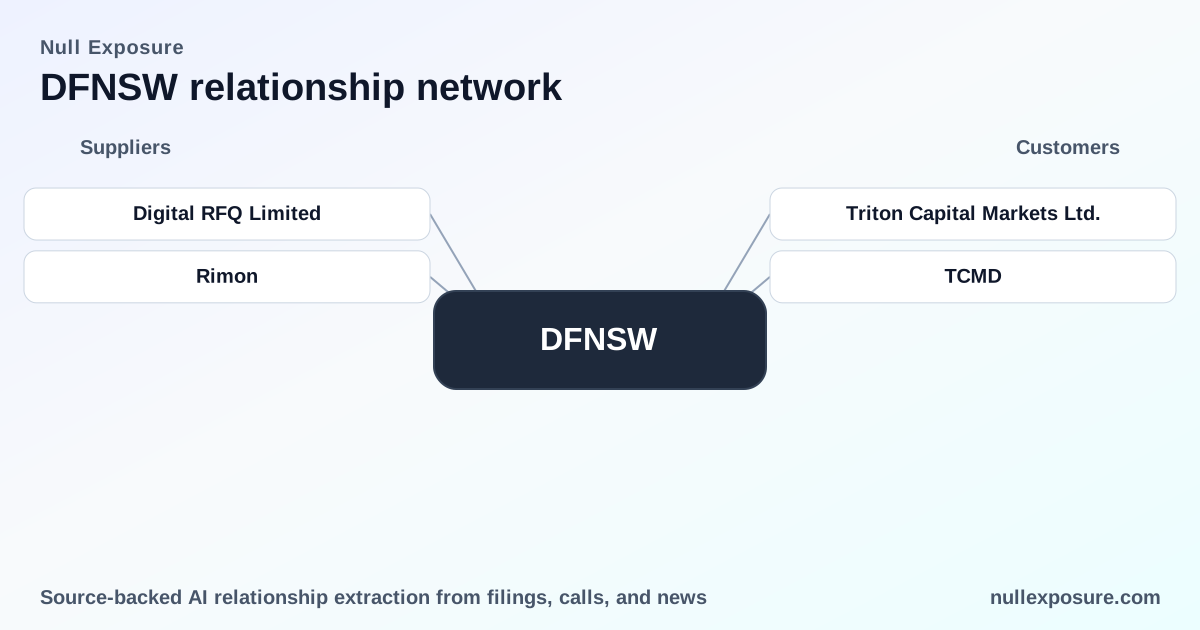
DFNSW (T3 Defense Inc.): Supplier footprint and what it means for investors
T3 Defense Inc. operates as a holding company that acquires and runs defense-related businesses and monetizes through sales, distribution and services delivered by its subsidiaries and affiliates; recently the company has shifted meaningful operational focus to blockchain payment solutions run through a subsidiary structure. Revenue and cost flows are centrally mediated by a small set of related parties, creating concentrated operational leverage that drives both upside (scale from a primary supplier) and downside (single-counterparty dependency). For a fast read on counterparty risk and supplier transparency, visit https://nullexposure.com/.
The two counterparties you need to know now
The company’s FY2024 public filing identifies two named entities that underpin its historical supplier and solution footprint. Each relationship is materially different in role and risk.
Digital RFQ Limited — the payments vehicle
According to the FY2024 10‑K, T3 historically routed its blockchain payment solutions through Digital RFQ Limited (DRFQ), which is a wholly owned subsidiary of Match Financial Ltd, itself a wholly owned subsidiary of the company. This positions DRFQ as the operational vehicle for the company’s pivot into payment services and digital financial infrastructure (FY2024 10‑K).
Rimon — distributor and systems integrator
The FY2024 10‑K states that Star holds 95% of Rimon, an Israeli corporation that supplies generators for Iron Dome launchers and provides distribution and engineered tactical vehicle solutions; Rimon operates two primary lines of business — equipment distribution (generators, masts, lighting) and engineering/integration of specialized tactical platforms, sold mainly to defense and special forces customers (FY2024 10‑K).
How the filing characterizes supplier exposure and contractual posture
The company-level disclosures in the FY2024 filing reveal extreme supplier concentration and a recent structural change to the services business:
- Single-supplier concentration is critical. The 10‑K reports that one supplier — an affiliate — accounted for 94.6% of cost of revenues in 2024 (86.8% in 2023), a level of concentration that makes operations highly dependent on that counterparty (FY2024 10‑K).
- Material termination and strategic pivot. T3 ceased providing general support services in January 2024, terminated the customer and supplier contracts associated with those services, and confirmed by release agreement (as of September 30, 2024) that the GSA and GSS GSA were terminated effective January 1, 2024 with no outstanding obligations between the parties (FY2024 10‑K).
- Spend quantum is non-trivial but volatile. The 10‑K records $4,650,000 (FY2024) and $18,775,000 (FY2023) as cost of revenue — general support services — related party under the GSS GSA, reflecting material but decreasing spend as the company exited that service line (FY2024 10‑K).
These disclosures collectively describe a tight contracting posture: heavy reliance on a related-party supplier for core services, followed by a rapid contractual unwind and a refocus on payment services through subsidiaries.
For operators and investors seeking deeper counterparty analytics, NullExposure provides structured supplier risk intelligence at scale — check https://nullexposure.com/ for a practitioner toolkit.
What those constraints say about maturity, criticality and governance
- Criticality: Supplier concentration at >90% of costs is functionally critical; any operational change at the supplier level materially affects the company’s top-line servicing capability and cost base (company FY2024 disclosure).
- Maturity: The company is in transition — a de-emphasis on legacy general support services and an active pivot to payment solutions conducted through DRFQ suggests early to mid-stage operational maturity for the payments business while legacy defense distribution/integration remains live through holdings like Rimon.
- Governance and related-party complexity: The filings document related-party arrangements for both the supplier role and historical service delivery, increasing the need for scrutiny of contract terms, pricing, and independence in governance.
Relationship-level takeaways and investor implications
- Digital RFQ Limited: DRFQ is the structural vehicle for the company’s blockchain payment initiatives; investors should treat DRFQ as the primary locus of future payment revenue upside and monitor operating metrics and intercompany cash flows disclosed in subsequent filings (FY2024 10‑K).
- Rimon: Rimon is a 95%-controlled affiliate focused on equipment distribution and engineered tactical platforms sold to defense customers; Rimon supplies mission-critical hardware lines that provide operational diversification from the payments pivot but remain concentrated in defense end markets (FY2024 10‑K).
How this shapes a risk-adjusted investment stance
- Concentration risk dominates near-term value drivers. With one affiliate supplying the majority of cost of revenues historically, operational continuity and contract stability are the single largest determinants of near-term performance.
- Transition risk is real but directional. The company has formally exited general support services and pivoted to payments; this reduces legacy supplier spend but introduces execution risk in scaling DRFQ’s payments offerings.
- Transparency and governance scrutiny are mandatory. Several financial metrics in public profiles are absent or zeroed out, and the company relies on related-party flows; active investors should demand clear disclosures on intercompany contracts, transfer pricing, and customer concentration.
Practical next steps for investors: insist on periodic operational KPIs for DRFQ, request detail on the identity and independence of the dominant supplier, and track Rimon’s order book and distributorship agreements for defense equipment. If you want a structured supplier risk dossier for decision support, start at https://nullexposure.com/.
Final assessment
T3 Defense’s supplier picture is defined by very high historical supplier concentration, a controlled pivot away from legacy support contracts, and a clear operational anchor in a payments subsidiary. For investors, the calculus is simple: upside will be driven by successful scale of DRFQ and the preservation or replacement of critical supplier functions, while downside is governed by related-party counterparty disruption and sparse financial disclosure. Monitor subsequent filings closely for intercompany revenue recognition, cash flows, and any re-emergence of supplier concentration metrics. For ongoing supplier surveillance and counterparty intelligence, visit https://nullexposure.com/.