Definium Therapeutics (DFTX): what its supplier map tells investors about execution risk and optionality
Definium Therapeutics is a clinical‑stage biopharma developing lysergide (LSD)‑based oral formulations for brain‑health indications; it monetizes by progressing proprietary candidates through clinical development and commercializing via third‑party manufacturing and distribution partnerships rather than owning large internal production capacity. Revenue upside is entirely conditional on clinical and regulatory progress; supplier relationships are therefore the operational linchpin that will determine timing, cost and feasibility of commercialization. For a quick supplier‑risk readout and vendor benchmarking, visit https://nullexposure.com/.
How Definium structures supplier relationships and what that implies for investors
Definium outsources the bulk of its clinical and non‑clinical drug substance and drug product work to contract development and manufacturing organizations (CDMOs) and contract research organizations (CROs) under master service and quality agreements with purchase‑order execution. That contracting posture delivers flexibility but also creates execution dependency: the company is contractually configured to scale development through external partners rather than through vertically integrated manufacturing.
Company disclosures highlight a single‑supplier manufacturing approach for critical inputs such as lysergide, and an exclusive supplier engagement for at least one oral thin‑film/tablet formulation. Those facts create concentration risk: a disruption at a named CDMO could delay trials or a launch. Definium is a clinical‑stage issuer with zero reported revenue and a negative EBITDA, so supplier performance and counterparty reliability directly affect its valuation pathway.
Catalent: exclusive CDMO for the DT120 ODT product
Catalent is named as the exclusive supplier for Definium’s DT120 ODT, which uses Catalent’s Zydis fast‑dissolve technology to deliver a lysergide tartrate oral formulation with faster absorption and improved bioavailability. A company 8‑K filed in March 2026 describes DT120 ODT as an advanced formulation incorporating Catalent’s Zydis ODT platform and lists the putative pharmacokinetic and tolerability advantages that underlie Definium’s clinical strategy (8‑K, Mar 9, 2026). A separate industry news item in May 2026 reiterated that Catalent’s Zydis platform was used in the refined lysergide tartrate compound (MEXC news, May 2, 2026).
- Implication: Catalent is a critical manufacturing partner whose technology and capacity directly affect product performance and time‑to‑market. Given the explicit exclusive supplier language, operational continuity at Catalent is a material value driver for Definium.
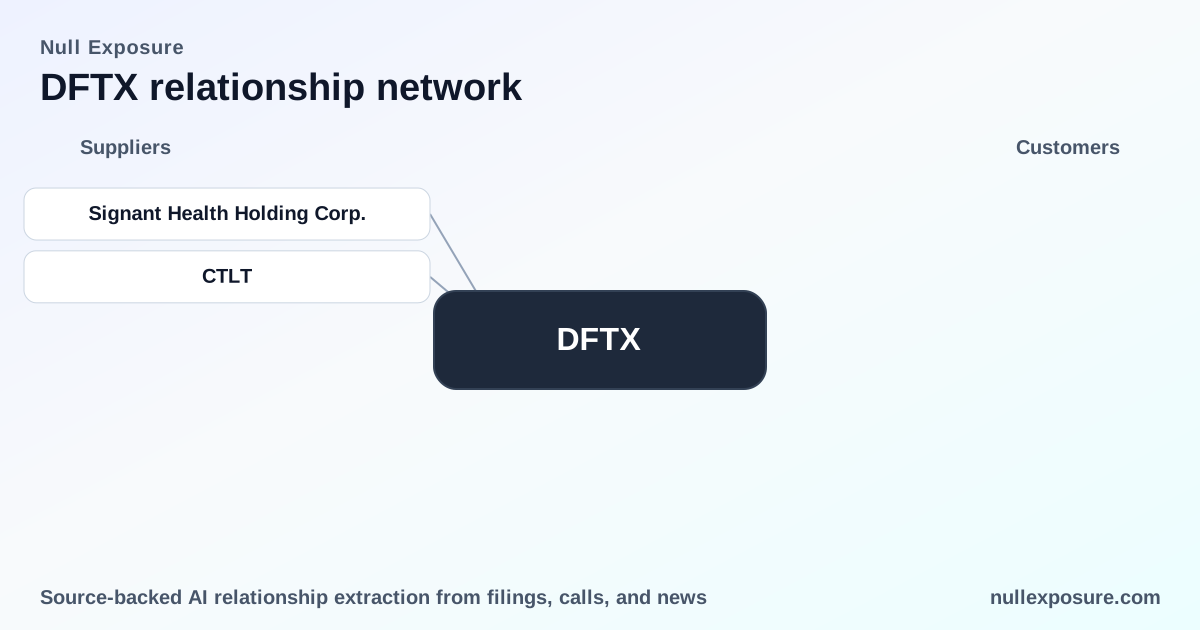
Signant Health: vendor dispute and trade‑secrets allegation
Signant Health has publicly accused Definium of improper sharing of confidential trial methodologies and pricing data with a replacement vendor after their business relationship ended, and Definium has moved to dismiss the trade‑secrets lawsuit alleging the claims are legally deficient (USA Herald, Mar 9, 2026).
- Implication: Vendor disputes introduce legal and reputational risk that can distract management, increase vendor oversight costs, and — in the short run — force sudden re‑procurement of CRO or eClinical services that are essential for trial continuity.
The broader relationship profile: roles, stage and spending posture
Company documents and disclosures create a consistent signal about how Definium buys and uses external services:
- The firm relies on third‑party CROs, clinical sites, academic collaborators and CDMOs to conduct preclinical work and run clinical trials; these relationships are active and operationally central.
- Manufacturing and repackaging are performed through CDMOs in the U.S. and internationally; Catalent is specifically called out as an engaged manufacturer for MM120/DT120 ODT in company filings (company 8‑K and corporate disclosures, FY2026).
- Contracting is executed under master service and quality agreements with purchase orders, a framework that offers agility but requires tight vendor management to avoid gaps in supply or quality.
- Financing signals show a material but not massive capital footprint for near‑term obligations: the company drew $15.0 million in a first tranche and achieved a $10.0 million milestone tranche in Q2 2024 under a Term Loan that matures August 1, 2027, supporting the view that supplier spend and working capital commitments sit in the $10m–$100m band as the programme progresses (company filing disclosures).
These characteristics together produce a clear operating profile: outsourced, concentrated on a few critical partners, active in the clinical stage, and financed with near‑term debt tranches that imply finite runway sensitivity to supplier delays.
What investors and operators should watch next
Key takeaways for investment and operational diligence:
- Concentration risk: single‑supplier language for lysergide and an exclusive Catalent engagement mean a supply disruption would be highly material to timelines and costs.
- Contract posture: master service agreements executed via purchase orders produce flexibility but require continuous vendor governance; ensure exclusivity terms, lead times and contingency provisions are understood.
- Legal exposures: the Signant dispute is a governance red flag; track litigation developments for potential injunctions, damages or operational impacts to trial data management.
- Capital sensitivity: with no revenue and negative EBITDA, supplier delays translate directly into financing needs; historical loan tranches ($15m + $10m milestone) reveal the company’s reliance on milestone financing to fund supplier spend.
- Regulatory/distribution readiness: if product scheduling requires DEA‑registered distributors, Definium will need to secure distributors with appropriate registrations — a non‑trivial operational step.
Investors should prioritize contract reviews with Catalent and any CROs, monitor the Signant case for operational implications, and model downside scenarios that assume 3–6 month supplier delays given the company’s financing and clinical timelines.
For an actionable supplier risk scorecard tailored to early‑stage biotechs, see https://nullexposure.com/ — it provides comparable benchmarks and vendor concentration analytics.
Bottom line
Definium’s strategy is execution‑centric: clinical progress and a narrow set of third‑party manufacturing relationships will determine intrinsic value creation. Catalent is the single most important supplier named; the Signant dispute underscores non‑technical vendor risk. For investors, the proper investment question is not whether the science is interesting — it is whether the supplier architecture and contracting discipline are robust enough to deliver consistent, on‑time evidence generation and a viable commercial supply path.