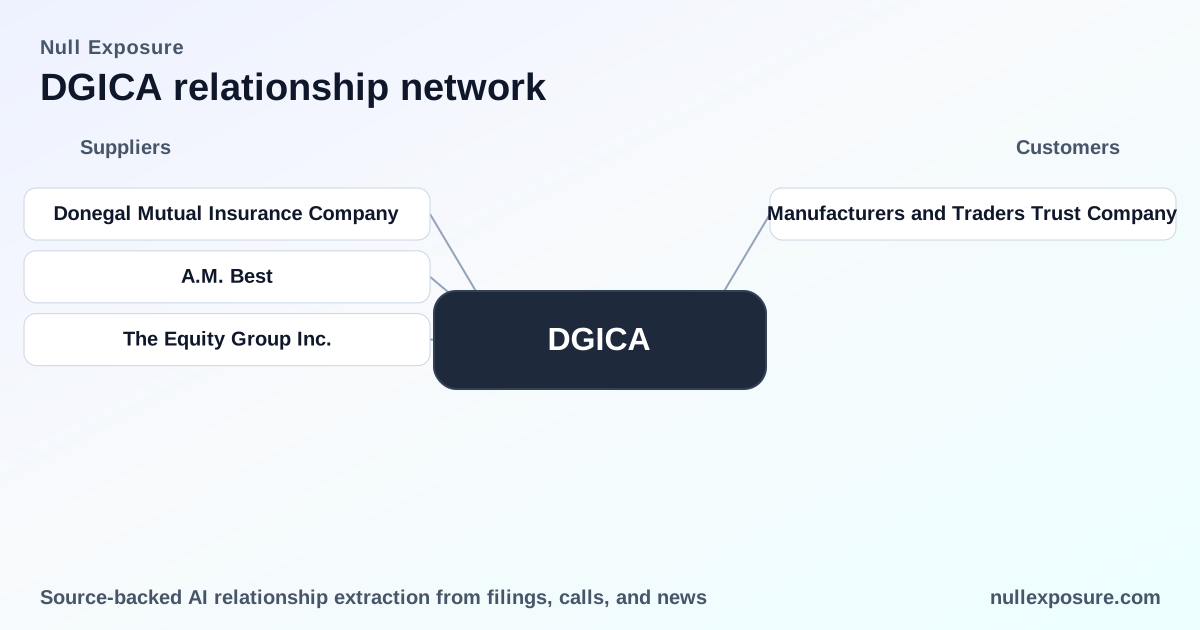
Donegal Group A (DGICA): Supplier relationships, operating posture, and what investors should price in
Donegal Group A Inc. is a regional property & casualty insurer that monetizes through written premiums, underwriting profit and investment income, selling personal and commercial lines via independent agents across the Mid‑Atlantic, Midwest, New England and southern states. The company runs a partially centralized service model: an affiliated mutual entity provides facilities, management and allocated services while a diversified set of reinsurers and independent agents distribute and back risk. Investors should focus on the financial impact of allocated service spend, the company’s reinsurance structure, and the one‑time expense elements tied to a recent systems modernization. Learn more about supplier intelligence at https://nullexposure.com/.
Why suppliers matter to Donegal’s economics
Donegal’s operating model blends centralized services and a distributed sales channel. A material share of company operating costs are allocated from an affiliated service provider, which creates a critical internal supplier relationship that directly affects expense ratios and reported underwriting margins. Reinsurance and independent agents reduce direct concentration risk in underwriting but create a multi‑counterparty dependency that is operationally active and persistent.
- Contracting posture: The company carries long‑dated cash arrangements in its wider group (evidence of long‑term financing elsewhere in filings), and the service arrangement with the affiliated mutual generates recurring allocated expenses across multiple years.
- Concentration: Donegal reports no single customer or agent contributes 10% or more of revenues, which reduces revenue concentration risk at the agent/customer level.
- Criticality and spend: Allocations from the affiliated mutual represent tens to hundreds of millions of dollars annually; that makes the affiliated service provider operationally critical.
- Maturity and near‑term impacts: Costs tied to a multi‑year systems modernization were recognized in late 2025 and had a measurable impact on expense ratios.
For deal teams and operators evaluating supplier risk, those characteristics mean supplier continuity, allocation methodology and the timing of technology capitalizations are primary value levers. If you want a dashboard view of supplier exposure for underwriting and credit diligence, visit https://nullexposure.com/.
Every named supplier relationship in the record — what investors need to know
Donegal Mutual Insurance Company
Donegal Mutual is the affiliated mutual that provides facilities, management and other services to Donegal’s insurance subsidiaries; these allocated costs totaled hundreds of millions over recent years and the mutual’s allocations contributed to a 1.5 percentage‑point adverse impact on the expense ratio in Q4 2025 due to final software releases related to a systems modernization project. That allocation pattern makes Donegal Mutual a large, recurring internal service supplier. (Company press release via GlobeNewswire, FY2026; company filings showing allocated expenses, 2022–2024.)
A.M. Best
A.M. Best rates Donegal Insurance Group A (Excellent), a credit and financial strength affirmation that supports the company’s capacity to cede and maintain reinsurance arrangements and to operate within industry capital standards. This rating underpins counterparty selection and reinsurance program stability. (QuiverQuant summary of FY2026 results citing A.M. Best.)
The Equity Group Inc.
The Equity Group acts as Donegal’s investor relations and communications advisor, with named contacts used in press releases; this is a disclosure and IR services relationship rather than a material operational supplier. Investor outreach and public disclosure are handled through this retained communications resource. (Press release syndication and disclosures in FY2025–FY2026 via Globe and Mail / Manila Times / QuiverQuant.)
What the constraints and disclosures reveal about supplier risk
The company disclosures and extracted constraints establish practical rules for investors assessing supplier exposure.
- Large, recurring allocated spend is a corporate‑level signal. Allocations from the affiliated mutual totaled approximately $224.6M in 2024 and remained material in prior years, while separate allocated amounts of $12.3M (2024) reflect other mutual cost allocations; these figures indicate the affiliated mutual is both mission‑critical and high‑spend, not a peripheral vendor.
- Long‑term contracting posture exists at the enterprise level. Filings note long‑dated fixed‑rate cash advances in related entities (for example, a $35.0M fixed‑rate advance maturing in 2026 on related balance sheets), which signals the group manages multi‑year financing and obligations. Treat supplier continuity assumptions as long‑horizon when modeling.
- Distribution concentration is low. The company explicitly reports that no single customer or agent accounts for 10% of revenues, which reduces counterparty concentration risk on the revenue side.
- Reinsurance program is intentionally diversified and active. Management discloses up to 29 reinsurers on a single treaty in 2024, with no reinsurer taking more than 20% of any one treaty, indicating an active, spread risk posture rather than reliance on a single reinsurer.
Those constraints together form the practical operating profile: high internal service dependency, diversified external reinsurance support, low customer concentration, and multi‑year contractual/financial commitments.
Investment implications and a short checklist for buyers
Key financial context: revenue TTM near $978M, market cap roughly $622M, trailing P/E ~7.8 and forward P/E ~16, price‑to‑book ~0.97, and an A.M. Best A rating supporting underwriting counterparty confidence. Against that backdrop:
- Positive drivers: Diversified agency distribution and broad reinsurance panels reduce single‑counterparty underwriting risk; A.M. Best A supports balance‑sheet stability.
- Watch items: Allocated service spend from the affiliated mutual is large and directly affects expense ratios; recent systems modernization costs increased Q4 2025 expense ratio by ~1.5 percentage points. Monitor allocation methodology, capitalization versus expense treatment, and timing of future releases or projects.
- Liquidity and obligations: Group‑level long‑term advances and recurring allocations mean operational vendors are effectively integrated into corporate financing — model these as semi‑fixed cost lines rather than discretionary vendor spend.
Practical checklist for operator diligence: review the affiliate allocation methodology, confirm service‑level continuity with the affiliated mutual, map reinsurance counterparties and limit concentrations, and quantify the next material IT/capital release that could affect expense recognition.
If you are evaluating counterparty exposure or building a supplier risk score for Donegal, our platform aggregates these signals and contextualizes them for commercial diligence — start a review at https://nullexposure.com/.
Bottom line: what to price in now
Donegal’s supplier footprint is not a loose network of commodity vendors — it is a set of tightly coupled relationships where an affiliated mutual supplies high‑value services, reinsurance is intentionally diversified, and investor communications are managed by an external IR firm. For investors, the tilt is clear: price Donegal for stable underwriting supported by reinsurance and credit quality, but discount for the recurring, measurable expense impact of affiliate allocations and for the timing risk around systems modernization costs. Conduct targeted vendor diligence on the mutual allocation methodology and the schedule for any remaining technology rollouts before assuming expense ratios normalize.
Final note: for an integrated supplier risk assessment or to track changes in these relationships across future filings and press releases, see https://nullexposure.com/.