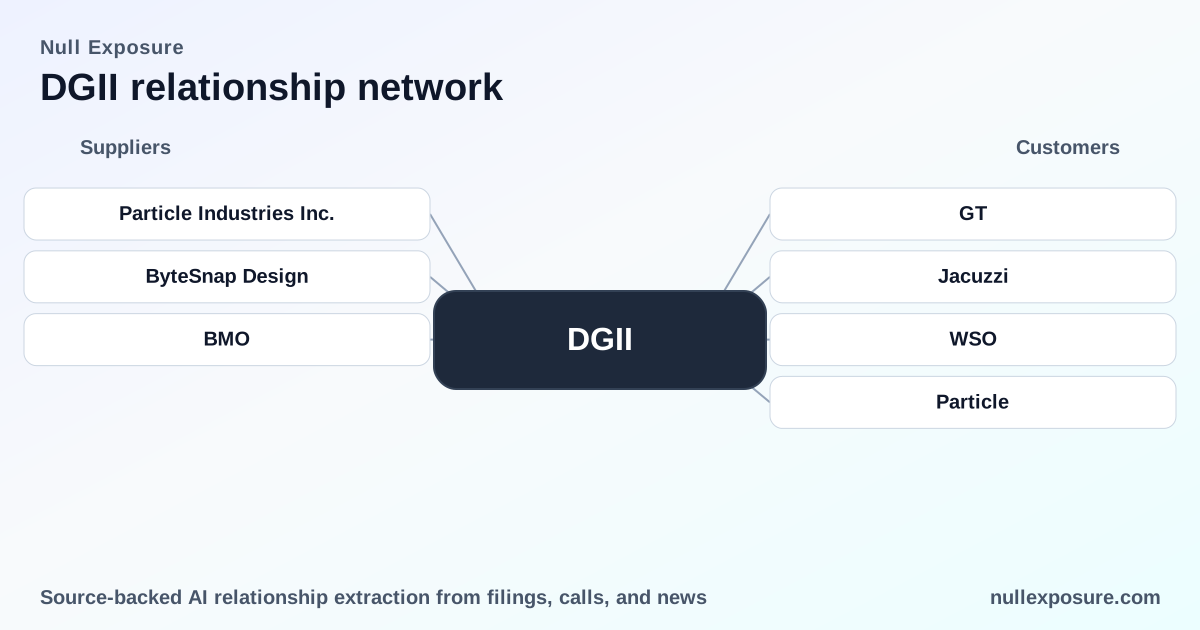
Digi International (DGII): Supplier relationships, operational constraints, and what they mean for investors
Digi International operates as a hardware-led IoT provider that monetizes through embedded device sales, accompanying software and cloud connectivity, and managed services for enterprise customers. The company’s model blends product revenue with growing service layers—software porting, managed security and cloud agents—that increase lifecycle value and recurring revenue potential while keeping manufacturing outsourced to contract partners. For equity holders, the critical lenses are supply-chain concentration, the maturity and criticality of outsourced manufacturing, and the extent to which recent partnerships and financing actions change that risk-return profile.
Explore deeper supplier intelligence at https://nullexposure.com/.
How Digi contracts, sources, and where the operational pressure sits
Digi’s operating model is an outsourced-manufacturing posture with vertical integration on software and systems integration. The company openly outsources manufacturing to contract manufacturers located in Thailand, Mexico, Taiwan and Cambodia and relies on third‑party foundries, primarily in Taiwan, for ASICs, which concentrates semiconductor sourcing in APAC. Those facts translate into three practical investor signals:
- Contracting posture: Digi uses contract manufacturers rather than captive fabs, which reduces capital intensity but increases dependency on partners for quality, lead times and volume flexibility. The company-level disclosure confirms these outsourced arrangements and the geographic footprint of production partners.
- Concentration and criticality: Foundry reliance centered in Taiwan is a concentration risk for ASIC supply; the company itself warns that supplier shortfalls could adversely affect results in a material way, making supplier performance a high‑impact variable for revenue and margins.
- Maturity and diversification: Use of multiple contract-manufacturing jurisdictions (Thailand/Mexico/Taiwan/Cambodia) signals practical geographic diversification for assembly and test, but the semiconductor bottleneck remains concentrated. That mix supports operational resilience for logistics and labor but not for chip supply.
These signals come from Digi’s public disclosures and regulatory excerpts describing third‑party foundry use and the materiality of supplier disruptions as company-level constraints.
Partners and deals listed in the public record
Below are the relationships surfaced in recent public reporting. Each entry includes a plain-English summary and the source reference.
Particle Industries Inc.
Digi has announced that Particle’s device OS and cloud agents will be ported to run on Digi’s embedded hardware, signaling an integration strategy that brings a software-first IoT stack onto Digi’s installed base and new devices. This reinforces Digi’s effort to monetize through software and cloud services layered on physical hardware. According to Embedded.com coverage in March 2026, the Particle software will be migrated to Digi platforms as part of that transaction.
Source: Embedded.com, March 9, 2026.
ByteSnap Design
Digi and ByteSnap Design launched a managed security service for embedded Linux devices that can be delivered as part of Digi-based deployments or across mixed hardware environments, with ByteSnap handling integration and implementation support. This partnership expands Digi’s managed-service footprint and adds a channel for recurring revenue tied to device security. New Electronics reported the service offering and ByteSnap’s role in March 2026.
Source: New Electronics, March 2026.
BMO Bank (tradingview notice)
Digi signed an amendment to its revolving credit agreement that lists BMO Bank as administrative agent and other lenders, indicating syndicate-led bank financing support for the company’s working capital and corporate flexibility. The trading platform notice summarized the counterparty role of BMO Bank as administrative agent in the amendment.
Source: TradingView news item, reporting on the amendment (filed/posted March 2026).
BMO Bank N.A. (Globe and Mail)
On December 23, 2025, Digi amended its existing revolving credit agreement with BMO Bank N.A. and a syndicate of lenders, revising pricing and expanding potential borrowing capacity, which increases liquidity optionality and lowers refinancing risk in the near term. The Globe and Mail coverage explains the expanded facility terms and the December 2025 amendment.
Source: The Globe and Mail, December 23, 2025.
Why these relationships change the investment picture
Taken together, the partner set and credit actions shift both the risk profile and the optionality available to management.
- Software and services acceleration. The Particle integration and ByteSnap managed security partnership are initiatives that convert hardware sales into persistent revenue streams through software porting and security services. That supports an operational shift from one-time product revenue to higher-margin, recurring services, which is consistent with Digi’s reported operating margin and gross-profit profile.
- Balance sheet flexibility. The amended revolving credit facility with BMO and the syndicate increases borrowing capacity and revises pricing, providing working-capital breathing room and the capacity to fund integration and go-to-market investments without tapping equity in the near term.
- Supply-chain risk remains the primary constraint. Despite progress on software and finance, supplier concentration in Taiwan for ASICs and reliance on contract manufacturers for production are material operational constraints that can create manufacturing delays with direct profit and revenue impact; the company’s disclosures explicitly state this materiality.
For targeted supplier and counterparty analytics, visit https://nullexposure.com/.
Key takeaways for investors and operators
- Positive re‑rate vector: Integration of Particle and the ByteSnap security service strengthen recurring revenue channels and product stickiness, which supports a multi-year margin expansion thesis if adoption scales.
- Liquidity risk moderated: The BMO-led amendment expands capacity and optimizes pricing, lowering short-term refinancing pressure and supporting strategic deployments.
- Primary operational risk unchanged: Semiconductor and component concentration in APAC—particularly Taiwan—remains a high-impact constraint; investors must value Digi with that supply‑side fragility priced into multiples and scenario analyses.
Recommended next steps for investors: quantify upside from software and managed services build‑out against downside scenarios for a semiconductor supply disruption; verify supplier KPIs and contract terms in upcoming filings; and track integration milestones for Particle and customer uptake of the ByteSnap security offering.
Explore supplier-focused intelligence and counterparty risk analysis at https://nullexposure.com/.
Final frame
Digi is executing a clear hybrid strategy—hardware distribution augmented by software and managed services, financed with bank-syndicated flexibility and operating on outsourced manufacturing. The strategic moves strengthen long-term monetization but do not eliminate a material APAC-concentrated supplier risk that directly affects manufacturing continuity. Investors should treat recent partnerships and credit amendments as positive de‑risking for growth and liquidity, while actively monitoring foundry dependency and production KPIs as the principal operational constraint.