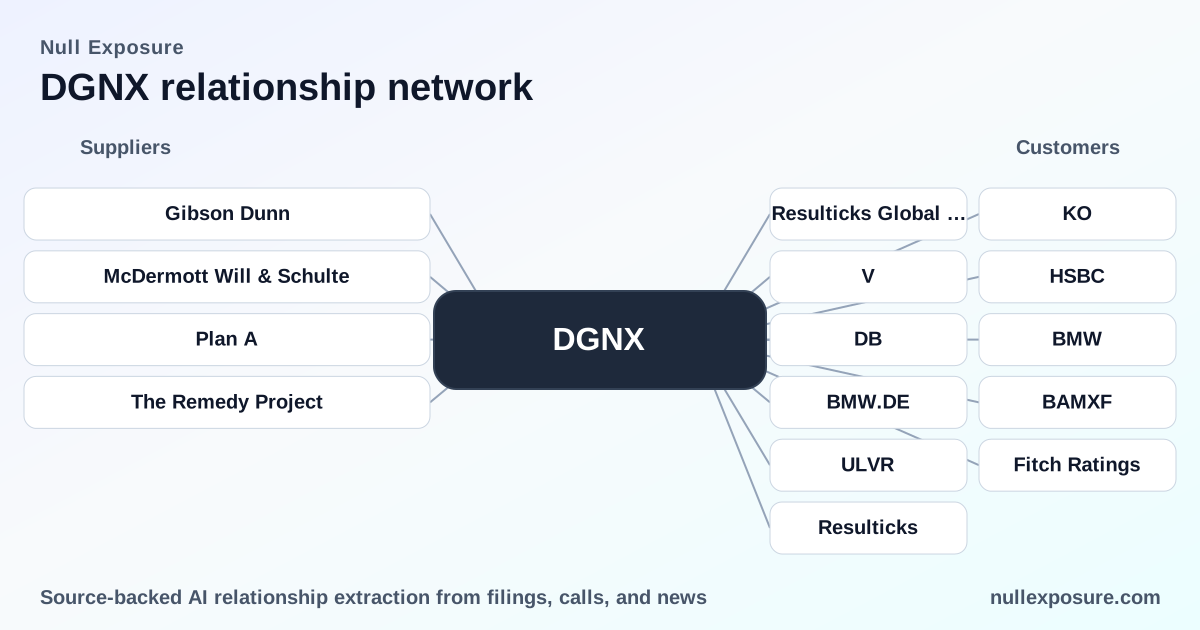
Diginex (DGNX) — Supplier relationships and what they signal for investors
Diginex is a financial-technology operator that monetizes institutional digital-asset services—custody, trading, and asset management—by packaging compliance-first infrastructure and ESG-related products for investors and corporates. The company generates revenue from platform fees and service contracts while pursuing strategic acquisitions and partnerships that extend its product set into carbon accounting and social audit services. Investors should read supplier links as strategic signals: legal advisers indicate transaction activity, and ESG vendors point to an active pivot toward sustainability offerings.
For more supplier intelligence on Diginex and comparable coverage, visit https://nullexposure.com/.
Why the supplier list matters to portfolio managers
Diginex’s disclosed suppliers reflect a company executing a transactional and product-expansion strategy. Two top-tier law firms appear as advisers in a FY2026 transaction, which is consistent with an organization executing M&A or capital-raising activity. At the same time, partnerships with ESG providers show a deliberate move to broaden recurring-revenue services beyond pure trading and custody.
- Contracting posture: engagement of elite law firms signals disciplined contracting and a willingness to employ external legal muscle for major deals.
- Concentration and governance: insider ownership is extremely high (67.9%), while institutional ownership is minimal (0.39%), which concentrates control and elevates reliance on internal decision-making.
- Criticality and strategic fit: ESG vendors are not peripheral—Plan A and The Remedy Project plug directly into the company’s stated product pivot and therefore represent strategic, not incidental, supplier relationships.
- Maturity: financials show a small revenue base (Revenue TTM: $3.57M) with negative EBITDA (-$9.58M) and a heavy valuation premium (Price/Sales ~35x), indicating an early-stage or pivoting public company that is priced for growth rather than current profitability.
Supplier-by-supplier snapshot
Gibson Dunn
Diginex engaged Gibson Dunn as legal counsel in connection with a FY2026 definitive agreement, which signals the use of blue‑chip external counsel on transactional work. According to a Financial IT report dated March 9, 2026, Diginex was advised by Gibson Dunn in the transaction (https://financialit.net/news/infrastructure/diginex-limited-announces-signing-definitive-agreement-acquire-plan-creating-one).
McDermott Will & Schulte
McDermott Will & Schulte served as co-advisor alongside Gibson Dunn for the same FY2026 deal, indicating parallel legal teams supporting negotiation and documentation for the announced agreement. The Financial IT story (March 9, 2026) lists both firms as advisers to Diginex (https://financialit.net/news/infrastructure/diginex-limited-announces-signing-definitive-agreement-acquire-plan-creating-one).
Plan A
Plan A is cited as the carbon-accounting provider through which Diginex is expanding its ESG platform, reflecting a deliberate product extension into environmental reporting and credits. An ad-hoc-news briefing on March 9, 2026 notes that expansion of the ESG platform is underway via Plan A (carbon accounting) (https://www.ad-hoc-news.de/boerse/news/ueberblick/diginex-shares-surge-as-strategic-pivot-gains-traction/68461967).
The Remedy Project
The Remedy Project is identified as the supplier for social supply-chain audits, complementing Plan A’s carbon accounting to form a broader ESG offering for Diginex’s clients. The same ad-hoc-news piece from March 9, 2026 highlights The Remedy Project’s role in the company’s ESG initiative (https://www.ad-hoc-news.de/boerse/news/ueberblick/diginex-shares-surge-as-strategic-pivot-gains-traction/68461967).
For a consolidated view of Diginex’s supplier signals and to monitor updates to these relationships, see https://nullexposure.com/.
What the relationships imply for risk and upside
The mix of suppliers creates a clear strategic narrative: legal advisers for transaction execution and ESG vendors for product expansion. That dual posture creates distinct implications:
- Upside: Successful integration of Plan A and The Remedy Project can create cross-sell opportunities into institutional clients that demand ESG-compliant digital-asset services, supporting a revenue diversification story beyond custody and trading fees.
- Execution risk: Heavy reliance on external legal counsel signals complex deals that carry typical M&A integration and regulatory execution risks. Given Diginex’s small revenue base (TTM revenue $3.57M) and negative EBITDA (-$9.58M), transaction costs and integration execution are material.
- Governance and financing pressure: High insider ownership (67.9%) and negligible institutional ownership (0.39%) place strategic control with insiders and reduce the stabilizing influence of diversified institutional shareholders; this is a governance signal investors must price.
- Valuation gap: Market metrics (Price/Sales ~35x, EV/Revenue ~34.8x) reflect a valuation that assumes successful strategic execution and rapid revenue growth; absent transparency on deal economics, the premium prices in execution risk.
Constraints and company-level signals
No supplier-specific contractual constraints were surfaced in the available results. Company-level observable constraints include small scale of current revenue, ongoing operating losses, concentrated insider control, and a high valuation multiple—all of which should influence diligence posture when evaluating supplier dependence and payment terms. Those characteristics point to a firm that contracts selectively (using high-caliber counsel for pivotal transactions) and prefers strategic supplier relationships that accelerate product expansion rather than broad commoditized procurement.
Practical next steps for investors and operators
- Confirm the terms and closing conditions of the FY2026 definitive agreement referenced in the March 9, 2026 coverage and quantify projected synergies or costs tied to Plan A and The Remedy Project integration.
- Monitor legal and advisory fees and any contingent liabilities disclosed in periodic filings; sizeable transactional spend can materially affect cash runway given negative EBITDA.
- Track customer adoption metrics for the ESG modules and look for early recurring-revenue indicators that would validate the high valuation multiples.
For deeper supplier mapping and ongoing monitoring of Diginex, navigate to https://nullexposure.com/.
Bottom line
Diginex is executing a transaction-led pivot into ESG-enabled institutional services, supported by top-tier legal advisers and specialist ESG vendors. These supplier choices are consistent with an operator that is prioritizing strategic acquisitions and product expansion while still operating at a small revenue base and negative profitability. Investors should weigh the upside of a differentiated ESG product stack against concentrated governance, execution risk on the announced deal, and a valuation that assumes successful near-term growth.
For continuous updates on supplier relationships, transaction filings, and material changes for DGNX, visit https://nullexposure.com/.