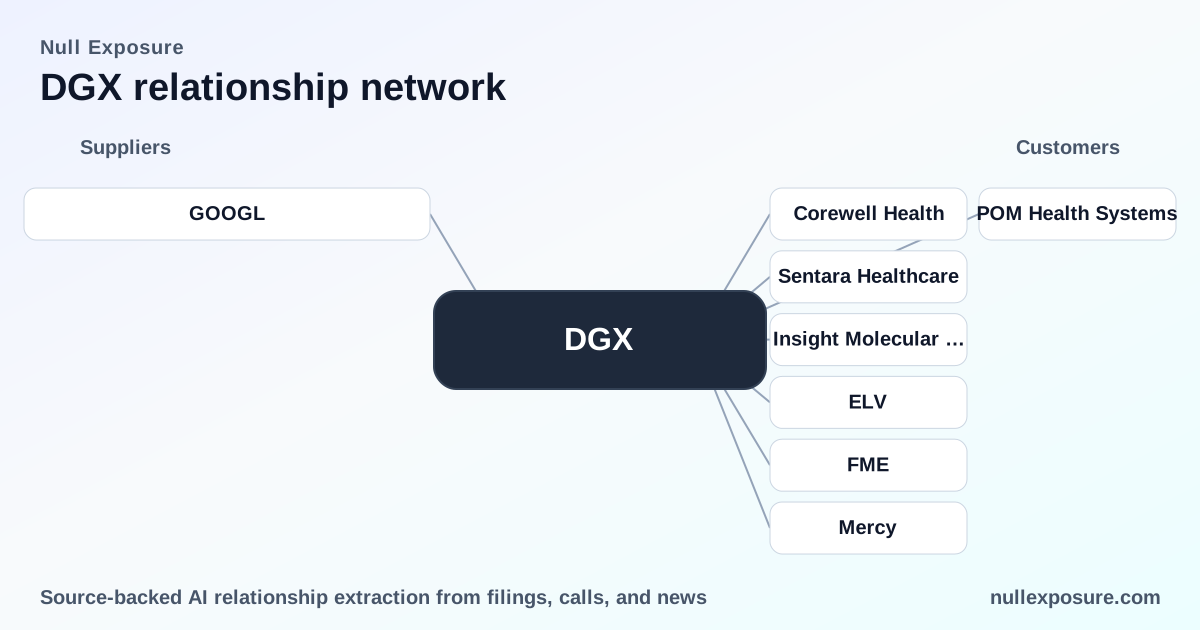
Quest Diagnostics (DGX): Supplier relationships and the Google Cloud AI pivot
Quest Diagnostics operates and monetizes as a high-volume clinical diagnostics provider: it generates fee-for-service revenue from laboratory testing, contractual arrangements with health systems and employers, and value-added digital services that increase patient engagement and higher-margin testing. Quest’s scale — roughly $11.0 billion in trailing revenue and a $22.1 billion market capitalization — gives it bargaining leverage with technology and supply partners, while its operating model creates meaningful, long-duration supplier exposure. For investors evaluating supplier risk and strategic upside, the company’s recent AI partnership with Google Cloud and its long-term procurement commitments are the most material items to track.
Explore deeper supplier intelligence at https://nullexposure.com/.
What the Google Cloud tie-up actually delivers
Quest launched an “AI Companion” product built on Google Cloud technology and Google’s Gemini models. The partnership is positioned to accelerate Quest’s patient-facing analytics and streamline internal data workflows, converting core lab outputs into more actionable, automated patient communications. This relationship is both a product-enablement arrangement and a strategic technology supply relationship that enhances Quest’s customer experience capabilities.
The reported relationship entries (each source)
- Quest’s AI Companion is “Powered by Google’s Gemini family of models,” and the collaboration with Google Cloud was established in March 2025, according to a Finviz news summary published in March 2026. (Finviz news, first seen 2026-03-09).
- A March 2, 2026 report from Sahm Capital repeated that Quest’s AI Companion is powered by Google Cloud’s Gemini models and identified the underlying March 2025 collaboration as the origin of the integration. (Sahm Capital news, 2026-03-02).
- A StockTitan item covering the same announcement reiterated the Gemini-powered positioning and the March 2025 collaboration date in its March 2026 coverage. (StockTitan news, first seen 2026-03-09).
Takeaway: multiple outlets report the same commercial AI integration; the relationship is a public, product-facing collaboration rather than a silent infrastructure purchase.
Why this supplier relationship matters for investors
- Revenue enhancement vector: embedding Google’s LLM technology into patient-facing workflows increases the potential for higher per-test yields and ancillary digital services that command premium pricing.
- Operational leverage: outsourcing advanced AI and cloud infrastructure shifts capital and technical risk to Google Cloud, converting fixed technology investment into an operating expense model that scales with usage.
- Reputational and compliance exposure: using third-party models for patient-facing outputs raises regulatory and data-governance considerations that investors should monitor.
Explore supplier risk profiles and comparative relationships at https://nullexposure.com/.
Company-level supplier constraints and the investor implications
The filings and disclosures establish a set of persistent supplier dynamics that apply across Quest’s vendor base:
- A long-term outsourcing posture is explicit. A ten-year outsourcing agreement entered in September 2016 covers billing and related operations for the majority of Quest’s revenues, with annual fees adjusted for volume and performance. This is a structural operating decision that locks in service dependency and performance-based pricing over multi-year horizons.
- Quest acts as a substantial buyer. The company discloses noncancelable commitments and take-or-pay arrangements for consulting, services, reagents and laboratory supplies, which creates a fixed-cost floor that supports supplier scale economics and limits short-term procurement flexibility.
- Third-party service delivery is a material operational channel. Filings warn that failures by third-party manufacturers, software vendors, and outsourced service providers can create operational and data-security risks because Quest interfaces with those parties for critical services and confidential data handling.
- Commitment scale is meaningful: as of December 31, 2024 Quest reported approximately $693 million in future purchase commitments, with $231 million expected in 2025 and $345 million forecast for 2026–2027. This level of committed spend signals high procurement concentration and predictable vendor demand.
These constraints together create a profile of mature, contractual supplier relationships with elevated criticality and predictable spend, which benefits negotiating leverage but raises single-point-of-failure risk if key providers underperform.
How the Google Cloud tie-up fits the constraint picture
The Google Cloud collaboration is a strategic technology supplier relationship that sits alongside Quest’s legacy outsourcing and procurement commitments. It is a product-enabling partnership rather than the kind of procurement lock-in exemplified by the ten-year billing outsourcing contract, but it nonetheless increases reliance on a single cloud/AI provider for a visible, customer-facing feature set. Investors should view the relationship as a complementary strategic contract that increases digital differentiation while layering additional third-party operational and compliance dependencies.
Investment implications and risk-reward calculus
- Upside: Quest’s sustained margins (operating margin ~14% TTM) and scale give the company the capacity to monetize AI-enabled services without a large incremental capital outlay; Google Cloud provides the technology backbone that accelerates time-to-market. This increases the optionality of higher-margin digital revenue streams.
- Downside: long-term supplier commitments and take-or-pay arrangements create a fixed-cost profile that reduces short-term flexibility. Third-party dependencies introduce operational and reputational risk if vendors fail to perform or regulatory scrutiny intensifies over AI-driven patient interactions.
- Valuation context: with a forward P/E near 19 and analysts clustered around an $218 target price, incremental service monetization could support multiple expansion if execution on digital products converts engagement into persistent revenue.
Actionable next steps for diligence
- Confirm contract scope and financial terms of the Google Cloud collaboration: scope of services, data governance, uptime/SLAs, and termination mechanics.
- Reconcile AI Companion commercialization plans with existing revenue mix to estimate potential contribution and timeline.
- Monitor regulatory filings for any expanded disclosures about third-party risk and noncancelable commitments.
For a structured supplier-risk assessment and ongoing monitoring, visit https://nullexposure.com/.
Bottom line
Quest Diagnostics combines scale and entrenched supplier commitments with a clear strategic pivot toward cloud-based AI through a public partnership with Google Cloud. That combination delivers both an asymmetric growth lever (AI-enabled patient services) and persistent operational dependency (long-term procurement and outsourcing obligations). Investors should weigh digital upside against the company’s fixed spend profile and third-party operational risk when positioning around DGX.