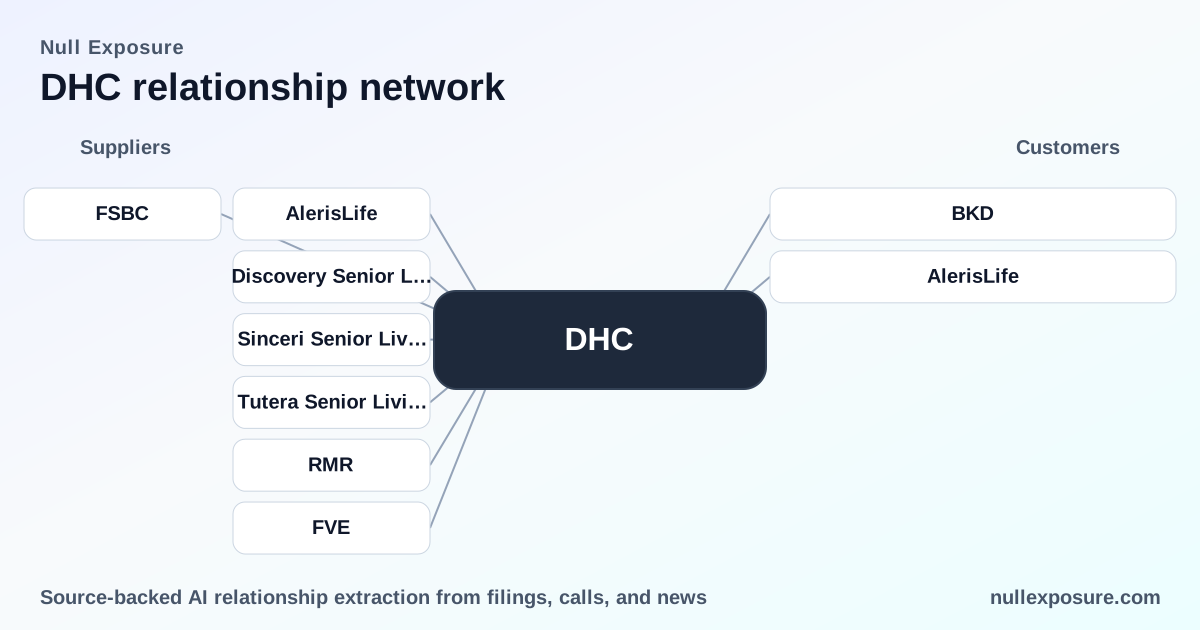
Diversified Healthcare Trust (DHC): operator reset creates both risk and optionality
Diversified Healthcare Trust is a healthcare-focused REIT that owns medical office, life-science, senior living and wellness properties and monetizes primarily through rental income, operator management fee passthroughs and selective asset sales/repositioning. The company reported $1.538 billion in trailing revenue and $222.8 million of EBITDA (TTM), and its earnings profile is driven as much by operator performance and contract mechanics as it is by real estate fundamentals. For investors evaluating supplier/operator relationships, the near-term story is an operator-concentration unwind and an outsized reliance on a third‑party manager for core corporate services. Learn more about supplier exposure and tracking at https://nullexposure.com/.
Operator disruption: what changed and why it matters
DHC disclosed a material transition in its senior‑living operator base at the end of 2025. The company terminated master management agreements that had been in place with AlerisLife and is transferring management of 116 communities to a handful of third‑party operators. That operational disruption creates short‑term cash‑flow and execution risk while opening tactical opportunities to reallocate capital or reset operator economics across the portfolio.
- Operational criticality is high: DHC has no employees and relies on external managers for personnel and on RMR for core administrative services, so operator transitions directly affect property performance and reporting cadence.
- Contracting posture is mixed: DHC’s third‑party management arrangements generally carry multi‑year terms and usage‑based fees (commonly 5–6% of gross revenue), which gives investors forward visibility on fee structure even as operator mix changes.
If you are tracking counterparty risk or operator concentration for portfolio stress testing, DHC’s operator reset warrants immediate review. For a centralized view of supplier relationships and to track further changes, visit https://nullexposure.com/.
Counterparty rundown: the full set of relationships flagged
AlerisLife
DHC terminated its master management agreements covering 116 senior‑living communities with AlerisLife effective December 31, 2025, triggering the transfer of those assets to new third‑party operators. TradingView reported the termination notice and DHC noted the transition in its 2025 disclosures (https://www.tradingview.com/news/tradingview:9dd97ff42c8bf:0-diversified-healthcare-trust-terminates-master-management-agreement-with-alerislife/; https://www.tradingview.com/news/tradingview:944fa46d6b805:0-diversified-healthcare-trust-sec-10-k-report/).
Discovery Senior Living
DHC is moving a portion of the former AlerisLife‑managed communities to Discovery Senior Living as part of the 4Q25 operator reallocation, a transfer that factored into management’s description of a “noisy quarter.” Senior Housing News covered the transfers and the operational impact to 4Q25 results (https://seniorhousingnews.com/2026/02/24/diversified-healthcare-trust-substantially-done-with-shop-sales-plans-to-reinvest-in-portfolio/).
Sinceri Senior Living
Sinceri Senior Living is another named recipient of communities previously managed by AlerisLife as DHC reallocates operator responsibilities across its portfolio, contributing to the company’s 4Q25 operational noise (https://seniorhousingnews.com/2026/02/24/diversified-healthcare-trust-substantially-done-with-shop-sales-plans-to-reinvest-in-portfolio/).
Tutera Senior Living
Tutera Senior Living received transfers from the AlerisLife wind‑down and forms part of the new operator mix managing former AlerisLife properties, per DHC’s quarter‑end reporting (https://seniorhousingnews.com/2026/02/24/diversified-healthcare-trust-substantially-done-with-shop-sales-plans-to-reinvest-in-portfolio/).
RMR
RMR provides DHC with management and administrative services and was recognized an incentive fee of $17.9 million for the full year, underscoring RMR’s material role in operations and capital allocation; DHC’s filings also show RMR agreements that extend long term (contracts noted to run through 2044 with annual automatic extensions). The earnings transcript and company commentary document the fee recognition and RMR’s central service role (https://www.insidermonkey.com/blog/diversified-healthcare-trust-nasdaqdhc-q4-2025-earnings-call-transcript-1703062/; DHC SEC disclosure referenced in TradingView).
Five Star Senior Living
Historical reporting shows DHC amended management arrangements with Five Star Senior Living for a set of senior‑living units, a relationship that has evolved over multiple years and influences legacy operating coverage across parts of the portfolio (Herald‑Times Online, April 2021; https://www.heraldtimesonline.com/story/news/2021/04/12/meadowood-plans-to-close-part-of-nursing-home-complex-worrying-families/44030051/).
Five Star (FSBC)
Separately reported coverage indicates DHC completed transition of all former Five Star communities to seven new operators as part of previous re‑operatoring activities, signaling the REIT’s willingness to re‑contract at scale when operator performance or strategy requires it (Simply Wall St coverage; https://simplywall.st/stocks/us/real-estate/nasdaq-dhc/diversified-healthcare-trust/news/does-alerislife-cash-and-portfolio-shift-change-the-bull-cas).
Contracting, concentration and where value flows
DHC’s supplier relationships reveal a consistent pattern: longer‑dated management contracts overlayed with usage‑based fee mechanics, and outsized reliance on external managers for operational capability.
- Contract length and renewal mechanics: Third‑party manager agreements generally run five years with automatic two‑year extensions, while RMR’s arrangements are explicit multi‑decade contracts that extend annually and were described as ending on December 31, 2044 before rolling annually—this gives DHC stability in corporate services while concentrating governance risk with RMR.
- Fee mechanics: Operational fees for third‑party managers are usage‑based (roughly 5–6% of gross revenues) plus expense reimbursements, so operator performance directly feeds DHC’s net operating cash flows.
- Spend and materiality: Management fees and G&A items are non‑trivial; DHC discloses management incentives and G&A figures consistent with a spend band that is meaningful to EBITDA (company filings reference business management fees and general administrative expense lines).
- Operational maturity: The firm’s reliance on long agreements and automatic renewals indicates mature contracting, but the AlerisLife wind‑down demonstrates that contractual maturity does not immunize the portfolio from operator failure or strategic reallocation.
Mid‑analysis action: if you are modeling downside scenarios, incorporate operator replacement lags and RMR incentive variability—and check the supplier change log at https://nullexposure.com/.
Investment implications and risk matrix
- Short‑term execution risk: The AlerisLife exit and rapid reassignments create near‑term occupancy and revenue volatility; the management‑fee structure transmits that volatility to DHC’s cash flows.
- Operational concentration: RMR is a single point of failure for corporate services; its long‑dated arrangement is both a stability anchor and a governance concentration risk.
- Valuation context: DHC trades with an EV/EBITDA near 27.9 and a beta above 2.3, signaling market expectations for volatility and a premium for either growth or risk compensation; revenue is roughly $1.54B (TTM) and dividend yield is modest.
- Optionality: Re‑contracting gives DHC the ability to reset operator economics, sell underperforming assets, or selectively reinvest proceeds—this is an active management lever for the REIT.
Bottom line and next steps for investors
DHC’s recent operator reshuffle is the dominant supplier story: it increases near‑term operational risk while creating a path to reprice and reposition the portfolio. The company’s long‑term service arrangement with RMR and usage‑based manager fees are central to cash‑flow modeling and should be stress‑tested in any valuation work.
For investors and operations teams tracking counterparty shifts and supplier concentration, monitor operator performance metrics, RMR incentive disclosures and any follow‑on asset sales or leases. For an ongoing, centralized supplier view and alerts on changes to DHC’s relationships, visit https://nullexposure.com/.
If you want a tailored supplier risk brief or a watchlist tied to DHC‑level exposures, request a custom report via https://nullexposure.com/ and we will prepare a concise counterparty scorecard focused on operational, contractual and cash‑flow risk.