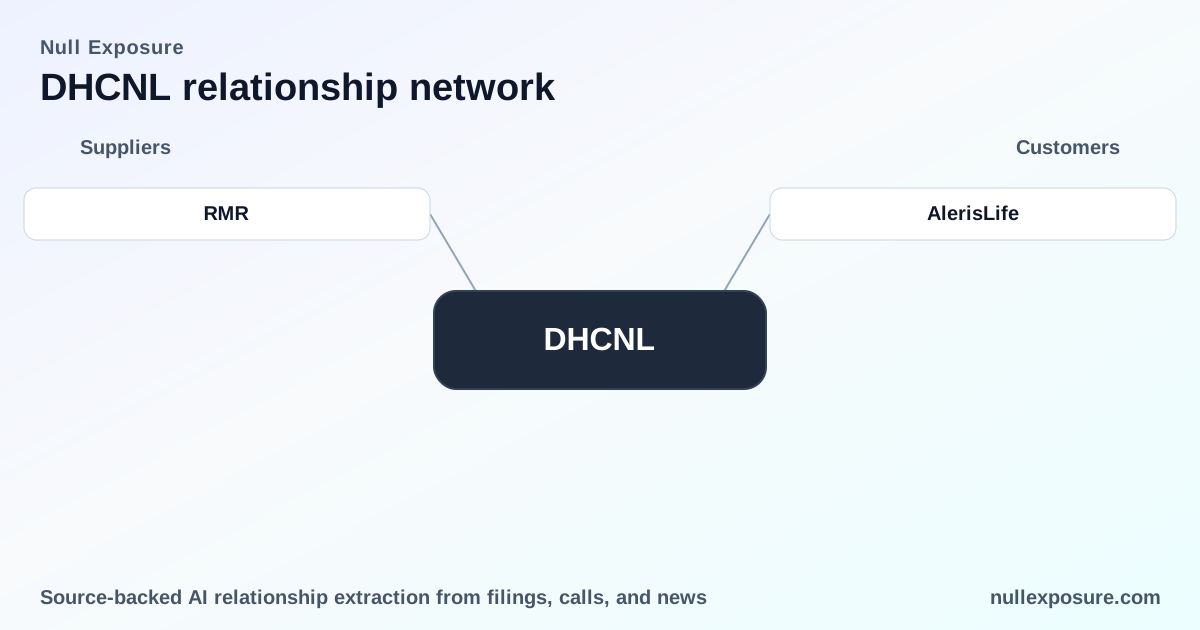
DHCNL — Supplier relationships and what they mean for investors
Diversified Healthcare Trust (DHC) operates as a healthcare-focused REIT that owns medical office buildings, life sciences real estate, senior living communities and wellness centers across the U.S. The company monetizes its asset base through rental income, tenant reimbursements, and outsourced management arrangements that generate recurring cash flows and usage‑based management fees; it also returns capital to shareholders via a meaningful dividend yield. A critical part of DHC’s operating model is third‑party management: externally managed properties deliver scale but also concentrate operational and technology risk with those managers. For a quick audit of supplier exposure and contractual posture, review the relationship notes below and the company disclosures linked here: https://nullexposure.com/.
Fast take: what investors need in one paragraph
- Management by external operators is material to cash flow and operations. DHC is run under external management arrangements that influence property operations, IT controls and insurance responsibilities.
- Fee structures are a mix of long‑term master contracts and usage‑based fees, which aligns operator incentives with revenue but increases exposure to tenant performance.
- Operational concentration and IT dependence are non-trivial risks; the company explicitly relies on managers for information systems and cybersecurity.
For a deeper supplier exposure analysis, start here: https://nullexposure.com/.
Every relationship mentioned in the available record
The RMR Group — FY2026 mention
DHC is managed by The RMR Group, a U.S. alternative asset manager, with the disclosure noting approximately $39 billion AUM as of September 30, 2025, highlighting RMR’s role as the external manager of DHC’s portfolio. According to a StockTitan news release tied to DHC’s 2025 dividend announcement (published March 9, 2026), RMR is identified as DHC’s manager and custodian of day‑to‑day commercial real estate operations. (Source: StockTitan / news item, March 9, 2026).
The RMR Group — FY2025 mention (conference call)
In a separate mention tied to a third‑quarter 2025 conference call, DHC repeats that RMR manages DHC operations and the note lists approximately $40 billion AUM as of June 30, 2025, reinforcing continuity in the management relationship across reporting periods. A StockTitan summary of that conference call (published March 9, 2026) records RMR’s institutional experience and custodial role for DHC. (Source: StockTitan / Q3 2025 conference call coverage, March 9, 2026).
What the company disclosures and constraints reveal about how DHC contracts and operates
Company disclosures and clause excerpts paint a clear picture of DHC’s supplier posture.
- Long‑term contracting is part of the fabric. Management agreements include master contracts with extended terms (for example, a Five Star master agreement that runs to 2036 with options to extend), indicating multi‑year commitments that create revenue stability but reduce near‑term flexibility. This is presented as a company‑level signal in filings covering 2024–2025.
- Usage‑based economics align payments to revenue. Other third‑party managers generally earn 5%–6% of gross revenues plus reimbursed costs, signaling a pay‑for‑performance element that preserves landlord economics when occupancy and rents are strong.
- DHC acts as buyer for certain insurance coverages. Disclosures show either DHC or tenants bear insurance costs, with reimbursements structured into leases and management arrangements; this allocates insurance cost risk across counterparties.
- Service providers are operationally critical — and RMR is explicitly named. Filings state DHC “relies on the information technology and systems maintained by our managers, including RMR,” and that managers are responsible for identifying and managing cybersecurity risks. This makes manager IT posture a first‑order operational risk for DHC.
- Relationships are active and concentrated. As of year‑end 2024, the company reported that a substantial portion of senior living communities are managed by third parties (114–118 communities referenced), indicating persistent, active engagements rather than ad‑hoc contractors.
These constraints should be read as company‑level operating characteristics; where a constraint names an entity (for example RMR in IT reliance), that constraint is linked to the identified supplier.
For investors who want a quick supplier risk checklist, consider the operational reliance on external managers, the impact of multi‑year master agreements on flexibility, and the concentration of management relationships across the senior living portfolio. If you want a deeper supplier scorecard and counterparty map, see additional resources at https://nullexposure.com/.
Investment implications — how supplier structure changes the risk/return profile
DHC’s supplier design has several concrete implications for investors:
- Cash‑flow stability vs. control tradeoff. Long‑term management contracts and usage‑based fees create predictable fees and protect NOI during stable markets, but they reduce DHC’s direct control over operations and capex decisions. That is a structural tradeoff for externally managed REITs.
- Operational concentration is a vulnerability. Heavy reliance on a small number of managers for day‑to‑day operations and IT increases single‑point risk; a vendor incident or governance failure at a manager like RMR would have outsized impact on DHC’s operations.
- Financials underscore the materiality of operations. DHC reports TTM revenue of approximately $1.503 billion and EBITDA around $400.4 million, with a dividend policy reflected in a ~7.3% yield; however, net profit margin is negative on the reported basis, signaling that capital structure and non‑operating items influence shareholder returns.
- Contractual terms tilt toward stability but limit re‑pricing. Multi‑year master agreements and automatic renewals protect operations through downturns but constrain the REIT’s ability to renegotiate fees or reconfigure operating models quickly.
Key takeaway: supplier relationships are a source of reliable operations and revenue alignment, but they create concentration and IT/cybersecurity dependence that investors must monitor.
Actionable next steps for investors and operators
- Request the current management agreements and an up‑to‑date counterparty map to quantify concentration and termination provisions. Focus on expiration schedules and extension rights.
- Conduct targeted due diligence on manager IT and cyber controls, especially for named partners such as RMR, since the filing explicitly assigns them responsibility for systems and security.
- Reassess insurance pass‑through mechanics to determine where DHC bears residual cost and loss exposure.
If you want a full supplier exposure report and covenant analysis tailored to institutional portfolios, start with our landing page: https://nullexposure.com/.
Bottom line
DHC’s operating model is built on externally managed, long‑dated relationships that deliver operational scale and usage‑aligned fees, but that model concentrates operational risk with managers and embeds IT/cyber dependence as a material supplier risk. For investors, the question is not whether these arrangements exist — they clearly do — but whether contract terms, manager governance and contingency plans are sufficient to protect cash flow through stress. For a structured supplier risk assessment and primary‑document review, visit https://nullexposure.com/ and request the supplier dossier.